After many years, Vietnamstory has noticed a profound connection between the people of the Malabar Coast and the people of the Mekong Delta. We share a love for lush greenery, a deep respect for our spice heritage, and a resilient spirit born from living along vast coastlines. However, because Vietnam is a long, S-shaped country spanning 1,600 km, our weather is not as uniform as Kerala’s. “So, when is the best time to visit Vietnam from Kerala?” Because you now have the convenience of direct flights from Kerala to Vietnam (specifically the Kochi to Ho Chi Minh City route), the timing of your trip determines whether you’ll be basking in the sun on a Phu Quoc beach or shivering in the misty mountains of Sapa. In this comprehensive guide, VNS will break down the Vietnam weather for Indian tourists from Kerala, providing you with the exact evidence you need to plan a seamless adventure.
Why timing matters more for Kerala-to-Vietnam trips?
Reaching Vietnam from Kerala has been revolutionized. The flight time from Kerala to Ho Chi Minh is now a mere 5 hours and 10 minutes via the direct VietJet service from Kochi (CIAL). However, reaching the North or Central regions still often involves 8 to 12 hours of total travel time via hubs like Bangkok or Singapore.
Because many Kerala-origin trips are 5–7 days in duration, weather stability is critical. You don’t want to spend 20% of your holiday navigating a tropical storm or extreme heat on arrival day. At Vietnamstory, we always suggest that our Kerala clients bookmark our monthly-wise recommendations. We don’t just look at the rain, we look at how the humidity affects a senior traveler from Thrissur versus a honeymoon couple from Ernakulam.
Understanding the Vietnam seasons for Kerala travellers is the secret to a high “Return on Investment” for your vacation time.
Vietnam’s big seasonal picture: A practical snapshot
Unlike the relatively consistent tropical climate of South India, Vietnam is regionally split. To keep your planning simple, think of the country in two main phases.
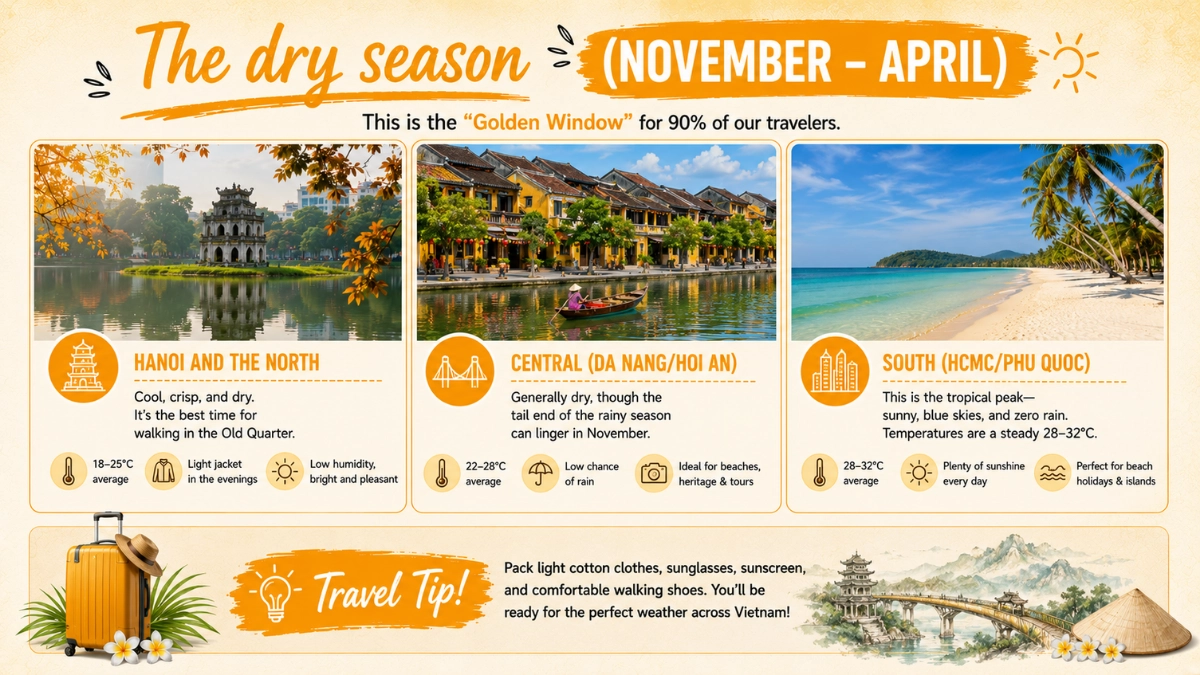
The dry season (November – April)
This is the “Golden Window” for 90% of our travelers.
- Hanoi and The North: Cool, crisp, and dry. It’s the best time for walking in the Old Quarter.
- Central (Da Nang/Hoi An): Generally dry, though the tail end of the rainy season can linger in November.
- South (HCMC/Phu Quoc): This is the tropical peak—sunny, blue skies, and zero rain. Temperatures are a steady 28–32°C.
The wet and hot season (May – October)
This is the “Value Window” for budget-conscious travelers.
- North: Increasing humidity and dramatic afternoon rains. The mountains of Sapa become incredibly lush and green.
- Central: Hot and sunny from May to August, but September-October brings high typhoon risks.
- South: More frequent but short-lived tropical downpours that usually clear within 30 minutes.
The best months that suit Kerala-origin travellers
The ideal “classic” window (October – April)
This is the undisputed best time to visit Vietnam from Kerala. It aligns perfectly with the Indian festive season and the year-end winter breaks.
- October – November (The Shoulder Season): This is my personal favorite for Kerala families. The North is transitioning into autumn. While there is a slight rain risk in the Center (Da Nang/Hoi An), the crowds are thin and the prices are moderate.
- December – February (Peak Winter): This is the busiest time. For a Kerala traveler used to 30°C winters, the 15°C weather in Hanoi feels like a refreshing European escape. Warning: Sapa can drop to 4°C – pack your woolens!
- March – April (Spring): The most stable weather nationwide. It is very dry, making it perfect for Mekong Delta boat tours and Halong Bay cruises.
The wet-season window (May – September)
Many tech and business professionals from Kochi’s Infopark take advantage of this window because it aligns with summer school holidays in India.
- The price advantage: You will see 20-30% lower prices on 5-star cruises and luxury resorts in Da Nang.
- Adventure focus: This is the best time for “Green” photography. The rice terraces in the North are a vivid, electric green.
- Practical caution: We do not recommend this window for senior citizens or families with very young infants, as the high humidity can be exhausting for those used to the coastal breezes of Kerala.
Best time by region
To find the best route to Vietnam from Kerala, you must match the month to the geography.
North Vietnam (Hanoi, Ha Long Bay, Sapa)
Best months: October to April.
- Flight time Kerala to Hanoi: Typically 8–10 hours via a hub.
- Experience: In December, you can wear your fashionable layers! It is dry and pleasant.
- The Sapa factor: From Dec–Jan, it gets truly cold (down to 4°C). For Keralites, this is a rare and welcome “Winter Experience.”
- Avoid: July and August due to heavy rains that can occasionally cancel cruises in Ha Long Bay.
Central Vietnam (Da Nang, Hoi An, Hue)
Best months: February to August.
- While the rest of the country gets rainy in May, Central Vietnam stays sunny and bright. This is the best time to visit Vietnam from Kerala if your heart is set on the Golden Bridge and Hoi An lanterns.
- Critical warning: Avoid September to November. This is the typhoon window. At Vietnamstory, we rarely book 5-day Central-focused itineraries during this time because flight cancellations are common.
South Vietnam (Ho Chi Minh City, Mekong Delta, Phu Quoc)
Best months: November to April.
- How to reach Vietnam from Kerala: Use the direct Kochi-SGN flight.
- Experience: Constant sunshine and low humidity. This is the best time for Phu Quoc’s crystal-clear waters.
- South India comparison: The weather in Saigon feels very much like a pleasant day in Kochi, making it the most “comfortable” entry point for Malayali travelers.
READ MORE: North Vs Central Vs South Vietnam: Which Route From Kerala?
Kerala-specific trip-planning tips by traveller type
At Vietnamstory, we customize our advice based on who is traveling from the Malabar Coast.

Families with kids
- Preferred window: October to February.
- Why: Kids stay energized longer when it’s 22°C rather than 34°C. Stable weather ensures that your Ba Na Hills theme park day isn’t rained out.
- Pro-tip: Landing at 6:40 AM on the direct Kochi flight means you can be in the Mekong Delta by noon – pick the dry season to ensure the boat rides are smooth for the little ones.
Seniors and easy-travellers
- Preferred window: November to February.
- Why: This is the most comfortable Vietnam seasons for Kerala travellers. It involves the least amount of physical strain. Walking the ancient streets of Hoi An is a joy in the cool breeze.
- Avoid: May to September. The combination of heat and humidity can make transport-heavy itineraries very tiring for elders.
Honeymooners
- Preferred window: October to April.
- Hoi An romance: Visit between February and August for those iconic dry, lantern-lit evenings.
- Phu Quoc romance: Use the dry window (Nov–Apr) for private beach dinners under the stars.
Festival and event-timing notes: Practical advice
Tet (Lunar New Year)
Tet usually falls around February. While it’s culturally fascinating, it is a difficult time for a standard 5-day trip. Many Indian restaurants and local shops close for 3 to 5 days. Flights from Kochi to Vietnam also reach peak pricing. If you want a “shopping and food” holiday, avoid Tet week.
Hoi An Lantern Festival
This happens on the 14th day of every lunar month. If you are a photography-focused group from Kerala, ask your Vietnamstory consultant to sync your Da Nang arrival with the full moon. The sight of the Thu Bon River glowing with thousands of candles is a core memory.
Kerala holiday synergy
Align this with a Central Vietnam focus. While Kerala is entering the monsoon, Da Nang is enjoying its best beach weather. This is the perfect “Monsoon Escape.”
When to avoid Vietnam?

VNS is always honest with our guests. You should reconsider your dates if:
- You hate rain: Do not book a tight 5-day trip to Da Nang or Hoi An in October or November. You risk being stuck indoors due to typhoons.
- You have a rigid 5-day schedule: In the wet season (June-August), flight delays are slightly more frequent. If you only have 5 days, a delay can ruin 20% of your trip.
- You can’t handle heat: Avoid Ho Chi Minh City or Hanoi in May. The humidity can reach 90%, which even for a Keralite can feel oppressive during city tours.
READ MORE: Flights & How To Reach Vietnam From Kerala
Quick Reference
| Your Plan | Best Months | Why it Works |
| Hanoi–Halong–Ninh Binh | Oct – Apr | Cool, dry, few storms; ideal for first-timers and seniors. |
| Da Nang–Hoi An | Feb – Aug | Dry, sunny; the absolute best for beaches and lantern evenings. |
| HCMC–Mekong Delta | Nov – Apr | Stable, dry; perfect for the direct Kochi-SGN flight users. |
| HCMC–Phu Quoc | Nov – Apr | Classic “winter-beach” escape; warm but not sweltering. |
| Budget-Focused / Lush | May – Oct | 30% cheaper; landscapes are green; best for active adults. |
Summary
The best time to visit Vietnam from Kerala is between October and April. This window offers the most comfort, the most beautiful photos, and the lowest risk of travel disruption.
- For 5-day trips: Match your region to the specific season (e.g., Central in July, South in January).
- For 10-day “full sweep” trips: Target March or April for country-wide stability.
- Expert recommendation: Always check the Vietnamstory Kerala-to-Vietnam pages for real-time weather alerts and seasonal “Super Saver” deals that align with the VietJet flight schedules.
Vietnam is a land of resilience, beauty, and soul. Whether you come for the misty lakes of the North or the sun-drenched islands of the South, our team Vietnamstory looks forward to welcoming you with a warm smile and a hot cup of Vietnamese coffee.
Contact us at Vietnamstory today for a customized quote that matches your preferred Kerala departure dates with the perfect Vietnamese weather window.