The best South Vietnam itinerary for Indians is usually a 7-day route combining Ho Chi Minh City, the Mekong Delta and Phu Quoc. Travellers with only 4 or 5 days should stay on the mainland, while a relaxed 9 or 10-day trip can add more Mekong time or a longer island stay. The biggest mistake is adding Phu Quoc to a short itinerary without accounting for airport transfers, hotel changes and the final international departure.
This guide will help you decide how many days to spend in South Vietnam, which cities and experiences belong together, what to skip and when an island extension is worth the extra flight. It also covers the details that often matter to Indian travellers, including departure-city logic, vegetarian and Jain meals, tropical weather, family pacing and departure-day buffers.
Is South Vietnam worth visiting?
South Vietnam is worth visiting for travellers who want a strong contrast between a major Asian city, low-lying river landscapes and a tropical island. Ho Chi Minh City provides history, food and urban energy. The Mekong Delta changes the pace through canals, orchards and riverside communities. Phu Quoc adds beaches and resort downtime.

South Vietnam is particularly practical when the trip needs to begin or end in Ho Chi Minh City. The city acts as the main transport hub for nearby mainland excursions and flights to Phu Quoc. Travellers can experience several sides of the region without crossing the entire length of Vietnam.
South Vietnam may not be the best first choice for travellers whose main priorities are misty mountains, cool weather or the limestone scenery associated with northern Vietnam. The southern landscape is flatter, warmer and more tropical. The appeal comes from urban life, river culture, food, history and beach access rather than dramatic mountain scenery.
A couple wanting restaurants, nightlife and a beach finish may find South Vietnam more satisfying than a mountain-heavy route. A family with young children may value fewer long overland transfers and a resort stay. A senior traveller may prefer Ho Chi Minh City and a gentle Mekong experience while skipping activities that involve repeated boat changes or long periods in the heat.
Vietnam Story planning note: South Vietnam feels easy only when the route follows a clear sequence. Ho Chi Minh City, the Mekong Delta and Phu Quoc connect logically, but every added hotel still requires packing, transfer time and another check-in.
How many days are enough for South Vietnam?
Four days are enough for Ho Chi Minh City and one nearby excursion. Seven days allow Ho Chi Minh City, a Mekong Delta experience and a short Phu Quoc stay. Nine or ten days create a more relaxed southern route with fewer rushed transitions.
| Trip length | Recommended scope | Accommodation bases | Best use of time |
|---|---|---|---|
| 3 to 4 days | Ho Chi Minh City and one excursion | One | City highlights plus Cu Chi Tunnels or the Mekong Delta |
| 5 to 6 days | Ho Chi Minh City and the Mekong Delta | One or two | Urban history, food and a slower river experience |
| 7 to 8 days | Ho Chi Minh City, Mekong Delta and Phu Quoc | Three | The classic southern circuit |
| 9 to 10 days | Ho Chi Minh City, deeper Mekong stay and Phu Quoc | Three | A balanced route with meaningful downtime |
A seven-night trip does not always provide seven usable sightseeing days. A late arrival from India may turn the first date into little more than immigration, baggage collection and a hotel transfer. A morning flight home can remove most of the final day.
A traveller arriving in Ho Chi Minh City early may have time for lunch and an evening walk on day one. A traveller reaching the hotel after a one-stop journey from Bengaluru, Chennai, Hyderabad, Jaipur or Guwahati may need the same day for recovery. The route should be built around usable time rather than the number printed on the hotel voucher.
For a broader comparison between duration and geographic scope, use the guide to how many days are enough for Vietnam.
Which South Vietnam route is best?
The best South Vietnam route depends on whether the traveller values urban sightseeing, river culture or beach time most. Ho Chi Minh City is the natural anchor. The Mekong Delta works as a cultural extension, while Phu Quoc is best treated as a separate island stay rather than a quick day trip.
| Route | Ideal duration | Best for | Main trade-off |
|---|---|---|---|
| Ho Chi Minh City only | 3 to 4 days | Short trips, food, history and nightlife | No river stay or beach time |
| Ho Chi Minh City and Mekong Delta | 5 to 6 days | Culture, families and travellers avoiding another flight | Less resort downtime |
| Ho Chi Minh City and Phu Quoc | 6 to 8 days | Couples, beach travellers and relaxed families | Less Mekong cultural depth |
| Ho Chi Minh City, Mekong Delta and Phu Quoc | 7 to 10 days | First-time travellers wanting the full southern contrast | Three accommodation bases and one domestic flight |
A traveller choosing between regions can compare the wider national possibilities in the Vietnam route map for Indian travellers.
South Vietnam itinerary for 4 days
A 4-day South Vietnam itinerary should remain based in Ho Chi Minh City. Adding both the Mekong Delta and Phu Quoc would create too many transfers for a short trip.
Day 1: Arrive in Ho Chi Minh City
Check in and keep the first day light. Depending on the arrival time, walk around the central city, have an early dinner or simply rest. A late-night arrival should not be followed by an early Cu Chi Tunnels departure the next morning unless the traveller is comfortable with a fast pace.
Day 2: Explore central Ho Chi Minh City
Combine a small number of central landmarks with time for food, cafés and a slower evening. The War Remnants Museum, Central Post Office area, local markets and the riverfront represent different parts of the city, but not every landmark needs to be visited in one day.
Day 3: Take one major excursion
Select either the Cu Chi Tunnels or a Mekong Delta day trip. Cu Chi focuses on wartime history and underground infrastructure. A Mekong Delta excursion offers canals, local workshops and rural scenery. Combining both in one day may be physically possible through some tours, but the experience can feel compressed.
Day 4: Leave time for departure
Use the final morning for breakfast, shopping or one nearby activity only when the flight timing allows. Ho Chi Minh City traffic can affect airport transfers, so the departure buffer should be planned conservatively.
A family landing late may treat day one as a pure transfer day and move the central city tour to day two. A couple interested in food may skip a long excursion and use day three for neighbourhood dining and an evening experience instead.
South Vietnam itinerary for 7 days
A 7-day South Vietnam itinerary can combine Ho Chi Minh City, the Mekong Delta and Phu Quoc when the domestic flight and hotel sequence are planned carefully. Three nights in the city, one Mekong experience and three nights on the island create a realistic balance.
Day 1: Arrive in Ho Chi Minh City
Check in and adjust to the heat, traffic and travel fatigue. Keep the evening flexible rather than committing to a long tour immediately after landing.
Day 2: Discover Ho Chi Minh City
Focus on the central city. Combine history with local food and leave part of the evening free. Younger couples or groups may enjoy an organised food experience, while families may prefer a slower dinner close to the hotel.
Day 3: Visit the Cu Chi Tunnels or keep a second city day
The Cu Chi Tunnels suit travellers interested in military history and prepared for a road journey, heat and some walking. Travellers who prefer city culture can remain in Ho Chi Minh City and explore museums, cafés, markets or neighbourhoods at a slower pace.
Day 4: Experience the Mekong Delta
Take a full-day excursion to a suitable Mekong destination, or stay overnight when the schedule and budget allow. A day trip provides a first view of canals, orchards and river life. An overnight stay creates a quieter evening and a less hurried morning.
Day 5: Fly to Phu Quoc
Allow time for check-out, airport transfer, the flight and resort check-in. Treat the afternoon as a settling-in period rather than filling it with a distant island tour.
Day 6: Enjoy one Phu Quoc experience
Select one main activity based on the weather and the group. Options may include a beach day, cable-car excursion, boat trip, spa or family attraction. Trying to combine several island zones in one day can create more road time than expected.
Day 7: Depart or return to Ho Chi Minh City
A same-day domestic connection to an international flight needs a generous margin and compatible tickets. When the international departure is early or the bookings are separate, returning to Ho Chi Minh City the previous day may be safer.
A honeymoon couple may value a second unstructured evening in Phu Quoc more than another island tour. A family with children may prefer a resort pool and one major attraction rather than a full day of repeated vehicle and boat transfers.
Vietnam Story planning note: A domestic flight to Phu Quoc should be calculated from hotel door to resort door. The flying time is only one part of the travel day.
South Vietnam itinerary for 9 or 10 days
A 9 or 10-day South Vietnam itinerary gives each part of the region enough time to feel distinct. Travellers can spend three nights in Ho Chi Minh City, one or two nights in the Mekong Delta and three or four nights in Phu Quoc.
Days 1 to 3: Ho Chi Minh City
Use the first day for arrival, the second for central sightseeing and the third for either Cu Chi or a more personal city experience. Three nights allow the city to feel like a destination rather than an airport stop.
Days 4 and 5: Mekong Delta
An overnight Mekong stay changes the experience from a quick excursion into a regional visit. Depending on the selected base, travellers may see quieter canals, local agriculture, riverside communities or an early-morning market environment.
A senior traveller may enjoy a riverside lodge and a gentle boat journey but prefer to avoid an itinerary with frequent transfers between small boats. A Jain family may benefit from confirming dinner and breakfast with the accommodation before leaving Ho Chi Minh City, where meal alternatives are easier to find.
Days 6 to 9: Phu Quoc
Three or four nights in Phu Quoc allow one active day, one beach or resort day and one flexible period for weather changes. The island becomes more rewarding when travellers do not treat every day as an attraction checklist.
Day 10: International departure
Position the final night according to the international flight. Some travellers may connect through Ho Chi Minh City on the same day, while others will benefit from returning to the city earlier. Airline schedules, ticket conditions and baggage arrangements should be checked before the island nights are confirmed.
Ho Chi Minh City: the main anchor of South Vietnam

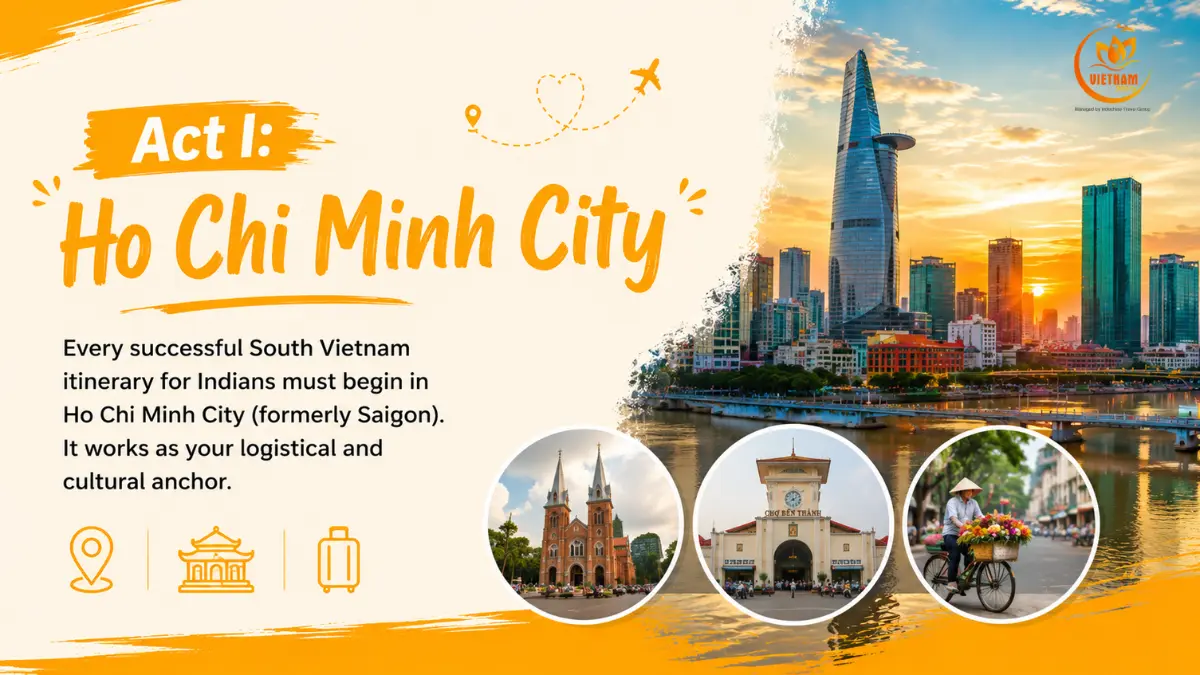
Ho Chi Minh City is the natural starting point for most South Vietnam itineraries because it combines international access, domestic connections, hotels, restaurants and day-trip options. The city deserves at least two full days when it is the traveller’s first visit.
What should travellers see in Ho Chi Minh City?
The city’s most useful first-time sights include the central colonial-era area, major museums, local markets and the riverfront. The exact combination should reflect the traveller’s interest rather than a standard checklist.
- Central Post Office and nearby landmarks provide an easy introduction to the historic centre.
- War Remnants Museum offers a serious historical experience that may require emotional space and sufficient time.
- Ben Thanh Market and other shopping areas can be useful for souvenirs, coffee and local products, but price comparison remains sensible.
- Saigon River and rooftop viewpoints show the modern side of the city after dark.
What should travellers do in Ho Chi Minh City?
Ho Chi Minh City rewards travellers who mix structured sightseeing with neighbourhood time. A food tour, café route, cooking activity or guided evening experience can reveal more than moving quickly between landmarks.
A family may prefer an air-conditioned lunch and a midday hotel break before returning outside in the evening. A group of friends may enjoy a guided nightlife or food experience. A senior couple may see fewer landmarks but spend more time at each one, especially during the hotter part of the year.
Where should travellers stay in Ho Chi Minh City?
First-time visitors usually benefit from a central area with convenient access to restaurants and major sights. The ideal hotel balances walkability with vehicle access, lift availability and manageable street noise.
A hotel directly inside a nightlife area may suit a group of friends but not a family with young children. A larger room farther from the centre may look attractive, yet daily traffic can reduce the time saved on accommodation costs.
Mekong Delta: day trip or overnight stay?
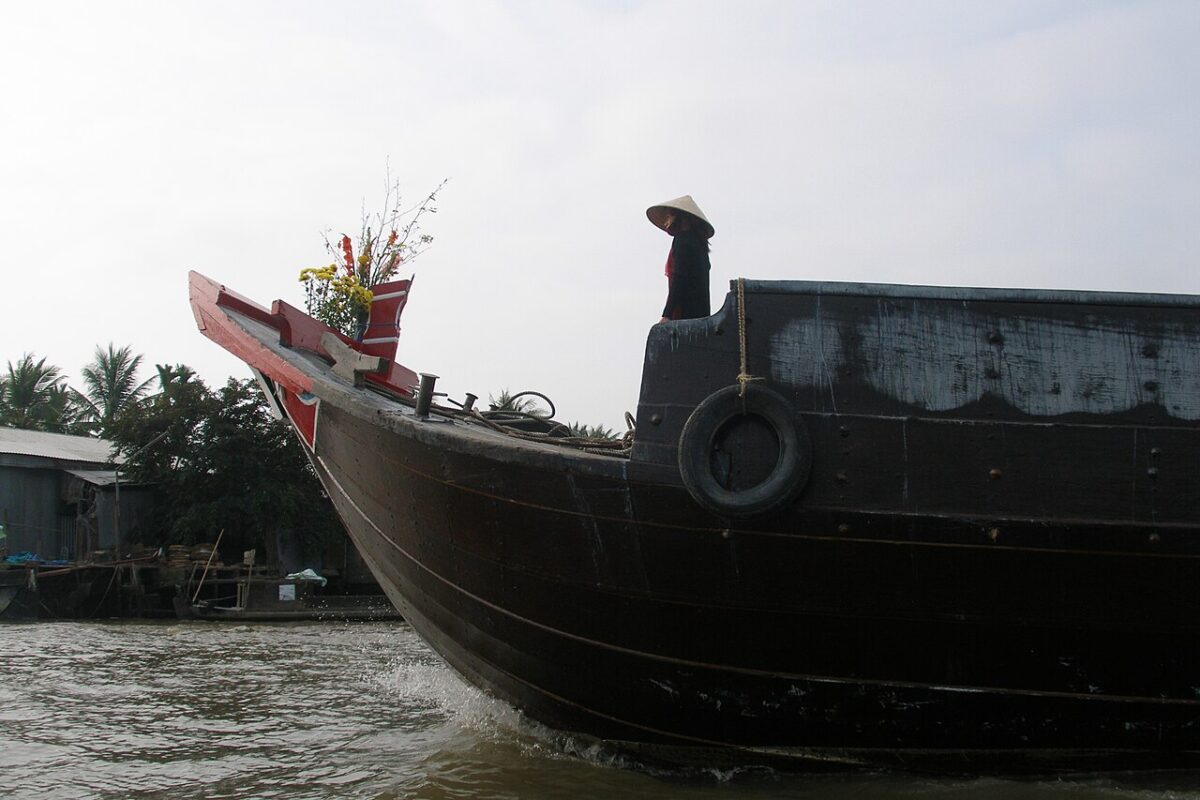
A Mekong Delta day trip is enough for a first introduction, while an overnight stay is better for travellers who want a slower river experience. The right choice depends on total duration, physical comfort and how much contrast the traveller wants after Ho Chi Minh City.
When a Mekong day trip makes sense
A day trip works well in a 4 to 7-day itinerary. It limits hotel changes and allows the traveller to return to the same Ho Chi Minh City room. The trade-off is that popular day-trip routes can feel structured and provide less time after other visitors leave.
When an overnight Mekong stay is better
An overnight stay is more suitable in a 9 or 10-day itinerary. A riverside lodge or town base can provide a quieter evening, early-morning atmosphere and a less compressed view of the region.
Travellers familiar with Kerala’s backwaters may notice the shared importance of water transport and tropical agriculture, but the Mekong Delta has its own architecture, food systems and river commerce. The comparison can create familiarity without reducing the Mekong to an Indian equivalent.
What should travellers check before a Mekong excursion?
- How much time will be spent on the road?
- How many boat transfers are involved?
- Is the activity suitable for children or limited mobility?
- Is lunch fixed, buffet-style or arranged individually?
- Can vegetarian or Jain requirements be confirmed in writing?
- What changes during high water, heavy rain or local operating disruptions?
Should a South Vietnam itinerary include Phu Quoc?
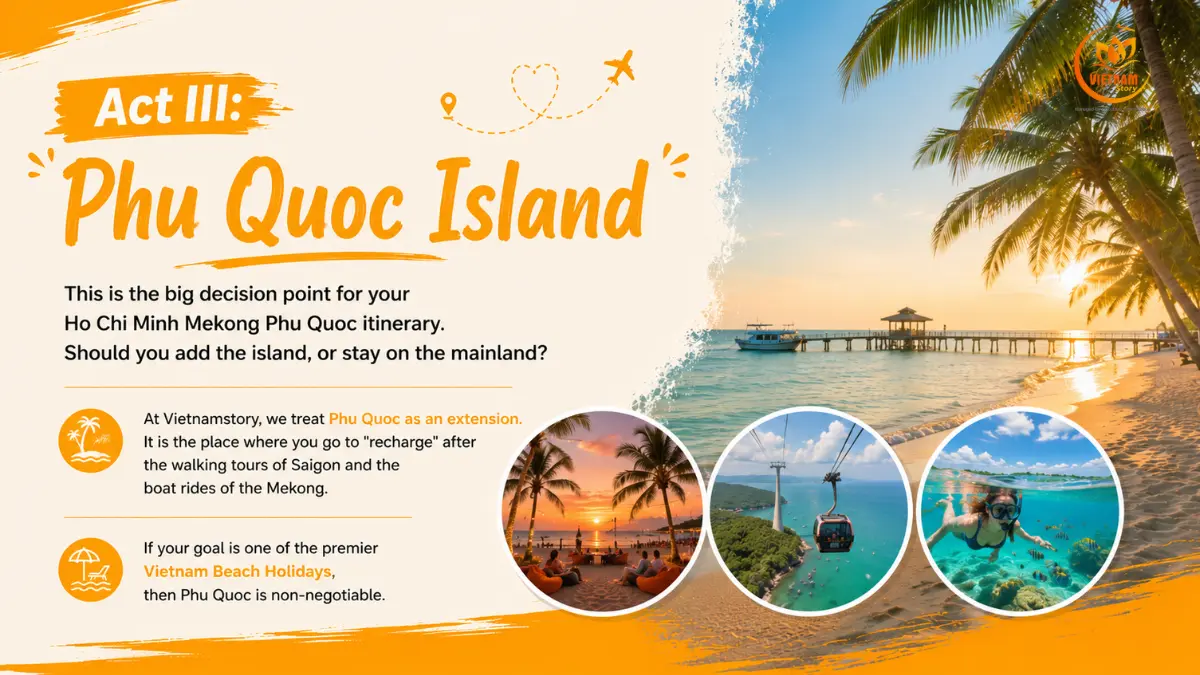
Phu Quoc is worth adding when the itinerary has at least seven days and beach time is a genuine priority. Travellers with six days or fewer should usually remain on the mainland unless Phu Quoc is the main purpose of the trip.

The island works particularly well as the final part of the journey. Ho Chi Minh City and the Mekong create active sightseeing days, while Phu Quoc provides a slower finish. Reversing the order may suit some flight schedules, but ending with the island often creates a more natural change of pace.
Phu Quoc for couples
Couples may prefer a resort with beach access, one island activity and at least one open evening. A honeymoon itinerary benefits more from a long breakfast and an unhurried sunset than from travelling between distant attractions every day.
Phu Quoc for families
Families can combine resort time with a theme park, wildlife attraction, cable-car experience or beach day. One major family attraction per day is usually enough, particularly when the resort itself has a pool or children’s facilities.
Phu Quoc for senior travellers
Senior travellers may value a well-located resort, direct transfers and fewer boat-based excursions. Accessibility varies by property and attraction, so lift access, walking distances and boarding arrangements should be reconfirmed.
What about Phu Quoc’s visa exemption?
Phu Quoc has a special visa-exemption framework for eligible foreign visitors staying on the island for a limited period under specified arrival and transit conditions. The exemption should not be assumed to cover a wider itinerary that includes Ho Chi Minh City, the Mekong Delta or other parts of Vietnam.
Indian travellers planning a combined Ho Chi Minh City and Phu Quoc itinerary should verify the current national entry requirement rather than relying only on the island exemption. Regulations and eligible travel patterns must be reconfirmed through official channels before booking.
For destination planning beyond this itinerary, see the Phu Quoc travel guide for Indian travellers.
What should travellers include in South Vietnam?
A balanced South Vietnam itinerary should include one full Ho Chi Minh City day, one major historical or cultural excursion, one Mekong experience and enough open time to absorb weather or travel delays. Phu Quoc belongs in the plan only when the trip has enough nights to protect the beach stay.
- At least two nights in Ho Chi Minh City so the city is more than an airport stop.
- One focused excursion to the Cu Chi Tunnels or the Mekong Delta in shorter itineraries.
- An overnight Mekong stay when the trip lasts nine or ten days and river culture matters.
- Three Phu Quoc nights when beach time is included in a seven-day or longer route.
- A final departure buffer before the international flight from Ho Chi Minh City.
- Written dietary arrangements for remote meals, boat trips and island excursions.
What should travellers skip?
Travellers should skip any addition that creates more transport than experience. South Vietnam can feel compact, but road traffic, airport procedures and island geography still affect the pace.
- Phu Quoc in a 4 or 5-day general itinerary. The island flight and hotel change consume too much of a short trip.
- Cu Chi and the Mekong Delta on the same compressed day. The route prioritises distance covered over meaningful time.
- A one-night Phu Quoc stay. The airport process leaves little time for the beach or resort.
- Several distant Phu Quoc attractions in one day. The island is larger than many first-time visitors expect.
- A tight domestic-to-international connection. Flight changes or baggage procedures can place the international departure at risk.
- Outdoor sightseeing through the hottest part of every day. Early mornings, indoor breaks and later evenings create a more comfortable rhythm.
What is the best time to visit South Vietnam?
South Vietnam is warm throughout the year, with a generally drier period and a wetter period rather than four distinct seasons. Ho Chi Minh City, the Mekong Delta and Phu Quoc share a tropical climate, but rainfall and sea conditions can still differ by destination and month.
The drier months are often preferred for city walking, Mekong excursions and Phu Quoc beach time. The wetter months can still be suitable because rain may arrive in shorter tropical periods rather than lasting all day, but outdoor schedules need more flexibility.
Phu Quoc deserves separate attention because sea conditions and boat operations can affect island activities. A month that remains workable for Ho Chi Minh City may be less reliable for a specific Phu Quoc boat trip.
An Indian family travelling during summer school holidays may still enjoy Ho Chi Minh City and the Mekong by starting outdoor activities earlier and keeping an indoor alternative. A honeymoon couple choosing Phu Quoc primarily for beach time should place greater weight on island weather than a traveller visiting for food and city sightseeing.
Review the regional guide to Vietnam’s weather before fixing the route, then reconfirm the short-term forecast before departure.
What is the fallback plan for rain or disrupted activities?
A strong South Vietnam itinerary keeps at least one flexible activity in every base. Tropical rain, rough sea conditions, traffic or operational changes may affect an excursion even when the overall trip remains possible.
- If heavy rain affects a Ho Chi Minh City walking plan, use the time for a museum, café, market or cooking activity.
- If Mekong boat conditions change, confirm whether the route can be adjusted or replaced with a land-based local experience.
- If a Phu Quoc boat excursion is unsuitable, keep a resort, spa, indoor attraction or road-based island plan available.
- If a domestic flight changes, protect the international departure by reconsidering the final night rather than compressing the airport connection.
Vietnam Story planning note: Do not make one island excursion the only reason for visiting Phu Quoc. The island stay should still feel worthwhile if sea conditions change the main activity.
Food and dietary planning for Indian travellers
Ho Chi Minh City provides the widest range of dining choices in a South Vietnam itinerary, including Indian restaurants and Vietnamese vegetarian food. Meal planning becomes more important in the Mekong Delta and during fixed island excursions.

Vegetarian travellers
Vietnamese vegetarian food is often described using the word “chay,” but travellers should still confirm whether fish sauce, meat broth, egg or shared cooking surfaces are acceptable. A dish that contains no visible meat may not meet every vegetarian preference.
Jain travellers
Jain requirements need more detail than a general vegetarian request. Specify onion, garlic, root vegetables, egg and any other restrictions in writing. Ho Chi Minh City offers more backup options, while Mekong lodges, fixed lunches and Phu Quoc excursions may require advance coordination.
A Jain family may prefer returning to Ho Chi Minh City after a Mekong day trip rather than staying overnight at a remote property without confirmed meals. Another family may value the overnight experience enough to arrange the menu in advance. The right route depends on how confidently the dietary requirement can be handled.
Travellers with children
Families should keep familiar snacks available on long road and boat days. Children may enjoy fruit, rice, noodles or simple dishes, but fixed excursion menus should be checked before departure rather than assumed.
Transport and arrival planning from India
A South Vietnam itinerary should be built around the actual arrival time at Ho Chi Minh City, not only the advertised flight duration. Direct services may operate from selected Indian cities and on selected days, while many travellers will use one-stop connections.
Direct and one-stop flight logic
Travellers from Delhi or Mumbai may find direct options on certain dates, while travellers from Bengaluru, Chennai, Hyderabad, Kolkata, Ahmedabad, Kochi or other cities should compare current direct and connecting schedules. Airline routes and operating frequencies may change, so every flight should be verified before hotels are confirmed.
A direct flight arriving very late may provide less usable time than a well-timed connection. Compare the complete journey, baggage allowance, arrival hour and onward plan rather than selecting the ticket only by price.
Moving around Ho Chi Minh City
Private transfers are useful on arrival and departure days, particularly for families, senior travellers or groups with several bags. App-based transport can be practical during free time, but payment methods and account setup should be checked rather than assuming every Indian-issued card will work.
Connecting to Phu Quoc
Flights connect Ho Chi Minh City and Phu Quoc, but schedules and frequencies vary. The island transfer also includes travel to the airport, check-in, baggage collection and the resort journey. A short flight still occupies a meaningful part of the day.
Protecting the departure day
Travellers using separate domestic and international tickets should avoid a tight same-day connection. Returning to Ho Chi Minh City the previous evening may cost an extra hotel night, but it can reduce the risk created by schedule changes and baggage re-checking.
Visa planning for Indian passport holders
Indian passport holders should confirm the current Vietnam entry requirement before making non-refundable bookings. The chosen visa or exemption pathway must match the complete route, including any mainland stay before or after Phu Quoc.
An Indian traveller visiting Ho Chi Minh City, the Mekong Delta and Phu Quoc should not assume that Phu Quoc’s special island exemption covers the whole journey. Passport details, entry point and travel dates should be checked carefully before submitting an application.
The Vietnam e-visa guide for Indian passport holders explains the main preparation steps and the details that should be reconfirmed through official channels.
What affects the cost of a South Vietnam itinerary?
The cost of a South Vietnam trip depends mainly on international flights, the number of hotel bases, Phu Quoc resort category, domestic transport and whether the Mekong is visited as a day trip or overnight stay. Adding the island affects the budget more than adding another city museum.
| Cost factor | Why it matters | Practical decision |
|---|---|---|
| Departure city in India | Direct and one-stop routes create different fares and usable time | Compare total journey time, not only the ticket price |
| Phu Quoc extension | Adds a domestic flight, transfers and another hotel base | Include the island only when at least two or three full nights remain |
| Mekong day trip or overnight | An overnight stay adds accommodation and more transfers | Pay for the stay when a slower river experience is a priority |
| Ho Chi Minh City hotel location | Central hotels may reduce daily transfer time | Balance room size against traffic and access |
| Private transport | Improves comfort for families, groups and complex travel days | Prioritise arrival, departure and long excursion days |
| Dietary arrangements | Remote or fixed meals may require advance planning | Confirm reliability before comparing small price differences |
| Travel season | Flight and resort demand can change by date | Verify live prices rather than relying on an evergreen estimate |
Removing Phu Quoc from a short itinerary may save more than reducing every hotel category. It also reduces transfer load. Conversely, a traveller whose main goal is a beach holiday may get better value by shortening Ho Chi Minh City rather than downgrading the island stay.
Use the Vietnam trip cost guide for travellers from India to understand the wider budget components without treating an estimate as a fixed package price.
Package or independent planning?
Independent planning works well for travellers comfortable arranging hotels, domestic flights, transfers and backup plans. A coordinated package becomes more useful when the itinerary includes a Mekong excursion, Phu Quoc flight, dietary requirements, children, senior travellers or a tight departure connection.
| Planning style | Best suited to | Main advantage | Main responsibility |
|---|---|---|---|
| Independent trip | Travellers comfortable booking every component | Maximum control and flexibility | Managing suppliers, changes and transfers |
| Partly coordinated trip | Travellers wanting free city time with support on complex sectors | Balance between independence and logistics | Keeping separate bookings compatible |
| Custom package | Families, groups, senior travellers and travellers with dietary needs | Connected transport and local coordination | Providing accurate preferences before confirmation |
A package does not need to schedule every hour. Hotels, airport transfers, a Mekong day and the Phu Quoc sector can be coordinated while evenings in Ho Chi Minh City and resort time remain open.
How to personalise South Vietnam for different Indian travellers
The ideal South Vietnam itinerary changes with the traveller’s age, food needs, arrival schedule and preferred pace. A route designed for a group of friends should not be copied unchanged for a multigenerational family.
For couples and honeymoon travellers
Use Ho Chi Minh City for food and evening energy, then finish with at least three nights in Phu Quoc. One open island evening often adds more value than another attraction. A couple arriving after wedding events may also benefit from placing a slower first day in the city before any long excursion.
For families with children
Limit long road days and place the most child-focused activities in Phu Quoc. A hotel pool may matter more than a second museum. In the Mekong Delta, check boat safety, shade, toilets and meal timing before booking.
For multigenerational families
Select central hotels with lifts, private transfers and easy vehicle access. An overnight Mekong stay may be enjoyable when the property is comfortable, but a long sequence of small boats and uneven boarding points may not suit every family member.
For senior travellers
Keep one main activity per day and reduce time outside during the hottest hours. A senior traveller may enjoy a short river journey and a comfortable lodge while skipping a physically demanding tunnel section or long island boat tour.
For groups of friends
Ho Chi Minh City can support later evenings, food experiences and flexible transport. Groups should still agree in advance whether Phu Quoc is meant for nightlife, beach relaxation or attractions, because trying to prioritise all three can fragment the stay.
For vegetarian and Jain travellers
Spend enough time in Ho Chi Minh City to benefit from wider restaurant choice, then pre-arrange meals for the Mekong and island excursion days. A route with fewer one-night stops reduces the number of kitchens that need to understand the same dietary instructions.
What should be booked first?
International flights, Phu Quoc accommodation, domestic flights and dietary-sensitive excursions should be confirmed before flexible city activities. Weather-dependent island plans and ordinary restaurant choices can remain adjustable.
| Book earlier | Keep flexible |
|---|---|
| International flights with practical arrival times | One free Ho Chi Minh City evening |
| Phu Quoc resort during high-demand dates | Café and shopping stops |
| Domestic flight between Ho Chi Minh City and Phu Quoc | One weather-dependent island activity |
| Mekong overnight accommodation | Low-priority city landmarks |
| Private arrival and departure transfers | One resort or pool half-day |
| Vegetarian or Jain meals on fixed excursions | Casual meals in Ho Chi Minh City |
The Vietnam trip planning timeline can help sequence flights, documents, accommodation, activities and final checks.
South Vietnam planning checklist
A final South Vietnam itinerary checklist should confirm the route, usable days, island weather, dietary communication and international departure buffer.
- Count usable sightseeing days rather than only hotel nights.
- Keep Ho Chi Minh City as the main transport anchor.
- Use either Cu Chi or the Mekong Delta as the main excursion on a short trip.
- Add Phu Quoc only when at least two or three full island nights remain.
- Check domestic and international tickets before relying on a same-day connection.
- Confirm vegetarian, Jain, halal or allergy requirements in writing.
- Review separate weather conditions for Ho Chi Minh City and Phu Quoc.
- Keep an indoor or low-intensity alternative for rainy periods.
- Allow extra transfer time for Ho Chi Minh City traffic.
- Leave one Phu Quoc evening or half-day unstructured.
For wider destination, transport and preparation guidance, consult the Vietnam travel guide for Indian travellers.
Frequently asked questions about a South Vietnam itinerary
What cities are in South Vietnam?
Major southern destinations include Ho Chi Minh City, cities and provinces of the Mekong Delta, coastal destinations such as Vung Tau and Mui Ne, and Phu Quoc Island. A first-time itinerary does not need to include every southern city; Ho Chi Minh City, the Mekong Delta and Phu Quoc provide the clearest regional contrast.
Is seven days enough for South Vietnam?
Seven days are enough for Ho Chi Minh City, one Mekong Delta experience and three nights in Phu Quoc. The itinerary needs careful flight timing and should not add another mainland beach destination.
How many days should I spend in Ho Chi Minh City?
Two full days are enough for a first introduction to Ho Chi Minh City. Three nights provide a more comfortable schedule when the arrival day is late or when a Cu Chi excursion is included.
Should I visit the Mekong Delta or Phu Quoc?
The Mekong Delta is better for river culture, local landscapes and a mainland trip without another flight. Phu Quoc is better for beaches, resorts and a slower finish. Travellers with seven or more days can include both, while shorter trips should select the experience that matters more.
How many days are enough for Phu Quoc?
Three nights are a practical minimum when Phu Quoc is part of a wider South Vietnam itinerary from India. Two nights can work with favourable flights, but one night rarely justifies the airport and hotel transition.
Is South Vietnam suitable for families?
South Vietnam suits families when the itinerary limits long road days and includes rest periods. Ho Chi Minh City offers flexible dining and indoor activities, while Phu Quoc provides resort facilities and family attractions. Mekong boat arrangements should be checked for young children and limited mobility.
Can Jain travellers find suitable food in South Vietnam?
Jain travellers can find suitable meals with advance planning, especially in Ho Chi Minh City. Requirements involving onion, garlic, root vegetables, egg and shared cooking surfaces should be sent in writing before Mekong trips, resort stays and fixed-meal excursions.
What is the best time for Ho Chi Minh City and Phu Quoc?
The drier period is generally preferred for combining Ho Chi Minh City with Phu Quoc beach activities. Travel remains possible during wetter months, but rain and sea conditions require a more flexible island schedule. The actual forecast should be checked close to departure.
Should I book a package or plan South Vietnam independently?
Independent planning suits travellers comfortable coordinating flights, hotels and transfers. A package is more useful for families, groups, senior travellers, dietary-sensitive trips or itineraries combining Ho Chi Minh City, the Mekong Delta and Phu Quoc within a limited number of days.
Build the route around the experience you value most
The best South Vietnam itinerary is not automatically the one with the most stops. A short trip may be more rewarding with Ho Chi Minh City and one meaningful excursion. A seven-day journey can add Phu Quoc when the traveller accepts the extra flight. A longer route can slow down in the Mekong and leave genuine time for the island.
If you know which southern route suits your group but prefer coordinated hotels, transfers, sightseeing, domestic connections and meal arrangements, compare the Vietnam tour packages for Indian travellers and use the preferred itinerary as the basis for a customised trip.