
While Ha Long Bay is the “famous sibling” that everyone knows, savvy travelers in 2026 are looking toward its serene, untouched neighbor: Bai Tu Long Bay. Geologically identical but 70% less crowded, this bay is a retreat for those who prefer the sound of waves over the buzz of drone cameras. However, the success of your trip depends entirely on one factor: the Bai Tu Long Bay weather. Understanding the seasonal shifts is vital to ensuring your photos are clear, your kayaking is calm, and your family remains comfortable. At Vietnamstory, we specialize in navigating these patterns. Whether you are looking for a comprehensive Bai Tu Long Route or a luxurious Bai Tu Long Route 2D1N Cruise Trip, our itineraries are designed to sync perfectly with the rhythm of the seasons. Let’s dive into the specifics of what the skies have in store for you in 2026.
Climate overview: Understanding the 4-season cycle of Bai Tu Long Bay weather
Unlike the tropical south of Vietnam, the North experiences a distinct four-season subtropical climate. Bai Tu Long Bay maintains an annual average temperature of 23.8°C, which is generally milder than the intense heat of Central or South India. The humidity stays high, around 80%, giving the islands their lush, emerald green appearance that looks so stunning in photographs.
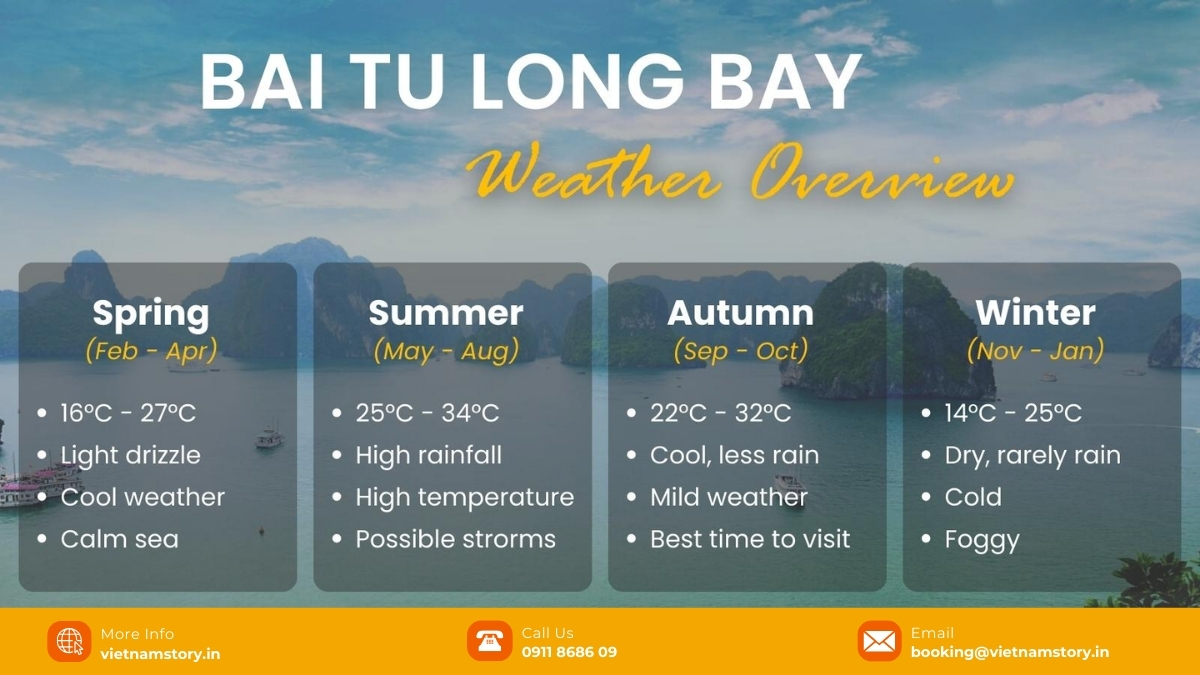
The Bai Tu Long Bay weather is divided into two primary halves: the dry season (November to April), which is cool and misty, and the wet season (May to October), which is hot, humid, and occasionally dramatic with tropical storms. Understanding this cycle allows you to pack correctly and manage your expectations for visibility and water activities. To help you visualize the year, here is how the seasons generally break down:
- Dry season (November – April): This is characterized by the northeast monsoon. It brings cooler air from China, low rainfall, and the famous “Dragon’s Breath” mists that make the limestone pillars look like they are floating in the sky.
- Wet season (May – October): This is the season of high energy. The southwest monsoon brings heat and tropical rain. While it is the “Green Season” where the flora is at its most vibrant, it also carries the risk of typhoons.
Spring (February – april): The “Golden Window” for Bai Tu Long Bay weather
Spring offers the most balanced Bai Tu Long Bay weather for exploration, with temperatures ranging from 17°C to 26°C. It answers the need for Indian travelers who want to avoid the extreme summer heat while still being able to swim in waters that are beginning to warm up to a pleasant 22°C. If you are planning a spring visit in 2026, here is what you can expect:
Transitioning from the chilly north-winter to a pleasant warmth. You will see coastal flora blooming on the cliffs, and the local fishing villages like Vung Vieng are bustling with spring energy. Rainfall is light (40–60mm), appearing as a gentle morning drizzle that adds to the “Zen” atmosphere. By 11:00 AM, the sun usually breaks through, offering 6 – 8 hours of daily sunshine.
Don’t miss Vietnam Poetry Day (March 3). Many cruises in Bai Tu Long Bay host traditional poetry readings and tea ceremonies to celebrate this cultural milestone, making it a very sophisticated time to visit.
Summer (May – august): Tropical highs and typhoon roulette in the Bay
Summer is what we call the “Green Season.” If you don’t mind the heat, this is when the bay is at its most vibrant and “alive.” However, for our guests from the hotter parts of India, I always give a warning: the humidity here can make 32°C feel like 40°C.
Summer Bai Tu Long Bay weather is characterized by high temperatures (24°C – 32°C) and the year’s heaviest rainfall. While the risk of typhoons requires a flexible travel spirit, the reward is the warmest water for swimming and a rare 2026 phenomenon: the peak visibility of bioluminescent plankton in June. Here is the “insider” reality of a summer trip to the bay:
July and August are the hottest months. The “Feels Like” index is high, so we always ensure our private transfers and cruise cabins have top-tier 2026-standard air conditioning. Tropical storms can lead to mandatory 24–48 hour cruise cancellations. At Vietnam Story, we monitor the 2026 maritime forecasts 72 hours in advance to provide our guests with seamless land-based alternatives if the port is closed.
In June, the nutrient-rich runoff from the rains makes the bay a haven for Bioluminescent Plankton. Taking a night kayak in a secluded lagoon during this time reveals trails of “underwater stars” with every paddle stroke – a magical experience that children especially adore.
Autumn (September – october): The romantic peak of Bai Tu Long Bay weather
Autumn provides the most stable Bai Tu Long Bay weather, with temperatures settling between 22°C and 29°C. With humidity dropping and water visibility peaking at 7 – 9 meters, this is the prime time for snorkeling in the Bai Tu Long National Park and enjoying sunset dinners on the sundeck. For our Indian travelers, there are two specific reasons to choose this window.

October coincides with these major Indian festivals. Celebrating a “Festival of Lights” under the clear, star-studded sky of Bai Tu Long Bay is a memory that stays with you forever. Because the air is dry, the “haze” of the summer and spring disappears. This is the only time of year when you can see the distant, jagged mountains of the Chinese border from the sundeck of your ship.
Winter (November – january): The misty mystique and zen vibes
Winter in the bay is for the dreamers. It is a hauntingly beautiful season where the limestone karsts play hide-and-seek with the fog. It feels less like a tropical beach and more like a scene from an ancient silk painting. Winter Bai Tu Long Bay weather is chilly and dry, with temperatures fluctuating between 14°C and 24°C. While it is generally too cold for swimming, the “ink-wash painting” aesthetic and the lack of crowds make it the perfect season for hiking to Thien Canh Son Cave or visiting floating villages without the summer sweat. Here is why winter is a “hidden gem” season:
December is the foggiest month. While this might delay some activities, the silence on the water is profound. It is a great time for “Wellness Cruises” that focus on yoga, meditation, and spa treatments. This is the driest period of the year (10–40mm of rain). You can explore the National Park trails without worrying about mud or sudden downpours.
For our Indian guests used to 30°C+, please bring a medium-weight jacket and a pashmina. The wind on the water in December can be quite sharp!
A comprehensive monthly breakdown of Bai Tu Long Bay weather
The following breakdown shows that the Bai Tu Long Bay weather offers various “sweet spots” throughout the year. While October and March provide the best balance of clarity and comfort, the summer months offer the best swimming conditions, and the winter months provide the most unique atmospheric photography.
| Month | Avg temp (°C) | Rain (mm/days) | Water clarity | Crowd levels |
| Jan | 15–20 | Low / 5 | Low (Foggy) | Low |
| Mar | 18–24 | 40–60 / 6 | High | Medium |
| May | 24–30 | Rising / 8 | Moderate | High (Local) |
| Aug | 26–30 | Peak / 14 | Low (Storms) | High (Local) |
| Oct | 22–27 | Low / 9 | Very High | High (Intl) |
| Dec | 16–22 | Minimal / 5 | Low (Foggy) | Low |
Note: “Local Crowds” peak in May/August due to Vietnamese school holidays, whereas “International Crowds” peak in October/November.
Vietnamstory signature: Tailoring the weather for you
At Vietnam Story, we don’t just look at the thermometer, we look at your “Travel Persona.” We know that a family from Bangalore has different needs than a couple from Mumbai. We tailor our recommendations for Bai Tu Long Bay weather to match your specific style.

We customize your trip by recommending the best months for your specific needs – October for honeymooners and March for families. Furthermore, we ensure that your cultural and dietary needs, such as Jain and Halal-certified meals, are seamlessly integrated into your itinerary, regardless of the season. Here is how we “weather-proof” your experience:
- For honeymooners: We strongly suggest October. You want your wedding photos to have that perfect blue-sky backdrop and the most reliable golden-hour sunsets.
- For families: March or April is our top pick. The moderate temperatures mean that children won’t get heat-exhausted, and seniors can comfortably climb the stairs to the viewpoints without feeling breathless.
- Dining comfort: We have partnered with specific cruises (like Mon Chéri) that provide separate kitchenware and dedicated chefs for Jain and Halal meals. Whether it’s a hot monsoon day or a chilly winter night, your comfort is guaranteed.
Rare attributes and insider tips for Bai Tu Long Bay weather
The unique positioning of Bai Tu Long Bay makes it 1-2°C cooler in the summer and provides significantly better air quality than the more industrial areas of Ha Long. By using modern gateways like Van Don Airport and packing specialized camera gear, you can master the bay’s weather like a professional.
- The “cooler” Bay: Because Bai Tu Long is positioned further northeast and is more exposed to the ocean breezes, it feels roughly 1°C – 2°C cooler than Ha Long City. This is a massive advantage during the humid peaks of May and June.
- AQI excellence: While Ha Long can sometimes suffer from industrial haze from the mainland, the distance of Bai Tu Long keeps its Air Quality Index (AQI) in the “Excellent” range (30–50). Your lungs will thank you!
- Packing hacks:
- Autumn: Bring a UV filter for your camera to handle the sharp, direct sun.
- Winter: Pack a lens cloth; the morning fog can create condensation on your phone or camera lens.
- May: Pack high-quality insect repellent for the National Park excursions, as the humidity brings out the forest life.
- Access tip: For the smoothest entry, fly into Van Don International Airport (VDO). It is only 1.5 hours from the Cai Rong harbor, allowing you to bypass the long drive from Hanoi and get to the bay while the morning light is at its best.
Conclusion
The Bai Tu Long Bay weather is a cycle of moods – sometimes dramatic, sometimes peaceful, but always beautiful. Whether you are kayaking through the bioluminescence of June, hiking through the mists of December, or celebrating Diwali under the clear October skies, this bay offers a serenity that is rare in our modern world.
At Vietnamstory, we are ready to guide you through every season. We handle the logistics, the dietary needs, and the “insider” timing so that you can simply breathe in the salt air and marvel at the limestone giants. We look forward to welcoming you to Bai Tu Long Bay!
Top Halong Bay Tours You’ll Love


Vietnam Highlights 7 Days: From Hanoi to Phu Quoc
Hanoi - Halong bay - Da Nang - Hoi an ancient town - Phu Quoc


8 Days Vietnam Journey: Culture, Heritage & Natural Wonders



Hanoi - Halong - Sung Sot - Titop - Luon Cave - Hanoi


Serenity Grandeur Cat ba cruise
Lan Ha Bay - Cat Ba - Cai Beo Floating Village - Viet Hai Village - Turtle Island - Tai Keo Cave


Hanoi - Lan Ha Bay - Dark And Bright Cave - Hanoi