A Vietnam itinerary during monsoon works best when the route follows the weather pattern of one region rather than trying to cover the whole country. For a 6–7 day trip, stay within one region. For 9–10 days, combine two regions and keep at least one half-day movable. Da Nang and Hoi An are often practical choices during India’s July–August monsoon, while Hanoi, Ha Long Bay and Southern Vietnam require stronger weather buffers. The biggest mistake is booking several outdoor activities on consecutive days with no fallback.
This guide helps Indian travellers decide which region to visit, how many nights to allocate, what to book in advance, what to keep flexible and how to protect the trip when rain changes the original plan.
Is Vietnam worth visiting during monsoon?
Yes, Vietnam can be worth visiting during monsoon because Northern, Central and Southern Vietnam do not share one identical rainy season. The right destination depends more on the month and regional weather than on the label “monsoon season”.
Some days may bring a brief shower followed by usable sightseeing time. Other days may involve persistent rain, poor visibility, rough seas or local transport changes. A successful rainy-season trip therefore needs a route that remains enjoyable even when one outdoor experience cannot operate as planned.
| Trip decision | Best planning rule |
|---|---|
| 6–7 days in Vietnam | Stay in one region and use no more than two hotel bases. |
| 9–10 days in Vietnam | Combine two regions with one domestic flight. |
| 11–14 days in Vietnam | Three regions are possible, but only with recovery time between transfers. |
| Outdoor-focused holiday | Keep one movable half-day for every three sightseeing days. |
| International departure | Do not place a cruise, mountain excursion or long road transfer immediately before the flight. |
Which part of Vietnam is best during monsoon?
The best part of Vietnam depends on when the trip takes place. Northern and Southern Vietnam are generally wetter during the middle of the year, while Central Vietnam often receives its heavier rain later.
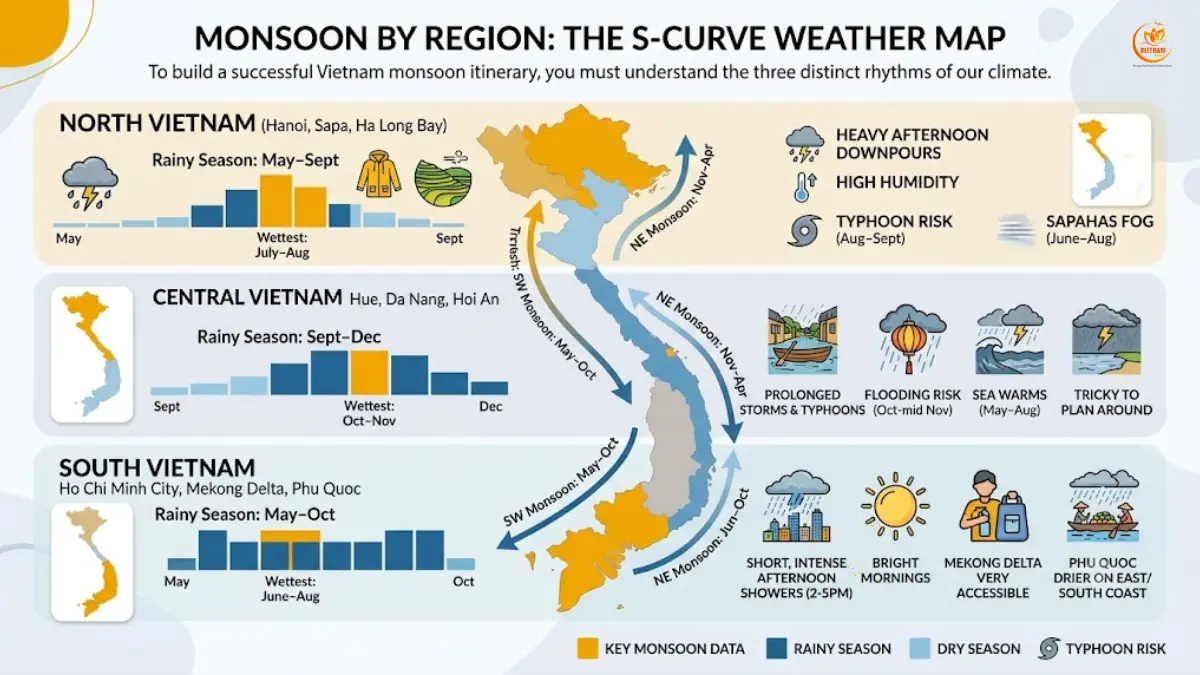
| Region | Broad rainy period | Best itinerary use | Main concern |
|---|---|---|---|
| Northern Vietnam | Generally May to September | Culture, city stays, landscapes and cruises with flexible terms | Heavy showers, slippery trails and possible boat changes |
| Central Vietnam | Heavier rain generally arrives later in the year | Da Nang and Hoi An can suit July–August trips from India | Late-year storms, flooding and reduced beach conditions |
| Southern Vietnam | Generally May to October | Urban sightseeing and a flexible Mekong programme | Intense showers and local transport disruption |
These periods are broad planning guides rather than guarantees. Travellers should check a current regional forecast before departure and reconfirm cruises, cable cars, boat trips and outdoor tours locally.
For a wider seasonal comparison, use the regional guide to Vietnam climate by month before selecting travel dates.
Northern Vietnam: best for culture with flexible landscape days
Northern Vietnam suits travellers who value Hanoi’s culture and can treat Ninh Binh, Ha Long Bay or Sapa as weather-sensitive additions. Hanoi provides the strongest base because museums, cafés, markets and covered attractions remain available when an outdoor day becomes impractical.
Ninh Binh and Ha Long Bay can still be included, but the schedule should not depend on perfect visibility. Sapa requires more caution because rain can make mountain paths slippery and fog may hide the views that justified the longer transfer.
A couple landing in Hanoi after an evening flight should count the first night as an arrival night. Starting a long Ninh Binh or Ha Long transfer early the next morning leaves little recovery time if the inbound flight is delayed.
Central Vietnam: often the strongest July–August option
Da Nang and Hoi An are often the most practical choices for Indian travellers visiting in July or August. Central Vietnam’s heavier rainy period generally arrives later than the summer rains affecting much of the North and South.
A single Da Nang hotel base works particularly well for families. Hoi An can be visited as an afternoon and evening excursion, while Ba Na Hills, the beach and Da Nang city can move around according to visibility and local conditions.
Travellers visiting later in the year need more caution because heavy rain, tropical systems or flooding may affect parts of Central Vietnam. Review the best time of year to visit Da Nang before fixing a beach stay or paying for weather-dependent activities.
Southern Vietnam: best for an urban base with a flexible Mekong day
Ho Chi Minh City remains workable during the wetter months because the city offers museums, restaurants, shopping and short transfers between attractions. The Mekong Delta can be added when local conditions support the planned boat route.
A senior traveller may enjoy the main boat experience but find repeated boarding, slippery paths or a long return journey tiring. In that situation, a shorter Mekong programme or an extra Ho Chi Minh City day may be more comfortable than an overnight delta stay.
Which Vietnam monsoon route should you choose?
Choose the route by matching the travel month, available sightseeing days and tolerance for weather-related changes. A slower regional itinerary is usually more reliable than a fast north-to-south circuit.
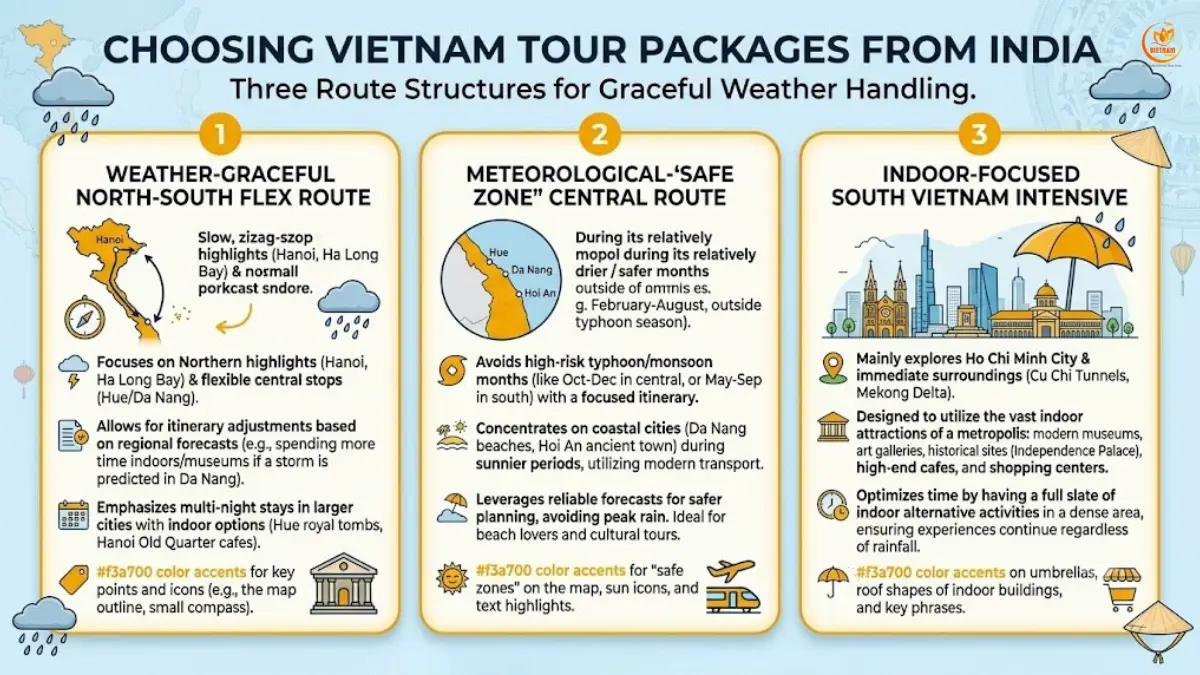
| Route | Ideal duration | Hotel changes | Best for | Skip when |
|---|---|---|---|---|
| Hanoi, Ninh Binh and Ha Long Bay | 6–7 days | One or two | First-time visitors and culture-focused couples | The trip depends on trekking or guaranteed cruise weather |
| Da Nang and Hoi An | 5–7 days | Zero or one | Families, couples and slower July–August holidays | Severe weather is forecast for Central Vietnam |
| Ho Chi Minh City and Mekong Delta | 5–7 days | Zero or one | Food, history and urban travellers | The main goal is uninterrupted beach time |
| Hanoi and Da Nang | 9–10 days | One | Travellers wanting culture and coastal variety | The domestic flight removes too much usable time |
| Hanoi, Da Nang and Ho Chi Minh City | 11–14 days | Two | Long first-time holidays | The trip has fewer than ten usable sightseeing days |
A practical 6-day Vietnam itinerary during India’s monsoon
For a July or August trip, six days in Da Nang and Hoi An provide a manageable route with one main hotel base, limited transfer fatigue and several indoor alternatives.
Day 1: Arrive in Da Nang and keep the evening light
Transfer to the hotel, check in and stay close to the accommodation. A late-arriving family gains little from forcing Hoi An or a long city tour into the first evening.
Day 2: Da Nang city with flexible beach time
Use the clearer part of the day for an outdoor stop and keep the afternoon adaptable. The Cham Museum, cafés, a spa or hotel downtime can replace beach time when conditions are poor.
Day 3: Ba Na Hills or a Da Nang fallback day
Ba Na Hills depends on visibility, wind and operating conditions. Check the forecast on the previous evening. If low cloud or disruptive weather remains likely, move Ba Na Hills rather than visiting only because Day 3 was assigned to it.
A relaxed city programme is the better fallback. Combining Ba Na Hills and a fixed Hoi An evening on the same day leaves no recovery margin if transport or visibility changes.
Day 4: Hoi An Ancient Town
Visit Hoi An after checking local conditions. Heritage buildings, cafés, tailoring and workshops remain useful during light rain. During heavy rain or a local flood warning, stay away from affected low-lying areas and move the visit to the reserve day.
A honeymoon couple may value an unhurried Hoi An evening more than another full-day excursion. Protecting the evening from back-to-back activities also makes the itinerary easier to adjust.
Day 5: Reserve day or optional Hue excursion
Day 5 protects the main experiences. When the forecast is favourable, use the day for Hue or an activity moved from earlier in the itinerary. When conditions are poor, remain in Da Nang for a shorter cultural, culinary or wellness programme.
Day 6: Departure with an airport buffer
Keep the departure morning simple. A major attraction, intercity transfer or cable-car excursion should not sit immediately before an international flight.
The Da Nang trip itinerary guide can help travellers decide which attractions deserve fixed time and which can remain optional.
A balanced 10-day Vietnam monsoon itinerary
A ten-day trip should normally combine no more than two regions. Hanoi and Da Nang offer variety without creating a hotel change every second day.
- Day 1: Arrive in Hanoi and recover from the flight.
- Day 2: Explore Hanoi with indoor alternatives nearby.
- Day 3: Visit Ninh Binh when local conditions are suitable.
- Day 4: Begin a Ha Long Bay cruise or remain in Hanoi if services change.
- Day 5: Return to Hanoi and leave the evening free.
- Day 6: Fly to Da Nang and check in.
- Day 7: Explore Da Nang.
- Day 8: Visit Ba Na Hills when visibility is suitable.
- Day 9: Visit Hoi An or use the day as a weather reserve.
- Day 10: Depart from Da Nang.
This ten-day route provides about seven to eight usable sightseeing days after arrival, departure and the domestic flight are considered. Adding Ho Chi Minh City would create another airport cycle and leave less room to recover from weather changes.
A traveller using a one-stop flight from India may lose more usable time than someone arriving on a convenient schedule. Count itinerary days from realistic hotel check-in time, not only from the dates printed on the ticket.
The monsoon-proof itinerary rule
A monsoon-proof itinerary does not attempt to predict every shower. It limits the number of bookings that can fail at the same time and gives each important outdoor experience a nearby alternative.
- One geographic risk per day: Do not combine a cruise, long road transfer and flight on the same day.
- One movable half-day in every three sightseeing days: The buffer can absorb a changed tour without disrupting the rest of the trip.
- At least three nights per main base: Longer stays reduce packing, wet-luggage handling and transfer pressure.
- No weather-sensitive activity before departure: Keep cruises, mountains and long day trips away from the final flight window.
- A same-city fallback for every outdoor priority: The replacement should not require another long transfer.
Vietnam Story planning note: A reserve half-day is not empty time. In good weather it becomes a slow meal, shopping break or spa visit. In poor weather it protects the experience the traveller came to Vietnam to see.
What should be fixed and what should stay flexible?
Flights, key hotels and essential transfers usually need advance booking. Weather-sensitive sightseeing deserves flexible terms or a movable position in the itinerary.
| Book or plan early | Keep flexible where possible |
|---|---|
| International flights | City walking routes |
| Domestic flight between two regions | Beach time |
| First hotel and late-arrival transfer | Spa, café and shopping time |
| Limited-inventory cruise or resort with suitable terms | Selected day trips |
| Dietary requirements communicated in advance | Exact order of outdoor attractions |
A Jain couple may prefer an extra night in a city with pre-identified meal options rather than a remote overnight stop that depends on last-minute restaurant availability. Ingredients, kitchen practices and meal timing still need direct reconfirmation with the relevant hotel or restaurant.
How rain affects Vietnam’s main experiences
Rain does not affect every activity in the same way. The important question is whether the weather reduces comfort, removes the main reason for visiting or creates a safety and operational issue.
Ha Long Bay cruises
Cloud or light rain may reduce visibility without stopping a cruise. Strong wind, storms or unsafe marine conditions can cause delays, route changes or cancellations. Keep the night after the cruise free from a tight international connection.
Travellers considering a summer cruise can review the Ha Long Bay weather in July before finalising the northern route.
Da Nang beaches and Ba Na Hills
Beach access may remain possible during suitable conditions, but swimming decisions should follow local warnings and sea conditions. Ba Na Hills is more sensitive to cloud and visibility because poor weather can remove much of the scenic value even when the attraction remains open.
Sapa trekking
Sapa becomes less suitable when the traveller’s main goal is a demanding trek or guaranteed mountain views. Senior travellers, families with young children and travellers with limited mobility may prefer a short village visit or another Hanoi night.
Mekong Delta boat trips
A Mekong programme may continue during light rain, but local water conditions, storms and road access can alter the route. Covered boats, practical footwear and a flexible return time improve comfort.
What is the fallback plan when rain changes the day?
The best fallback replaces the affected experience with an activity of similar length in the same base. A replacement that requires another long transfer usually creates more disruption than it solves.
| Original plan | Trigger for changing it | Fallback |
|---|---|---|
| Hanoi walking tour | Persistent heavy rain | Museum, covered market, café and a shorter vehicle-based route |
| Ninh Binh cycling | Slippery roads or unsafe conditions | Covered boat activity if operating, temple visit or Hanoi reserve day |
| Ba Na Hills | Poor visibility, wind or operational disruption | Cham Museum, café, spa or Da Nang city programme |
| Hoi An evening | Heavy rain or local flood warning | Move Hoi An to the reserve day and remain in Da Nang |
| Mekong Delta | Unsafe local conditions | Ho Chi Minh City museum, food experience or rest day |
| Sapa trek | Muddy trails or dense fog | Short village visit or additional Hanoi time |
Vietnam Story planning note: Do not replace a cancelled activity before checking what is actually operating. Confirm local conditions first, then select the closest alternative that protects the rest of the route.
How should the itinerary change for different travellers?
The regional route may remain the same, but the pace, hotel location and fallback activities should reflect the traveller’s mobility, meal requirements and preferred travel style.
| Traveller type | Useful adjustment |
|---|---|
| Couples and honeymoon travellers | Protect one unplanned evening and avoid filling every weather gap with another tour. |
| Families with children | Use one main base, keep indoor activities near the hotel and carry spare clothing. |
| Senior travellers | Reduce slippery walks, steep viewpoints and repeated boat boarding. |
| Vegetarian travellers | Identify several meal options near each hotel and reconfirm opening times. |
| Jain travellers | Discuss ingredients and preparation needs directly rather than relying only on a vegetarian label. |
What affects the cost of a monsoon itinerary?
The main cost drivers are flights, hotel category, number of regions, private transfers and booking conditions. Rain does not automatically make every Vietnam trip cheaper.
Adding another region usually means another domestic flight, two airport transfers and an additional hotel check-in. Flexible cancellation or amendment terms may also cost more than restrictive bookings, but they can be valuable for a cruise, resort or weather-sensitive activity.
Current prices should be checked for the exact travel dates, Indian departure city, room category and route. A generic rainy-season price cannot represent every itinerary.
Package or DIY during monsoon?
A DIY trip suits travellers who are comfortable monitoring weather, contacting several providers and changing reservations independently. Coordinated planning becomes more useful when flights, hotels, transfers, sightseeing and dietary requirements need to move together.
The route decision should come first. Package inventory, inclusions and pricing belong to the next stage, after the traveller has selected the correct region, duration and pace.
Packing checklist for Vietnam’s rainy season
Pack for humidity, sudden rain and strongly air-conditioned indoor spaces. Lightweight items that dry quickly are more useful than heavy waterproof clothing.
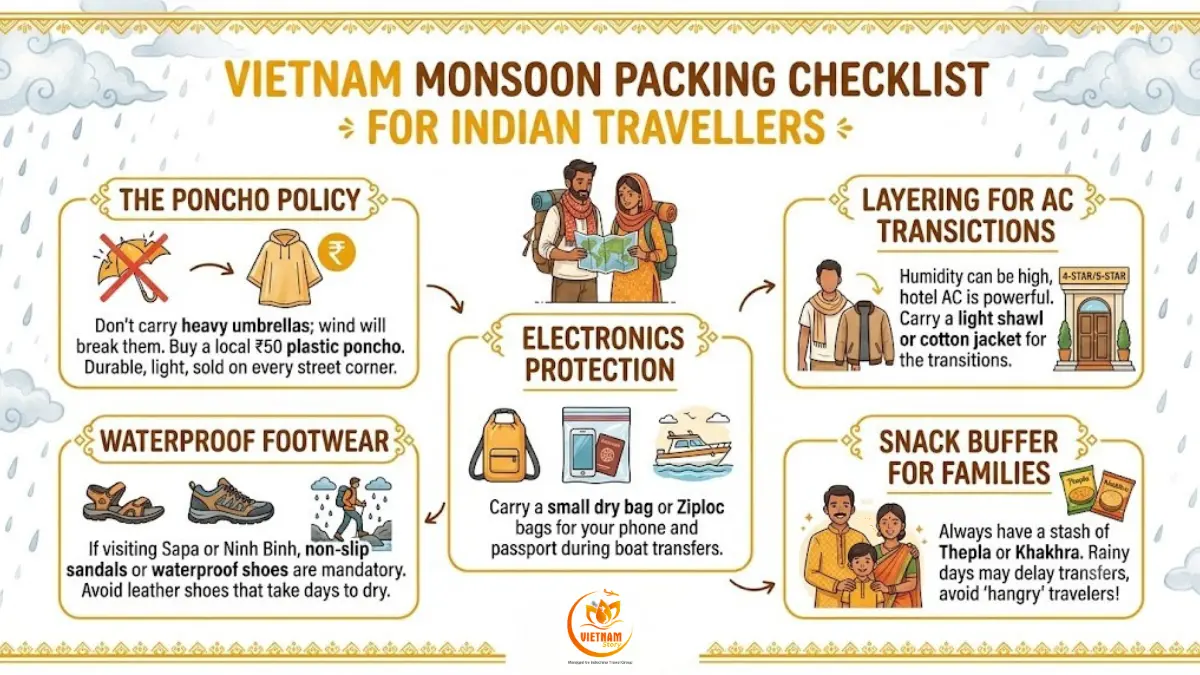
- Lightweight rain jacket or compact poncho
- Quick-drying clothing
- Non-slip sandals or waterproof walking shoes
- Dry pouch for passports, phones and power banks
- A light layer for flights, coaches and air-conditioned interiors
- Small familiar snacks for children or travellers with strict dietary preferences
Heavy denim and untreated leather footwear are slow to dry in humid weather. Leave enough suitcase space to separate wet items from clean clothing.
First-time visitors can use the Vietnam travel guide for Indian travellers for broader preparation beyond the rainy-season route.
Frequently asked questions
Is seven days enough for Vietnam during monsoon?
Seven days are enough for one regional itinerary such as Hanoi–Ninh Binh–Ha Long Bay, Da Nang–Hoi An or Ho Chi Minh City–Mekong Delta. Seven days are too short for a comfortable three-region trip.
Does it rain throughout the day in Vietnam?
Not necessarily. Some days have short showers, while others experience longer periods of rain. The pattern varies by region, month and current weather system.
Should Ha Long Bay be included during monsoon?
Ha Long Bay can be included when the booking has appropriate terms and the itinerary has a buffer after the cruise. Do not connect the cruise directly to an international departure.
Is Vietnam safe during monsoon?
Travel may continue normally during much of the rainy season, but severe weather can cause flooding, rough seas, slippery paths and transport disruption. Follow local guidance and do not proceed when an operator or authority considers conditions unsafe.
How many hotel changes are reasonable?
One hotel change is reasonable in a 6–7 day trip, while two hotel changes may work in a 9–12 day itinerary. More frequent changes reduce flexibility and increase transfer pressure.
Plan the route before selecting a package
A rainy-season trip becomes difficult when flights, hotels, transfers, sightseeing and meals are booked separately with no room for adjustment. Once the month, region and reserve time are clear, coordinated planning may help families, seniors and travellers with dietary requirements. Compare the available Vietnam tourism packages from India by VietnamStoryin after deciding which monsoon-friendly route fits the trip duration and travel pace.