Vegetarian travellers from Mumbai can eat comfortably in Vietnam when the food plan combines verified Vietnamese vegetarian restaurants with a few well-placed Indian meals. Hanoi, Da Nang, Hoi An and Ho Chi Minh City offer the most practical choice, while cruises, remote stays and full-day excursions need advance confirmation. Jain travellers should explain every excluded ingredient rather than requesting only “Jain food”. The biggest mistake is assuming that a vegetable dish is suitable without checking its broth, sauce, egg content and preparation.
This guide helps Mumbai travellers decide what to eat, which Vietnamese cities are easier for vegetarian food, what to arrange before leaving Mumbai and how to build reliable meal stops into a 5–10 day itinerary.
Is Vietnam vegetarian-friendly for travellers from Mumbai?
Vietnam is generally vegetarian-friendly in major cities and established tourist areas. Rice, noodles, tofu, mushrooms, vegetables, fruit and plant-based versions of popular Vietnamese dishes are widely available, particularly at restaurants using the word “chay”.
The main challenge is not finding vegetables. The challenge is confirming whether the broth, sauce or seasoning contains fish sauce, oyster sauce, shrimp paste, meat stock or egg.
| Dietary requirement | Practical outlook in Vietnam | What needs checking? |
|---|---|---|
| Indian lacto-vegetarian | Usually manageable in major destinations | Fish sauce, meat broth, egg and cooking sauces |
| Vegan | Easiest at dedicated vegan or vegetarian restaurants | Egg, dairy, honey, mayonnaise and spreads |
| Jain | Possible with careful planning | Onion, garlic, root vegetables, sauces and preparation method |
| Family with children | Manageable with familiar meal fallbacks | Meal timing, spice level and excursion-day food |
| Senior traveller | Easier with fewer hotel changes | Restaurant distance, early meals and long sightseeing days |
A restaurant may interpret “vegetarian” differently from a traveller from India. State the ingredients that must be excluded instead of depending on a single dietary label.
Use a two-track food strategy in Vietnam
The most practical approach combines local Vietnamese vegetarian food with familiar Indian meals. Vietnamese food provides cultural variety, while Indian meals create predictable comfort after flights, intercity transfers and demanding sightseeing days.
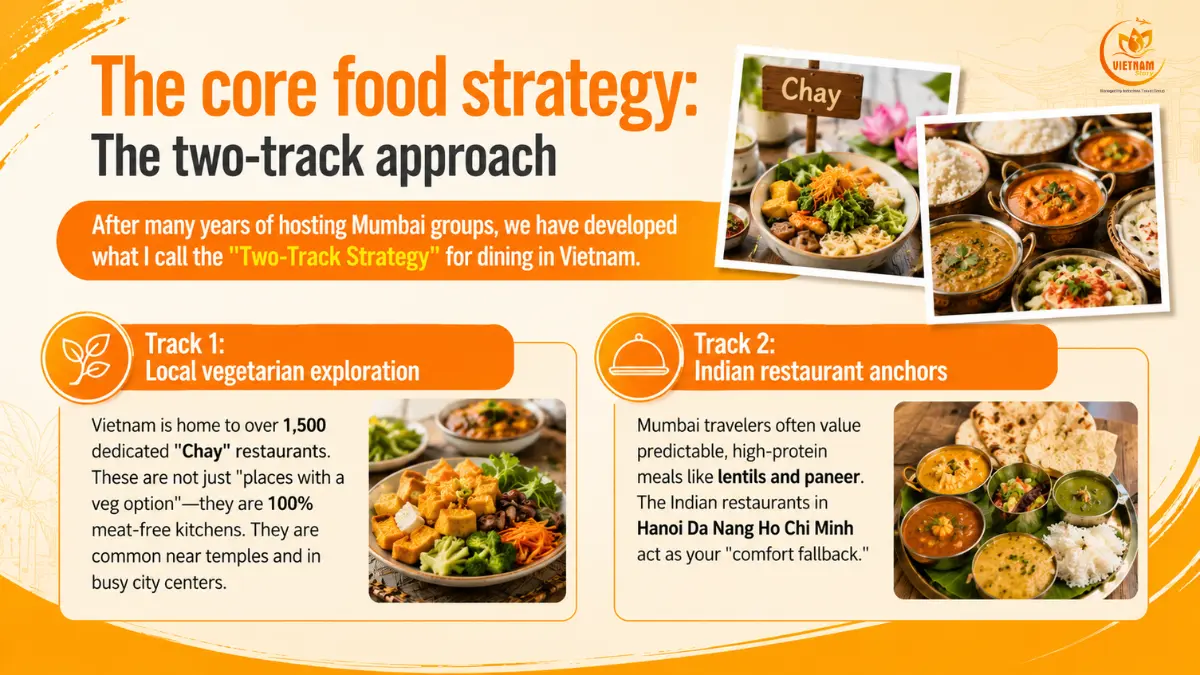
Track one: verified Vietnamese vegetarian meals
Dedicated vegetarian or vegan restaurants are usually the easiest places to explore Vietnamese flavours. Their menus may include vegetarian noodle soups, rice dishes, tofu, mushrooms, vegetables, fresh rolls and plant-based versions of regional dishes.
A dedicated vegetarian restaurant provides more certainty than a mixed restaurant, but it does not automatically meet every vegan, Jain or allergy-related requirement. Egg, dairy, onion, garlic and shared preparation may still need to be discussed.
Track two: Indian meals as comfort anchors
Indian restaurants are most useful on arrival evenings, after long excursions and during multi-city trips. A familiar meal of dal, rice, roti or vegetable curry may be more valuable after a tiring day than travelling across the city to reach a particular restaurant.
A couple staying five nights in Da Nang could use local vegetarian restaurants on relaxed city days and plan an Indian dinner after Ba Na Hills. A family changing cities may prefer a familiar dinner on every arrival night because that meal removes one decision from an already demanding day.
Vietnam Story planning note: Place comfort meals after the most tiring parts of the itinerary. The meal plan should follow the traveller’s energy, location and sightseeing schedule rather than a rigid rule such as eating Indian food every second day.
Travellers who have not yet selected their city order can compare the best Vietnam itineraries from Mumbai for 5–10 days before deciding where Indian meal anchors are genuinely needed.
The BOM-to-Vietnam meal-planning rule
A food plan from Mumbai should begin with the actual travel schedule from Chhatrapati Shivaji Maharaj International Airport, not with a restaurant wish list. Arrival time, connections, immigration, baggage collection and hotel transfer all affect when the first proper meal is realistic.
- Arrival meal: Keep the first meal close to the hotel and independent of an exact flight arrival time.
- Transfer meal: Carry a modest snack and identify a proper meal near the destination hotel.
- Excursion meal: Ask where lunch will be served and what the operator means by vegetarian food.
- Comfort meal: Place a familiar Indian dinner after a long flight, road journey or full-day tour.
- Strict-diet meal: Confirm the ingredients in writing when the traveller cannot easily select another restaurant.
A traveller reaching the hotel late after a connection may have little appetite for a long restaurant transfer. A hotel meal or nearby Indian restaurant is usually more practical than reserving a special dinner across Hanoi or Ho Chi Minh City.
The first meal should be planned around realistic hotel arrival, not only the landing time printed on the flight ticket.
What does “chay” mean on a Vietnamese menu?
“Chay” refers to vegetarian or Buddhist vegetarian food in Vietnam. Signs containing “quán chay”, “cơm chay” or “nhà hàng chay” can help travellers identify vegetarian eateries, but the exact ingredients and kitchen practices vary by establishment.
The word “chay” is a useful search term rather than a complete dietary guarantee. A vegan traveller may still need to ask about dairy or honey, while a Jain traveller must separately explain restrictions involving onion, garlic and root vegetables.
Vietnamese phrases worth saving on your phone
Show written phrases to restaurant staff instead of depending only on pronunciation. Several phrases can be used together when more than one restriction applies.
| Vietnamese phrase | Meaning | Purpose |
|---|---|---|
| Tôi ăn chay | I eat vegetarian food | State the general dietary requirement |
| Không thịt | No meat | Exclude meat |
| Không cá | No fish | Exclude fish |
| Không nước mắm | No fish sauce | Check sauces, soups and stir-fries |
| Không trứng | No egg | Request an egg-free dish |
| Không hành, không tỏi | No onion, no garlic | Explain part of a Jain requirement |
These phrases do not describe every preparation standard. Travellers with strict requirements should also save a short written note listing the exact ingredients they do not eat.
Which hidden ingredients can make a dish non-vegetarian?
Fish sauce, meat stock, oyster sauce, shrimp paste and egg are the ingredients most likely to make a vegetarian-looking dish unsuitable. In many cases, the sauce and broth matter more than the visible vegetables.
- Noodle broth: A bowl topped with tofu and vegetables may still use chicken, pork, beef or seafood stock.
- Dipping sauce: Fresh vegetable rolls may be served with a fish-sauce-based dip.
- Stir-fry seasoning: Oyster sauce or seafood seasoning may be added during cooking.
- Egg: Fried rice, noodles, fillings and batters may contain egg even when no meat is visible.
- Garnish: Meat floss, dried seafood or another topping may be added after cooking.
- Shared equipment: Mixed restaurants may use common pans, utensils, grills or frying oil.
Removing visible meat from an existing dish does not remove the stock or sauce used in its preparation. A purpose-made vegetarian dish is generally a better choice than a modified meat dish.
Which Vietnamese vegetarian dishes are easiest to order?
Phở chay, bánh mì chay, gỏi cuốn chay and cơm chay are useful starting points for Indian vegetarians. Each dish still needs a brief ingredient check because recipes differ between restaurants.
Phở chay
Phở chay is a vegetarian noodle soup commonly prepared with plant-based broth, rice noodles, mushrooms, tofu and herbs. Confirm that the broth is vegetarian and ask about egg when an egg-free meal is required.
Bánh mì chay
Bánh mì chay is a baguette that may contain tofu, mushrooms, pickled vegetables, cucumber and herbs. Vegan travellers should check mayonnaise, butter, pâté and other spreads.
Gỏi cuốn chay
Gỏi cuốn chay usually combines rice paper, noodles, tofu, vegetables and fresh herbs. Ask about the dipping sauce separately because a suitable roll can be served with an unsuitable sauce.
Cơm chay
Cơm chay is a vegetarian rice meal that may include tofu, mushrooms, cooked vegetables, soup or plant-based mock meats. Buffet-style eateries can make selection easier, although travellers with strict restrictions still need to ask about individual dishes.
Simple rice, noodle and tofu meals
Plain rice, stir-fried vegetables, tofu and noodle dishes can form a useful fallback meal. Jain travellers should check onion, garlic, root vegetables and sauce rather than assuming a plain-looking dish meets Jain requirements.
Hanoi, Da Nang or Ho Chi Minh City: which is easiest for food?
Ho Chi Minh City generally provides the widest dining choice, while Hanoi and Da Nang are also convenient for Indian and local vegetarian meals. Hoi An remains manageable, but strict dietary needs benefit from advance research.
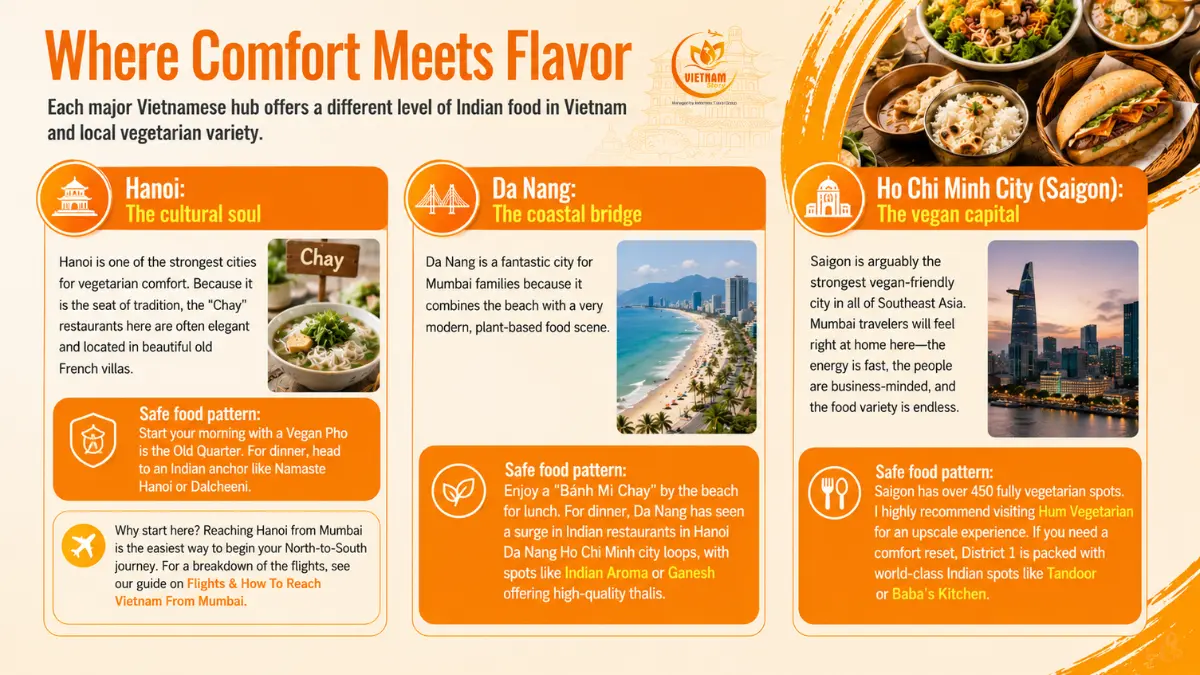
| Destination | Best fit for a Mumbai itinerary | Recommended meal strategy | Where extra planning is needed |
|---|---|---|---|
| Hanoi | Six to seven-day North Vietnam trip | Combine local chay meals with an Indian dinner near the hotel | Ninh Binh trips and Ha Long Bay cruises |
| Da Nang | Five to seven-day family or couple trip | Use Da Nang as a stable meal base for several nights | Ba Na Hills and late returns from Hoi An |
| Hoi An | Da Nang-based day trip or one-night stay | Identify the evening meal before leaving Da Nang | Strict Jain food and late return transport |
| Ho Chi Minh City | Short single-base trip or South Vietnam route | Mix Indian restaurants with dedicated vegetarian eateries | Mekong Delta excursions |
| Ha Long Bay cruise | North Vietnam itinerary | Send the full requirement before booking | Buffet contents, sauces and kitchen practices |
Hanoi: easy city meals, more preparation outside Hanoi
Central Hanoi provides access to Indian restaurants, local vegetarian eateries and international cafés. The city itself is relatively straightforward; uncertainty increases on a Ninh Binh day trip or Ha Long Bay cruise, where the operator controls the meal.
A vegetarian couple staying near the Old Quarter can keep a Hanoi lunch flexible and save one familiar dinner near the hotel. The same couple should request cruise-meal details before paying because an onboard “vegetarian option” may be simpler than expected.
Da Nang and Hoi An: fewer hotel changes improve food comfort
Da Nang is a practical base for the beach, Ba Na Hills and Hoi An. Staying several nights in Da Nang allows travellers to reuse reliable meal options instead of researching a new neighbourhood after every transfer.
A Mumbai family returning late from Hoi An may prefer a simple dinner near the Da Nang hotel. A couple planning to dine in Hoi An should save the restaurant location, current opening hours and return arrangement before leaving Da Nang.
Ho Chi Minh City: the easiest base for a short food-conscious trip
Ho Chi Minh City suits travellers who want extensive dining choice without frequent hotel changes. Central areas generally provide Indian, vegetarian, vegan and international food, although a Mekong Delta excursion still requires separate planning.
A senior traveller with five days may find one Ho Chi Minh City base more comfortable than a fast multi-city trip. Fewer transfers make meal timing, rest periods and access to familiar food easier to control.
Travellers deciding which region best matches their food preferences and sightseeing priorities can compare North, Central and South Vietnam routes from Mumbai.
How should Jain travellers arrange meals in Vietnam?
Jain meals require a written ingredient list, advance communication and direct confirmation. The words “vegetarian” and “chay” do not automatically exclude onion, garlic, potatoes or other root vegetables.
- Define the requirement: List every excluded ingredient instead of sending only the phrase “Jain meal”.
- Ask what can be prepared: A restaurant may be able to modify one dish without providing a separate Jain menu.
- Send the request before arrival: Hotels, cruises and remote properties need time to speak with the kitchen.
- Repeat the request at the point of service: Reconfirm the requirement during hotel check-in, cruise boarding or restaurant ordering.
- Prepare a fallback: Keep a suitable simple meal or pre-identified Indian restaurant for transfer days.
Vietnam Story planning note: A Jain couple from Mumbai usually benefits more from longer stays in Hanoi, Da Nang or Ho Chi Minh City than from several remote overnight stops. A stable city base provides alternatives when one kitchen cannot meet the complete requirement.
A no-onion-no-garlic dish prepared in a shared kitchen may be acceptable to one traveller and unsuitable to another. Decide the required preparation standard before the trip rather than after the meal arrives.
Which meals need advance confirmation?
Confirm meals in advance when the traveller cannot easily leave and select another restaurant. Cruises, remote stays, early departures and long excursions create the greatest food-planning risk.
| Travel situation | Food risk | Best action |
|---|---|---|
| Major-city sightseeing day | Low | Save several nearby options and decide during the day |
| Late arrival from Mumbai | Moderate | Use the hotel or a restaurant close to the accommodation |
| Full-day excursion | Moderate | Ask where lunch is served and what “vegetarian” includes |
| Intercity flight or transfer | Moderate | Carry a snack and identify a meal near the next hotel |
| Ha Long Bay cruise | High | Submit the complete requirement before booking |
| Remote homestay | High | Confirm ingredients and kitchen capability before selecting the stay |
| Strict Jain meal | High | Send a written ingredient list and request a clear response |
A restaurant in Hanoi can usually be replaced by another restaurant. A meal on a cruise cannot. Planning effort should increase as the traveller’s ability to change the meal decreases.
How should meals change for a 5, 7 or 10-day trip from Mumbai?
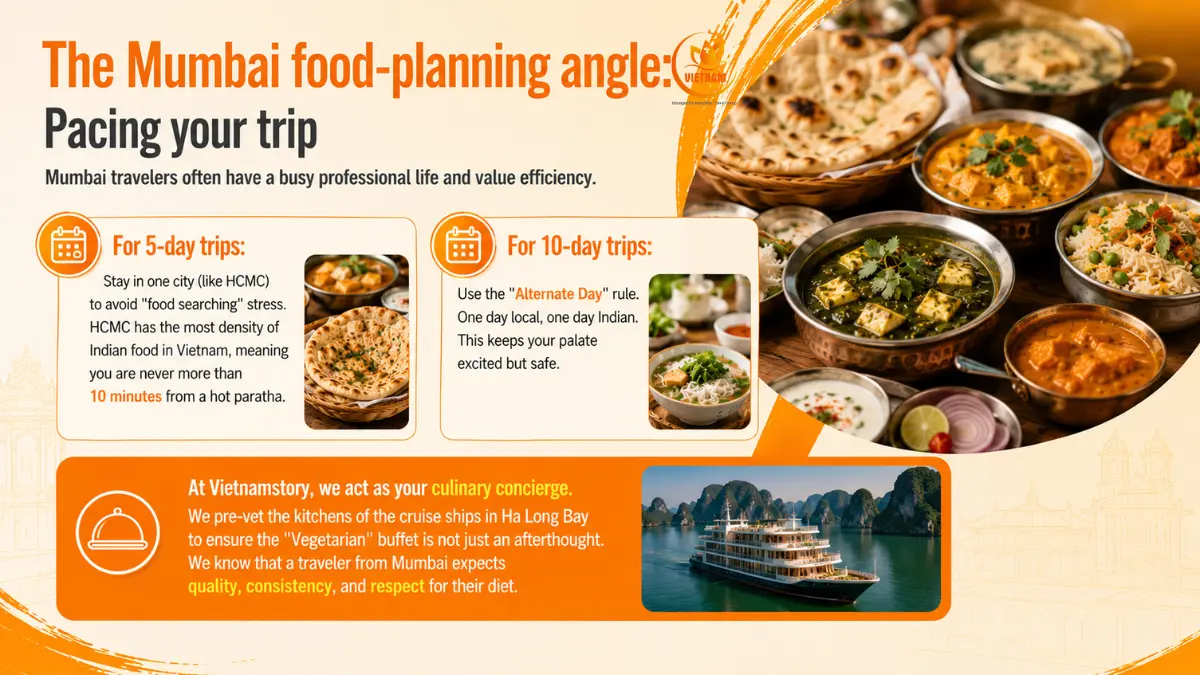
The number of meal anchors should increase with the number of hotel bases and restricted travel days. A five-day single-city holiday needs less advance planning than a ten-day itinerary involving flights, cruises and several accommodation changes.
| Mumbai trip format | Recommended food setup | What can remain flexible? |
|---|---|---|
| 5 days in one Vietnamese city | Arrival dinner, one Indian fallback and several local vegetarian options | Most city lunches and relaxed evenings |
| 7 days with two hotel bases | One familiar option near each hotel and confirmed excursion meals | Meals on ordinary sightseeing days |
| 9–10 days across two regions | A small food map for each base and planned meals on transfer days | Local meals in Hanoi, Da Nang or Ho Chi Minh City |
| Strict Jain itinerary | Written requirements, directly confirmed meals and transfer-day fallbacks | Only meals whose preparation can be discussed clearly |
Five days: keep one main accommodation base
A short trip from Mumbai should not lose sightseeing time to repeated restaurant searches. One main city, one dependable Indian restaurant near the hotel and several local vegetarian choices usually provide enough variety.
Ho Chi Minh City or Da Nang can work well for this style of trip because the traveller can return to the same meal area each evening rather than rebuilding the food plan after another flight.
Seven days: plan around arrival and excursion days
A seven-day route often involves two bases or one city plus several excursions. The arrival meal in each base and lunch on restricted day tours matter more than ordinary city meals.
A Mumbai family travelling from Hanoi to Da Nang may keep Hanoi and Da Nang lunches spontaneous but pre-plan the cruise meal, domestic-flight day and first dinner after reaching Da Nang.
Nine to ten days: coordinate meal handovers
A longer itinerary needs meal handovers between hotels, drivers, cruises and tour operators. Each provider should receive only the requirement relevant to the service they control.
A Jain couple combining Hanoi and Da Nang should not rely on one general note sent at the start of the trip. The Hanoi hotel, cruise operator, Da Nang hotel and any included restaurant may need separate confirmation.
How can families and senior travellers stay comfortable?
Families and senior travellers benefit from predictable meal windows, fewer hotel changes and at least one familiar option near each accommodation base. The food plan should account for early departures, late sightseeing returns and rest time.
- Near-hotel fallback: Save one suitable Indian or vegetarian option close to every main hotel.
- Early breakfast: Ask what is available before an airport transfer, cruise or day tour.
- Child-friendly food: Confirm spice level and carry a modest familiar snack for long transfers.
- Senior comfort: Keep dinner close to the hotel after a full-day excursion.
- Meal timing: Avoid leaving lunch until the end of a long sightseeing circuit.
- Hydration: Carry suitable drinking water during transfers and excursions.
A family arriving after a late flight should treat the first evening as a hotel-meal or nearby-restaurant evening. Crossing the city after immigration, baggage collection and transfer often creates more fatigue than value.
Traveller age, group style and meal requirements can also affect the wider itinerary. The Vietnam planning guide for couples, families, seniors and groups from Mumbai explains how route pace can change by traveller type.
What should travellers prepare before leaving Mumbai?
Prepare the dietary message, difficult meals and arrival-day fallback before leaving Mumbai. Ordinary city meals can remain spontaneous when several suitable options have already been saved.
- Write the complete dietary requirement in plain English.
- Save the relevant Vietnamese phrases and hotel address offline.
- Mark suitable restaurants near each hotel rather than across the entire city.
- Confirm cruise, remote-stay and full-day-tour meals before payment when food suitability affects the booking decision.
- Check current restaurant location, operating hours and availability shortly before visiting.
- Carry a modest quantity of familiar dry snacks while following airline and entry rules.
- Keep the first evening in each new city simple enough to absorb a delayed arrival.
Khakhra, roasted nuts or another familiar travel snack can help during a long transfer, but snacks should support the meal plan rather than replace proper meals throughout the holiday.
How do weather and transfer days affect food access?
Weather affects food planning mainly by delaying transfers, changing excursions or making a distant restaurant inconvenient. A reliable fallback should remain close to the hotel or current sightseeing area.
Heavy rain may make a restaurant across the city impractical even when the restaurant remains open. On cruise days, mountain excursions and Mekong Delta trips, the meal depends more on the operator than on restaurant choice in the departure city.
A family travelling during a wetter period may benefit from one nearby hotel fallback and dry snacks for delayed transfers. The best time to visit Vietnam from Mumbai guide can help align weather, route and food accessibility.
What should vegetarian travellers include and skip?
Include preparation where replacing a meal would be difficult, and skip rigid scheduling in cities with good dining choice. The best plan protects strict requirements without making every sightseeing decision depend on a restaurant.
| Include | Skip |
|---|---|
| A written dietary card | Using only the word “vegetarian” |
| A nearby arrival-day meal | Crossing the city after a late flight |
| Advance confirmation for cruises and remote stays | Assuming every buffet has a complete vegetarian meal |
| Questions about broth, sauce and egg | Judging food only by visible ingredients |
| One familiar fallback in each main base | Building the itinerary around a long restaurant list |
| Flexible local meals in major cities | Pre-booking every lunch and dinner |
Does vegetarian food make a Vietnam trip more expensive?
Vegetarian food does not automatically make a Vietnam trip expensive. The cost depends on restaurant style, destination, hotel meal plan, dietary complexity and the balance between local and Indian meals.
A local vegetarian meal may cost differently from an Indian restaurant meal, while special preparation at a hotel, cruise or remote property may have separate conditions. Menu prices and restaurant availability can change, so current information should be checked for the actual travel dates.
Travellers comparing dining with flights, accommodation and transfers can use the Vietnam tour cost guide from Mumbai for the wider budget decision.
Package or DIY: which offers better meal control?
DIY travel gives independent travellers direct control over restaurant selection, while coordinated planning can help when hotels, cruises, transfers and sightseeing providers must receive the same dietary instructions. Neither approach guarantees suitability without clear communication.
DIY travel can work well for couples who are comfortable researching restaurants and changing plans. Coordinated arrangements may be more useful for families, senior travellers, larger groups and Jain travellers with several non-negotiable restrictions.
Before selecting either format, ask what “vegetarian meal” means for every included service and distinguish between a request that has been sent and a meal that the provider has explicitly confirmed.
Frequently asked questions
Can Indian vegetarians find food throughout Vietnam?
Vegetarian food is easiest to find in Hanoi, Da Nang, Hoi An and Ho Chi Minh City. Cruises, smaller towns and remote excursions require more preparation because the individual operator controls the available meal.
Does “chay” always mean vegan food?
Not in every restaurant or dish. “Chay” indicates vegetarian food, but vegan travellers should still ask about egg, dairy, honey and preparation.
Can Jain food be arranged in Vietnam?
Jain-style meals may be possible at selected restaurants, hotels and travel services, but the traveller must state each excluded ingredient. Availability and kitchen practices vary and require direct confirmation.
Should every meal be reserved before travelling?
No. Confirm meals for cruises, remote stays, strict dietary requirements and difficult transfer days. Meals in major cities can remain flexible when suitable alternatives have already been identified.
Are Indian restaurants available in every Vietnamese destination?
Indian restaurants are more common in major tourist cities than in remote areas. Individual restaurants may close, relocate or change their menus, so current information should be checked shortly before the visit.
How much food should travellers carry from Mumbai?
A modest quantity of familiar dry snacks is usually more practical than carrying meals for the entire trip. Travellers should follow applicable airline, customs and entry rules and rely on a proper local food plan for most meals.
Plan the difficult meals before selecting a package
A reliable food plan does not require every restaurant to be booked. Select the route first, plan arrival and transfer meals, identify familiar options near the main hotels and confirm food for cruises, remote stays and strict Jain requirements.
If the route already suits the group but coordinating hotels, transfers, sightseeing and dietary requests feels difficult, compare the available Vietnam tour packages from Mumbai and ask which meal arrangements can be confirmed for the selected itinerary.