
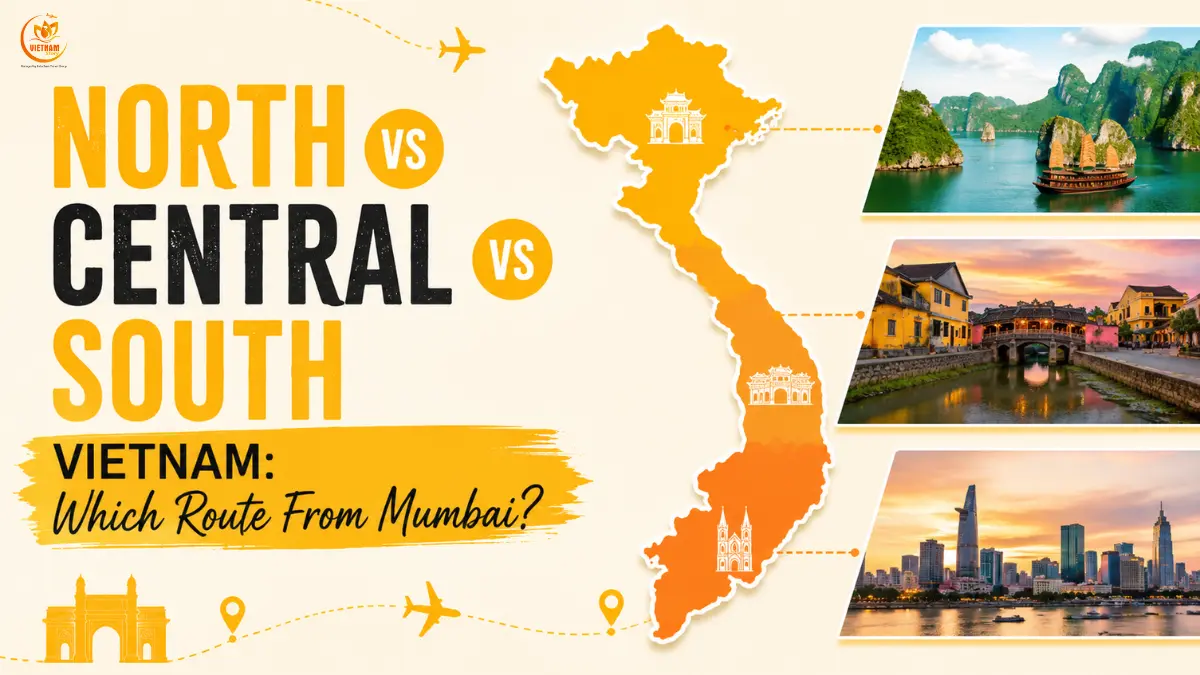
North Vietnam is the best first choice from Mumbai for scenery and culture, Central Vietnam is better for a slower beach-and-heritage break, and South Vietnam suits travellers who prefer city life, modern history and tropical excursions. For five or six nights, stay within one region. For eight to ten nights, combine two regions only when the flight timings preserve enough usable days. The mistake to avoid is planning three regions around the number of calendar days without accounting for arrival time, domestic flights and hotel changes.
North, Central or South Vietnam from Mumbai: quick comparison
The right region depends on what the holiday must deliver. North Vietnam provides the strongest combination of landscape and traditional culture. Central Vietnam offers the lowest transfer load when Da Nang is used as one base. South Vietnam provides the easiest mix of a major city, historical excursions and a tropical extension.
| Decision factor | North Vietnam | Central Vietnam | South Vietnam |
|---|---|---|---|
| Best for | First visits, scenery, culture and cooler-season travel | Couples, families, seniors, beaches and a gentler pace | City breaks, food, modern history and tropical excursions |
| Main gateway | Hanoi | Da Nang | Ho Chi Minh City |
| Practical short route | Hanoi–Ninh Binh–Ha Long Bay | Da Nang–Hoi An, with one optional day trip | Ho Chi Minh City plus Cu Chi or the Mekong Delta |
| Recommended minimum | Five nights | Four or five nights | Four or five nights |
| Hotel changes | Usually one or two | Can remain at one hotel | One hotel unless an island is added |
| Main compromise | Road transfers and limited beach time | Weather can affect coastal activities | Heat and long excursion days can reduce comfort |
For a Mumbai departure, the first comparison is not simply Hanoi versus Da Nang versus Ho Chi Minh City. The useful comparison is the total journey from Chhatrapati Shivaji Maharaj International Airport to the hotel, including connections and arrival time. A cheaper flight that lands late can remove most of the first day. Check the current routing logic in the guide to flights from Mumbai to Vietnam before fixing the region.
Why usable days matter more than calendar days
A six-night holiday from Mumbai rarely provides six full sightseeing days. The arrival day may end with immigration, baggage collection, an airport transfer and hotel check-in. The final day also needs enough buffer for the international flight.
Adding a second region means checking out, reaching the airport, completing security, taking a domestic flight, collecting baggage and checking in again. Even a short flight can consume a large part of the day. Adding two domestic sectors to a seven-day holiday often creates more movement than meaningful travel.
Vietnam Story planning note: Count a day as usable only when the arrival schedule leaves enough time and energy for a worthwhile activity. Do not build the route around calendar dates alone.
A couple landing in Hanoi late in the evening should treat the first date as an arrival night. A family reaching Da Nang in the morning may be able to settle into one hotel and preserve the afternoon for a light beach or riverside plan. The same number of nights can therefore produce very different holidays.
Choose North Vietnam for scenery, culture and a strong first trip
North Vietnam is the strongest first-trip route when Hanoi, limestone scenery and a bay experience matter more than beaches. Hanoi works as the gateway, while Ninh Binh and Ha Long Bay create a compact regional loop without a domestic flight.

What a short North Vietnam route should include
For five nights, keep the route to Hanoi, Ninh Binh and either a day cruise or an overnight bay cruise. Hanoi contributes historic neighbourhoods, museums, cafés and evening street life. Ninh Binh adds river journeys and limestone landscapes. Ha Long Bay or Lan Ha Bay adds the route’s main cruise experience.
Sapa should remain optional. The mountain region adds considerable travel and may involve trekking, slopes and variable visibility. Sapa fits better when the trip has at least seven nights and mountain scenery is one of the main reasons for visiting Vietnam.
Pace, hotel bases and physical demands
A Hanoi–Ninh Binh–Ha Long Bay route normally uses Hanoi as the main hotel base and may add one cruise night. The transfer load is moderate rather than light. Boat boarding, cave steps and elevated viewpoints can require mobility, although the route can be adjusted.
A senior traveller can retain Hanoi, the cruise and the lower-level Ninh Binh experiences while skipping a steep viewpoint. A family with a young child may prefer an overnight cruise with straightforward embarkation rather than combining several early departures.
Who may not enjoy the northern route
North Vietnam is less suitable when the main goal is a dependable beach stay, minimal road travel or one hotel for the entire holiday. Winter mist may also reduce mountain or bay visibility, while summer conditions can make outdoor sightseeing hotter and more tiring.
Choose Central Vietnam for fewer transfers, heritage and beach time
Central Vietnam offers the easiest pace when Da Nang serves as the accommodation base. Hoi An, the coast and several major attractions can be visited without repeated hotel changes, which makes the region practical for couples, families and seniors.

What a short Central Vietnam route should include
For four or five nights, use Da Nang as the main base, spend at least one evening in Hoi An and select one major day excursion. Da Nang provides beach time and convenient regional access. Hoi An contributes a walkable historic quarter, cafés, tailoring and a different evening atmosphere.
Hue adds imperial history but also introduces a longer transfer or another hotel stay. Add Hue when the trip has six or seven nights or when history is more important than keeping the pace light.
Why the Mumbai–Da Nang journey needs a connection check
Central Vietnam may look simplest after arrival, but the journey from Mumbai can be less convenient if the connection creates a long layover or an unfavourable landing time. Compare total journey duration rather than assuming that the region with the fewest road transfers automatically produces the easiest holiday.
A couple reaching Da Nang at a practical hour can settle into one beachfront hotel and use Hoi An as an evening excursion. A couple arriving after a tiring connection may need the first evening free, making an over-planned four-night route less comfortable.
Who may not enjoy the central route
Central Vietnam is less suitable when the traveller’s main goal is dramatic mountain scenery, an overnight limestone-bay cruise or the urban energy of Ho Chi Minh City. Coastal rain, wind or storms may also affect beach time, boat activities and visibility at elevated attractions.
Choose South Vietnam for city energy, history and tropical extensions
South Vietnam suits travellers who want Ho Chi Minh City as an urban base with access to Cu Chi, the Mekong Delta and an optional island extension. The region works well for food-focused travellers and those who prefer modern history to mountain scenery.

What a short South Vietnam route should include
For four or five nights, stay in Ho Chi Minh City and select either Cu Chi or the Mekong Delta as the main excursion. Cu Chi is the stronger option for modern history. The Mekong Delta offers waterways, settlements and a slower contrast to the city.
Including both excursions is possible, but consecutive full-day trips can make a short holiday feel scheduled from morning to evening. Phu Quoc should be added only when there is enough time for at least two or three island nights because the extension requires another airport sector and hotel change.
Pace, heat and excursion load
A city-and-day-trip plan can use one Ho Chi Minh City hotel, but the excursions may involve early starts and long periods on the road. Heat and humidity can reduce comfort even for travellers accustomed to Mumbai’s climate.
A traveller arriving in the evening should not automatically place Cu Chi early the next morning. A food-focused couple may gain more from a flexible city evening than from adding a second long excursion simply to complete a checklist.
Who may not enjoy the southern route
South Vietnam is less suitable when the main goal is cooler weather, traditional northern streetscapes, mountain landscapes or an easy beach-and-heritage base. Travellers sensitive to heat should also avoid placing several outdoor activities in one afternoon.
Which route fits a 5, 7 or 10-day holiday from Mumbai?
Five nights are best used in one region, seven nights can cover one region properly or two regions selectively, and ten nights can combine two regions without turning every second day into a transfer day.
| Trip length | Best scope | Practical examples | What to leave out |
|---|---|---|---|
| 4–5 nights | One region | Hanoi–Ninh Binh–Ha Long; Da Nang–Hoi An; or Ho Chi Minh City plus one excursion | Domestic flights and three-region routes |
| 6–7 nights | One complete region or two selective bases | North with Sapa; Central with Hue; or Hanoi plus Da Nang | Multiple one-night hotel stays |
| 8–10 nights | Two regions | North plus Central or North plus South | Trying to cover every major city |
| 11–14 nights | Two regions comfortably or three selectively | Hanoi–Ha Long–Da Nang–Hoi An–Ho Chi Minh City | Returning to the original gateway without a reason |
Once the regional choice is clear, use the Vietnam itinerary options from Mumbai for five to ten days to decide how many nights each base needs. The itinerary page should refine the chosen route rather than replace the regional decision.
Should you stay in one region or combine two?
Stay within one region when the trip has fewer than six nights, the group includes young children or seniors, or a relaxed pace matters more than geographic variety. Combine two regions when the trip has at least seven or eight nights and one domestic travel day will not remove a priority experience.
| Route choice | Best fit | Main value | Main trade-off |
|---|---|---|---|
| North only | First-time and scenery-focused travellers | Strong variety without a domestic flight | Limited beach time |
| Central only | Couples, families and seniors | One base and a flexible pace | Less geographic contrast |
| South only | City, food and history travellers | One urban base with varied excursions | Heat and long day trips |
| North plus Central | Travellers wanting scenery, culture and beach time | Strong contrast between Hanoi and Da Nang–Hoi An | One domestic flight |
| North plus South | Travellers wanting two major gateways | Clear contrast between Hanoi and Ho Chi Minh City | Central Vietnam is omitted |
| All three regions | Longer trips with an active pace | A broad national overview | Two domestic sectors and more hotel changes |
When an open-jaw route makes sense from Mumbai
An open-jaw route means entering Vietnam through one city and leaving through another. A north-to-south trip may begin in Hanoi and end in Ho Chi Minh City, which removes the need to return to Hanoi purely for the international flight.

The open-jaw strategy is not automatically better. Compare both international directions from Mumbai, the fare difference, baggage rules and the timing of the final domestic sector. A poor connection can remove more time than the open-jaw route saves.
- Use an open-jaw route when the trip covers two or three regions and suitable international schedules are available.
- Use a return flight to one gateway when the trip stays within a single region.
- Keep the final night in the international departure city instead of connecting from another region on the same day.
How weather should change the route decision
Vietnam does not have one nationwide weather pattern, so the travel month can change which region is most practical. North Vietnam may be cool or misty in winter and hot in summer. Central Vietnam has separate coastal rain and storm patterns. South Vietnam remains warm but alternates between wetter and drier periods.
| Region | Weather-sensitive experiences | Fallback approach |
|---|---|---|
| North | Bay visibility, mountain views and outdoor walks | Keep museums, cafés and lower-intensity city activities available |
| Central | Beach time, boat trips and elevated attractions | Use Hoi An heritage areas, indoor activities or a flexible Da Nang day |
| South | Long outdoor excursions and island transfers | Move city activities around the forecast and reduce afternoon intensity |
Compare regional conditions for the actual travel month in the best-time and weather guide for Mumbai travellers. Forecasts, cruise operations and boat services should be reconfirmed closer to departure.
Which region fits couples, families, seniors and Jain travellers?
Central Vietnam usually provides the easiest structure for families and seniors, North Vietnam provides the strongest scenic route for first-time couples, and South Vietnam works well for travellers who enjoy cities and food. Dietary requirements can be handled in every region, but the number of hotel bases affects how easily meals can be coordinated.
| Traveller profile | Best starting option | Reason |
|---|---|---|
| First-time couple | North Vietnam | Hanoi, Ninh Binh and a bay cruise create a strong first-trip contrast |
| Honeymoon couple seeking free time | Central Vietnam | Da Nang and Hoi An allow beach time and unscheduled evenings |
| Family with children | Central Vietnam | One main hotel reduces packing and transfer fatigue |
| Senior travellers | Central Vietnam or an adjusted North route | Activities can be selected around mobility and walking tolerance |
| Food-focused couple | South Vietnam | Ho Chi Minh City provides a broad urban dining environment |
| Vegetarian or Jain travellers | Any one-base route | Repeated communication with the same hotel or local team is easier |
For Jain meals, communicate requirements concerning onion, garlic, root vegetables, preparation surfaces and meal timings. A dish described as vegetarian may not automatically meet every Jain requirement. The Indian food and vegetarian planning guide for Vietnam explains how to prepare meal requests without turning the route into a restaurant checklist.
Four questions that settle the route decision
The final choice becomes easier when the route is tested against four practical questions rather than a list of famous attractions.
- How many full days remain after the Mumbai flights? Stay in one region when arrival and departure remove a large part of the holiday.
- Which experience would make the trip feel worthwhile? Select North for scenery and culture, Central for beach and heritage, or South for city life and tropical excursions.
- How many hotel changes will the group tolerate? Families, seniors and travellers with detailed meal requirements often benefit from one main base.
- Does the travel month support the priority activity? Keep a weather fallback when the route depends on cruises, beaches, islands or mountain views.
Domestic flights, extra hotel nights, cruise category and private transfers can change the budget more than the name of the region. Compare those variables in the Vietnam trip cost guide from Mumbai after selecting the route, rather than using price alone to select North, Central or South Vietnam.
The practical decision for Mumbai travellers
Pick North Vietnam when a five-to-seven-night trip must deliver Hanoi, limestone scenery and a cruise. Pick Central Vietnam when one hotel, beach time and relaxed evenings matter more than covering a large distance. Pick South Vietnam when Ho Chi Minh City, modern history, food and a tropical excursion match the travel style.
For fewer than six nights, one region is usually enough. For eight to ten nights, add a second region only when the Mumbai flight schedule and the domestic transfer leave enough usable time. Cover all three regions only on a longer trip that can avoid repeated one-night stays.
Once the region is selected, a coordinated package becomes useful when the group needs aligned hotels, airport transfers, sightseeing, domestic connections or meal arrangements. Compare the available Vietnam tour packages from Mumbai after deciding which route fits the group, rather than selecting a package by the number of cities alone.
Frequently asked questions
Is North or Central Vietnam better for a first trip from Mumbai?
North Vietnam is better for a first trip centred on iconic landscapes, Hanoi and a bay cruise. Central Vietnam is better when a slower pace, one hotel base, beaches and Hoi An evenings are more important.
Can Mumbai travellers cover all three regions in seven days?
Covering all three regions in seven days is technically possible but usually creates two domestic travel sectors and several short hotel stays. One region or a selective two-region route normally produces more usable sightseeing time.
Which Vietnam region requires the fewest hotel changes?
Central Vietnam can require the fewest hotel changes because Da Nang can serve as the main base for Hoi An and several nearby attractions. A South Vietnam city route can also remain at one hotel when Phu Quoc is not included.
Should a Mumbai traveller fly into Hanoi and leave from Ho Chi Minh City?
That open-jaw plan can reduce backtracking on a longer north-to-south trip. It is worthwhile only when the Mumbai flight timings, fare difference, baggage rules and final departure buffer remain practical.
Which region is easiest for vegetarian or Jain travellers?
Vegetarian and Jain travel can be planned across all three regions. A one-base Central or South route may make meal coordination simpler, while a multi-stop North route requires requirements to be reconfirmed with each hotel, cruise or restaurant.