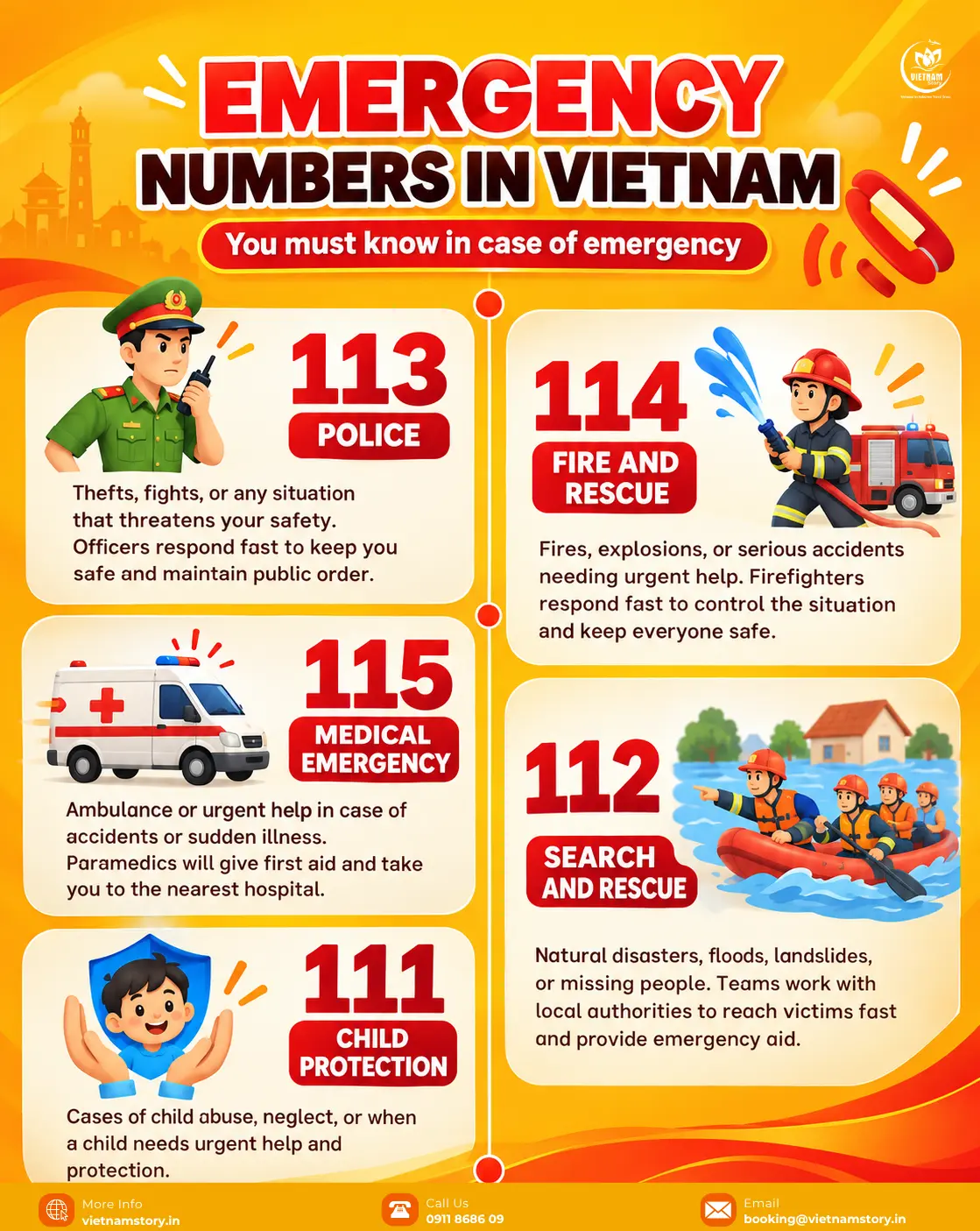
If something goes wrong while travelling in Vietnam, knowing who to contact first is more useful than keeping a long list of hospitals on your phone. For Indian tourists, save these key Vietnam emergency numbers before travelling: Police 113, Fire 114, Ambulance / medical emergency 115, also save your hotel, local guide or tour operator, travel insurer and current Indian consular emergency contacts. A useful sequence is: Immediate danger → emergency services → local assistance → appropriate medical facility → insurer → family/emergency contact. This guide is designed to help you prepare for emergencies while travelling. It is not medical advice.
What should you do first in an emergency?
Start with the urgency of the situation. For an immediate medical emergency, call 115 or ask your hotel, guide or another responsible local contact to help arrange emergency assistance. Call 113 when immediate police assistance is required and 114 for a fire emergency.
If you are travelling on an organised Vietnam tour, contact your local guide or operations team as soon as practical. They may be able to help communicate your location, coordinate transport and identify an appropriate medical facility. Do not spend valuable time comparing hospital reviews online when urgent assistance is needed.
For less urgent problems, you have more time to consider whether a clinic, hospital or other appropriate healthcare provider is the better option.
Emergency contacts are only one part of staying prepared. Before departure, review these Vietnam travel safety tips for Indian travellers so you know how to handle common risks, important documents and unexpected situations during the trip.
Hospital or clinic: Where should tourists go?
There is no single hospital that is automatically the “best hospital in Vietnam for tourists.” The practical choice depends on three questions.
How urgent is the situation?
If emergency assistance appears necessary, use the appropriate emergency service rather than travelling around looking for a preferred clinic.
For a non-emergency medical problem, contacting a clinic or hospital directly may be appropriate.
Where are you?
Healthcare options differ considerably by destination. Hanoi, Da Nang and Ho Chi Minh City provide tourists with more choices than remote mountain regions, rural excursions and islands. If Da Nang is one of your main bases, save our Da Nang hospitals guide for current hospital options, while using 115 first for a medical emergency.
The facility you would use during a Hanoi city stay may therefore be completely different from the practical option during a Ha Giang journey.
What does your travel insurer recommend?
Your insurer may operate an assistance line and have procedures relating to healthcare providers, hospital admission, direct billing or reimbursement.
For non-emergency situations, checking those procedures before treatment can be useful. In an emergency, however, appropriate immediate assistance comes first.
Medical access is also worth considering when building your route, particularly if you are travelling with children or seniors. A well-paced Vietnam itinerary for first-time Indian travellers can reduce unnecessary transfers while keeping major cities and support services within a practical travel plan.
Medical help outside major Vietnamese cities
This is where advance planning becomes more valuable. An itinerary involving Ha Giang, Sapa, the Mekong Delta, islands or an overnight cruise can place you farther from major medical facilities. This becomes particularly important in mountain regions. Travellers comparing Sapa vs Ha Giang should consider road access, trip difficulty and proximity to major services alongside scenery and adventure style.
You do not need to research every hospital along your route. Instead, know: local contact → practical transport option → nearest appropriate medical help → insurer assistance number. Before a remote excursion, ask your tour operator what the escalation process would be if a traveller needed medical attention.
This is particularly useful for families, senior travellers and groups. The objective is not to expect a problem. It is to avoid figuring out the entire response plan for the first time when one occurs.
Can Indian tourists use pharmacies in Vietnam?
Yes. Pharmacies are widely available in major Vietnamese cities and tourist areas but finding a pharmacy and knowing what treatment you need are two different questions.
For ordinary travel needs, a pharmacy may be useful. However, it should not replace appropriate professional medical assessment when a health problem is serious, unusual or worsening.
Indian tourists should also avoid relying only on familiar brand names. If you regularly use a medicine, record its: brand name → generic/active ingredient → dosage. The same Indian brand may not be available in Vietnam, even when an equivalent medicine exists.
Do not assume that a particular product or dosage can simply be substituted without appropriate professional advice.
For stomach-related concerns, prevention should begin before you need a pharmacy. Following basic food safety tips in Vietnam for Indians can help travellers make more careful decisions about water, street food, buffets and unfamiliar dishes during the trip.
Prepare prescription medicines before leaving India
If you regularly take prescription medicine, prepare before flying. Keep a basic medication record containing: medicine name, generic or active ingredient, dosage, prescription or supporting documentation where appropriate and relevant prescribing-doctor information. Keep essential medication accessible in your carry-on rather than putting your entire supply in checked baggage.
Where appropriate, retain original packaging. If medication requires special storage or may be subject to import controls, check the applicable requirements before departure.
Travellers with ongoing medical needs should discuss their travel plans with an appropriate healthcare professional before the trip.
Preparation is equally important when food requirements affect a traveller’s health or comfort. Families with Jain, vegetarian, allergy-related or religious requirements should clarify their dietary restrictions in Vietnam before the itinerary begins rather than explaining them from scratch at every restaurant.
How does travel insurance fit into the plan?
Travel insurance is not useful if the only copy of your policy is buried somewhere in your email.
Before leaving India, check what your policy says about: overseas medical treatment, hospital admission, emergency transport, medical evacuation where applicable, claims documentation. Save the insurer’s emergency assistance number and policy number offline.
If treatment is required, retain relevant documents such as medical reports, prescriptions, invoices and receipts according to your insurer’s requirements. Do not assume a hospital will automatically arrange everything with your insurer and remember the division of responsibilities:
Medical professionals make medical decisions. Your insurer determines what your policy covers. Your guide or tour operator assists with travel logistics and local coordination.
Insurance is only one part of preparing for the journey. Our Vietnam Travel Guide for Indian Travellers covers the wider practical questions around entry requirements, money, connectivity, transport and other essentials to check before leaving India.
Indian Embassy and Consular emergency help
Indian nationals should also save the current Indian consular contacts before travelling. At the time this guide was updated, the Embassy of India in Hanoi publishes: Emergency contact: +84 913 089 165 The Embassy states that this number is also available on WhatsApp.
For travellers in southern Vietnam, the Consulate General of India in Ho Chi Minh City publishes: Emergency contact: +84 917 180 776. Consular assistance is different from medical assistance. The Embassy or Consulate can assist Indian citizens with appropriate consular matters, but it does not replace Vietnam’s emergency or healthcare services.
Because contact information can change, verify the latest details on the official Embassy of India website shortly before departure. This is particularly important if you save your travel information weeks or months in advance.
Create a 60-second Vietnam emergency card
Before flying, create one note on your phone containing:
- Police: 113
- Fire: 114
- Ambulance: 115
- Hotel: name + address + phone
- Local guide/operator: contact number
- Travel insurer: assistance number + policy number
- Indian Embassy/Consulate: current emergency contact
- Medical information: essential medicines + allergies
- Emergency contact in India: name + phone number
Save an offline copy. If you are travelling as a family or group, at least two responsible adults should have the information. Do not keep the entire emergency plan on one person’s phone.
Common emergency-planning mistakes
- Saving a random hospital list. A famous hospital in Ho Chi Minh City is not useful when you are hours away in Northern Vietnam.
- Depending entirely on internet access. Emergency contacts should be available offline.
- Leaving prescription planning until arrival. Bring necessary medication and documentation rather than assuming the same Indian products will be available.
- Confusing consular and medical assistance. The Embassy assists with consular matters; medical professionals and emergency services handle healthcare emergencies.
- Ignoring your insurance procedure. Know whom to contact and which documents your insurer may require.
- Giving all important information to one traveller. Families and groups should have backup copies.
FAQs
What are the main emergency numbers in Vietnam?
For tourists, the key numbers to save are 113 for police, 114 for fire and 115 for ambulance/medical emergencies.
What should an Indian tourist do in a medical emergency?
Seek appropriate emergency assistance first. Contact your guide or local operator as soon as practical, then your insurer once the immediate situation is under control. Use Indian consular assistance when the situation also requires consular help.
Can I find pharmacies in Vietnam?
Yes, particularly in cities and tourist areas. However, the exact Indian medicine or brand you normally use may not be available.
Should I contact my insurer before going to hospital?
For a serious emergency, appropriate immediate assistance comes first. For non-emergency care, contacting the insurer beforehand may help clarify provider and claims procedures.
Should I save hospitals before travelling?
You can save relevant facilities for destinations where you will spend significant time, particularly if you have specific healthcare needs. However, knowing who to contact first is generally more useful than maintaining a long generic hospital list.
Conclusion
Emergency preparation for Vietnam does not need to be complicated. Save 113, 114 and 115. Keep your travel insurance details offline. Prepare prescription information before leaving India. Save your hotel and local operator contacts, and verify the current Embassy or Consulate emergency number before departure. If your itinerary includes cruises, mountain regions or remote excursions, know what the first local escalation step will be.
At Vietnam Story, practical trip planning includes more than hotels and sightseeing. Travellers who prefer to have transport, local coordination and sightseeing arranged within one journey can compare our Vietnam Tour Packages from India after completing their safety and emergency preparation.