
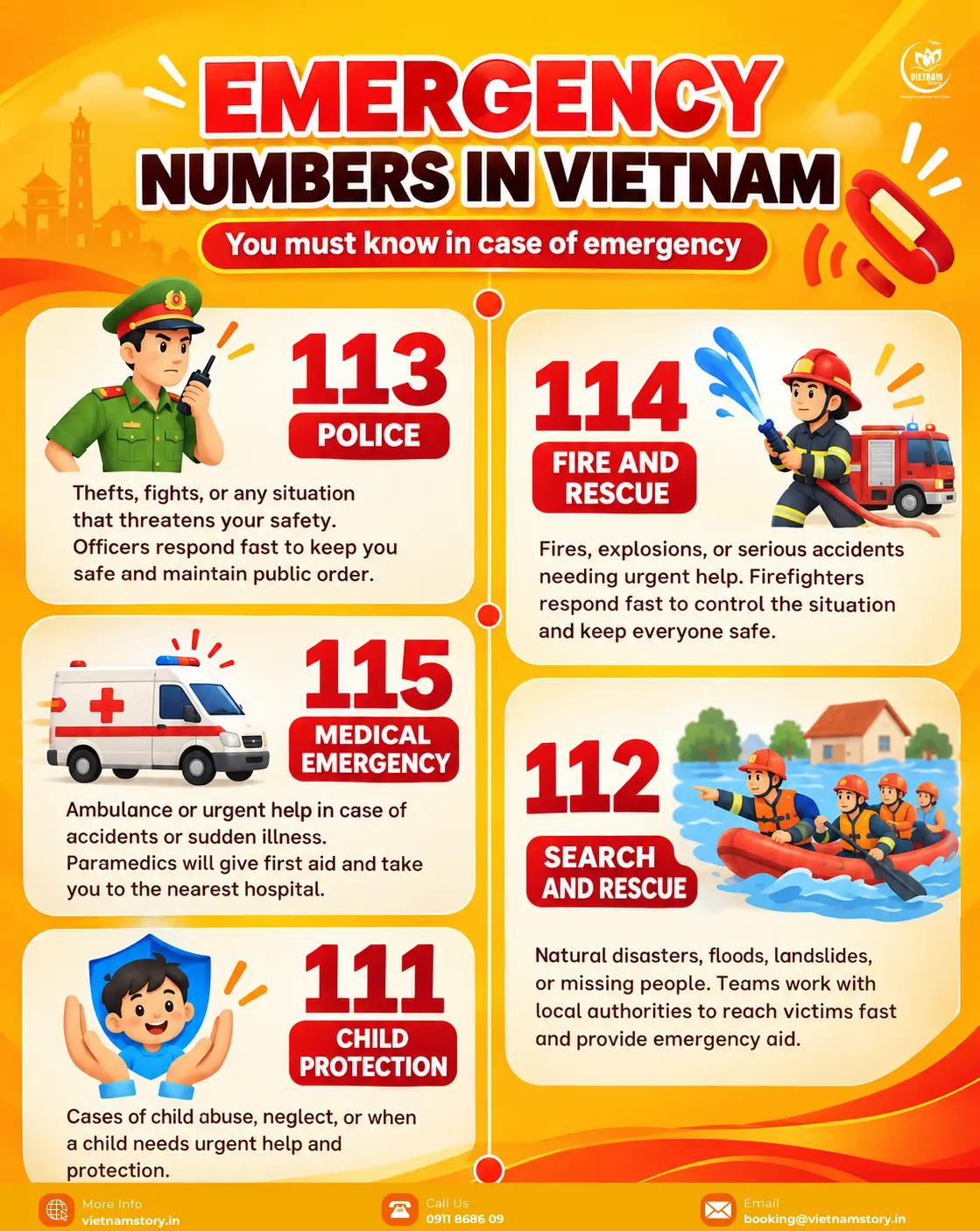
If you need urgent help in Vietnam, call 115 for an ambulance, 113 for police, 114 for fire or 112 for major accidents, disasters and rescue coordination. For Indian visitors, also save your hotel, tour coordinator, insurer and current Embassy/Consulate contacts offline. Vietnamese emergency phone services may operate in Vietnamese: ask a hotel receptionist or local guide to help communicate your exact location, while emergency services are contacted promptly. This is a practical travel-preparation guide, not medical advice.
What should you do first in an emergency?
For an immediate medical emergency, call 115; for police, call 113; for fire, call 114. Vietnam’s national 112 service also receives reports of major accidents, natural disasters and rescue needs, as described by the Vietnam Government’s emergency service notice. Do not postpone urgent local assistance while contacting an insurer or trying to find a preferred hospital. When language is a barrier, give the phone to a Vietnamese-speaking hotel or tour contact if they are available.
If you are travelling with a local operator, contact the on-the-ground coordinator when it is safe and practical. The coordinator can help communicate with drivers, hospitals or insurers, but is not an emergency responder or medical professional. Tell them your hotel or GPS location, nature of the problem, and the local contact number you can answer.
For less urgent problems, you have more time to consider whether a clinic, hospital or other appropriate healthcare provider is the better option.
Emergency contacts are only one part of staying prepared. Before departure, review these Vietnam travel safety tips for Indian travellers so you know how to handle common risks, important documents and unexpected situations during the trip.
Hospital or clinic: Where should tourists go?
There is no single “best tourist hospital” for every destination and emergency. Choose by urgency, location and appropriate capability, not by a generic travel ranking. In an emergency use professional emergency services; for a non-urgent concern you can ask the insurer which facilities they recognise and whether prior authorisation is needed.
How urgent is the situation?
If emergency assistance appears necessary, use the appropriate emergency service rather than travelling around looking for a preferred clinic.
For a non-emergency medical problem, contacting a clinic or hospital directly may be appropriate.
Where are you?
Healthcare options differ considerably by destination. Hanoi, Da Nang and Ho Chi Minh City provide tourists with more choices than remote mountain regions, rural excursions and islands. If Da Nang is one of your main bases, save our Da Nang hospitals guide for current hospital options, while using 115 first for a medical emergency.
The facility you would use during a Hanoi city stay may therefore be completely different from the practical option during a Ha Giang journey.
What does your travel insurer recommend?
Your travel insurer may offer a 24-hour assistance line, specify authorised treatment providers and require documentation for reimbursement. Save the policy number, emergency number and claims instructions offline before leaving India. Do not assume that every hospital offers direct billing or that every activity, including motorbike riding, is covered.
For non-emergency situations, checking those procedures before treatment can be useful. In an emergency, however, appropriate immediate assistance comes first.
Medical access is also worth considering when building your route, particularly if you are travelling with children or seniors. A well-paced Vietnam itinerary for first-time Indian travellers can reduce unnecessary transfers while keeping major cities and support services within a practical travel plan.
Medical help outside major Vietnamese cities
In Sapa, Ha Giang, remote countryside, islands or on an overnight cruise, reaching a major medical facility can require long road or boat transfers. Check the local operator’s contact process and how the group can return to a larger city if necessary. For mountain routes, compare the travel commitment in our Sapa vs Ha Giang route guide before adding days far from major centres.
You do not need to research every hospital along your route. Instead, know: local contact → practical transport option → nearest appropriate medical help → insurer assistance number. Before a remote excursion, ask your tour operator what the escalation process would be if a traveller needed medical attention.
This is particularly useful for families, senior travellers and groups. The objective is not to expect a problem. It is to avoid figuring out the entire response plan for the first time when one occurs.
Can Indian tourists use pharmacies in Vietnam?
Yes. Pharmacies are widely available in major Vietnamese cities and tourist areas but finding a pharmacy and knowing what treatment you need are two different questions.
For ordinary travel needs, a pharmacy may be useful. However, it should not replace appropriate professional medical assessment when a health problem is serious, unusual or worsening.
Indian tourists should also avoid relying only on familiar brand names. If you regularly use a medicine, record its: brand name → generic/active ingredient → dosage. The same Indian brand may not be available in Vietnam, even when an equivalent medicine exists.
Do not assume that a particular product or dosage can simply be substituted without appropriate professional advice.
For stomach-related concerns, prevention should begin before you need a pharmacy. Following basic food safety tips in Vietnam for Indians can help travellers make more careful decisions about water, street food, buffets and unfamiliar dishes during the trip.
Prepare prescription medicines before leaving India
If you regularly take prescription medicine, prepare before flying. Keep a basic medication record containing: medicine name, generic or active ingredient, dosage, prescription or supporting documentation where appropriate and relevant prescribing-doctor information. Keep essential medication accessible in your carry-on rather than putting your entire supply in checked baggage.
Where appropriate, retain original packaging. If medication requires special storage or may be subject to import controls, check the applicable requirements before departure.
Travellers with ongoing medical needs should discuss their travel plans with an appropriate healthcare professional before the trip.
Preparation is equally important when food requirements affect a traveller’s health or comfort. Families with Jain, vegetarian, allergy-related or religious requirements should clarify their dietary restrictions in Vietnam before the itinerary begins rather than explaining them from scratch at every restaurant.
How does travel insurance fit into the plan?
Travel insurance is not useful if the only copy of your policy is buried somewhere in your email.
Before leaving India, check what your policy says about: overseas medical treatment, hospital admission, emergency transport, medical evacuation where applicable, claims documentation. Save the insurer’s emergency assistance number and policy number offline.
If treatment is required, retain relevant documents such as medical reports, prescriptions, invoices and receipts according to your insurer’s requirements. Do not assume a hospital will automatically arrange everything with your insurer and remember the division of responsibilities:
Medical professionals make medical decisions. Your insurer determines what your policy covers. Your guide or tour operator assists with travel logistics and local coordination.
Insurance is only one part of preparing for the journey. Our Vietnam Travel Guide for Indian Travellers covers the wider practical questions around entry requirements, money, connectivity, transport and other essentials to check before leaving India.
Indian Embassy and Consular emergency help
Indian travellers should save the current Embassy of India in Hanoi contact page. As published on that official page, its emergency telephone number is +84 913 089 165; verify it again before departure. Consular staff can advise on emergency travel documents and other consular matters but do not replace Vietnamese ambulance, police or hospital services.
For Southern Vietnam, keep the contact details of the Consulate General of India in Ho Chi Minh City alongside the Hanoi Embassy’s numbers; consult its current official website before departure rather than relying on a saved number from an old travel blog. If you lose your Indian passport, the Embassy’s Emergency Certificate instructions call for a police report, an application to the Embassy and immigration arrangements before departure. Do not assume a replacement travel document can be issued instantly.
Because contact information can change, verify the latest details on the official Embassy of India website shortly before departure. This is particularly important if you save your travel information weeks or months in advance.
What if an Indian passport is lost in Vietnam?
Report the loss to the local police and request the documentation required by the Indian Embassy. The Embassy’s current Emergency Certificate instructions explain the application, supporting documents and the need to work with Vietnam Immigration on permission to depart. Contact the consular office for guidance, tell the airline your documents may change and do not assume you can travel internationally on a police report alone.
Create a 60-second Vietnam emergency card
Create one offline note on at least two travellers’ phones containing the local emergency numbers (112, 113, 114, 115), your hotel address in Vietnamese, local guide or driver, flight and passport details, Embassy/Consulate contacts, insurer policy and emergency line, and essential medical or allergy information only as appropriate and with the traveller’s consent.
- Police: 113
- Fire: 114
- Ambulance: 115
- Hotel: name + address + phone
- Local guide/operator: contact number
- Travel insurer: assistance number + policy number
- Indian Embassy/Consulate: current emergency contact
- Medical information: essential medicines + allergies
- Emergency contact in India: name + phone number
Save an offline copy. If you are travelling as a family or group, at least two responsible adults should have the information. Do not keep the entire emergency plan on one person’s phone.
Common emergency-planning mistakes
- Saving a random hospital list. A famous hospital in Ho Chi Minh City is not useful when you are hours away in Northern Vietnam.
- Depending entirely on internet access. Emergency contacts should be available offline.
- Leaving prescription planning until arrival. Bring necessary medication and documentation rather than assuming the same Indian products will be available.
- Confusing consular and medical assistance. The Embassy assists with consular matters; medical professionals and emergency services handle healthcare emergencies.
- Ignoring your insurance procedure. Know whom to contact and which documents your insurer may require.
- Giving all important information to one traveller. Families and groups should have backup copies.
FAQs
What are the main emergency numbers in Vietnam?
Save 112 for disaster/accident/rescue coordination, 113 for police, 114 for fire and 115 for ambulance/medical emergencies. According to official UK travel advice, these lines operate in Vietnamese, so ask your hotel or Vietnamese-speaking guide for help explaining the location if necessary.
What should an Indian tourist do in a medical emergency?
Seek appropriate emergency assistance first. Contact your guide or local operator as soon as practical, then your insurer once the immediate situation is under control. Use Indian consular assistance when the situation also requires consular help.
Can I find pharmacies in Vietnam?
Yes, particularly in cities and tourist areas. However, the exact Indian medicine or brand you normally use may not be available.
Should I contact my insurer before going to hospital?
For a serious emergency, appropriate immediate assistance comes first. For non-emergency care, contacting the insurer beforehand may help clarify provider and claims procedures.
Should I save hospitals before travelling?
You can save relevant facilities for destinations where you will spend significant time, particularly if you have specific healthcare needs. However, knowing who to contact first is generally more useful than maintaining a long generic hospital list.
Conclusion
Prepare before leaving India: save 112, 113, 114 and 115; share hotel and local operator contacts across the group; keep insurance details and relevant prescriptions offline; verify Indian consular contacts; and know whom to call first during a cruise or remote excursion. The goal is a practical response plan, not to memorise hospital rankings.
Planning a Vietnam holiday from India with children, seniors or remote excursions? Compare Vietnam tour packages from India and tell Vietnam Story your departure city, trip dates, group size, preferred pace, routes and any mobility or dietary requirements. Ask us to clarify local transport and supplier coordination in a written proposal. A tour operator may help with logistics; emergency healthcare, insurance cover, medical evacuation and specialist assistance are not automatically included and must be confirmed with the relevant provider.