

A Vietnam trip from India can be relatively affordable or significantly more expensive depending on how long you travel, which route you choose and how much is already included in your booking. For most Indian travellers, the biggest differences in the final budget come from international flights, hotel category, domestic flights, route complexity and whether the trip is booked as a land package or planned independently.
At Vietnam Story, we recommend separating the land-package price from the total trip cost from India. This makes it much easier to compare options without accidentally counting hotels, transfers, sightseeing or meals twice.
Use this guide to understand how the cost is calculated, choose a suitable trip duration, see how your route changes the budget and decide whether a package or DIY trip better suits the way you want to travel.
Planning note: Flights, hotels and travel-service prices change by date and availability. Use the individual tour details and your final written quotation as the source of truth before payment.

Vietnam Trip Cost From India at a Glance
There are two practical ways to budget a Vietnam holiday from India: start with a land package and add the expenses outside it, or build the entire trip independently as a DIY journey.
| Booking model | How the budget works | Best suited to |
|---|---|---|
| Land package | Start with the package price, then add flights and services not included in the quotation. | Travellers who want coordinated hotels, transfers and sightseeing. |
| DIY | Calculate flights, hotels, transport, meals and activities separately. | Travellers comfortable managing each booking independently. |
A land-package price is not automatically the total Vietnam trip cost from India. Depending on the selected itinerary, international flights, visa fees, domestic flights, optional activities and some meals may remain separate.
Already Know How Many Days You Want to Spend in Vietnam?
If your approximate duration is already decided, it is useful to look at the commercial options before calculating every expense separately. This helps you understand which hotels, transfers and sightseeing services may already be bundled into the land portion of the trip.
You can compare Vietnam tour packages from India first, then use the duration and route guidance below to narrow down the trip that best fits your time and priorities.
Package vs DIY: How Should You Calculate the Trip?
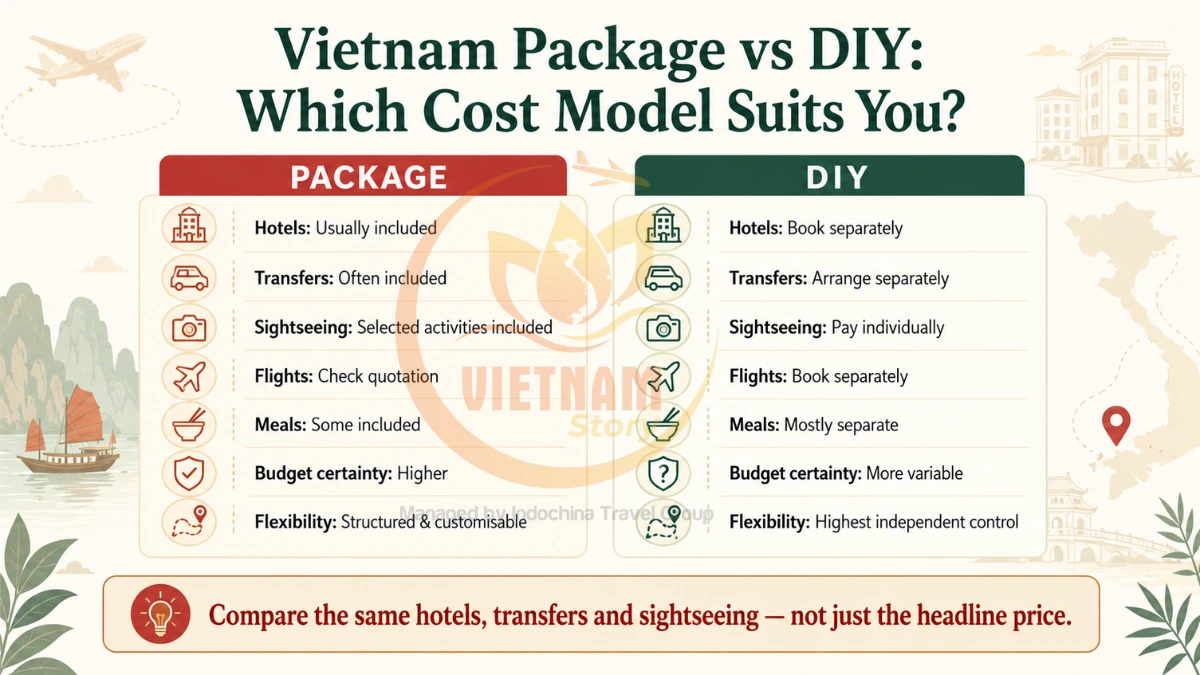
One of the easiest ways to create an unrealistic budget is to mix package costs with DIY expenses. The two booking models should be calculated separately.
If You Book a Vietnam Land Package
Estimated Total Trip Cost = International Flights + Land Package + Domestic Flights Not Included + Visa + Meals Not Included + Optional Activities + Insurance + Personal Expenses
If your package already contains the hotel, airport transfers, sightseeing or selected meals, keep those services inside the package total instead of adding them again.
If You Plan Vietnam Independently
Estimated Total Trip Cost = International Flights + Hotels + Intercity Transport + Local Transport + Visa + Meals + Activities + Insurance + Personal Expenses
With DIY travel, each component needs to be budgeted independently because no single quotation bundles the services together.
A more useful comparison: compare options with a similar hotel standard, route, transport and sightseeing scope rather than choosing only by the lowest headline price.
Package vs DIY at a Glance
| Factor | Package | DIY |
|---|---|---|
| Hotels | Usually bundled in the confirmed itinerary | Booked separately |
| Transfers | Often included for confirmed services | Arranged separately |
| Sightseeing | Selected activities may be included | Paid individually |
| Flights | Check the quotation | Booked separately |
| Meals | Some may be included | Mostly separate |
| Budget certainty | Higher once the quotation is confirmed | More variable across separate bookings |
| Flexibility | Structured but customisable | Highest independent control |
How Trip Duration Changes Your Vietnam Budget
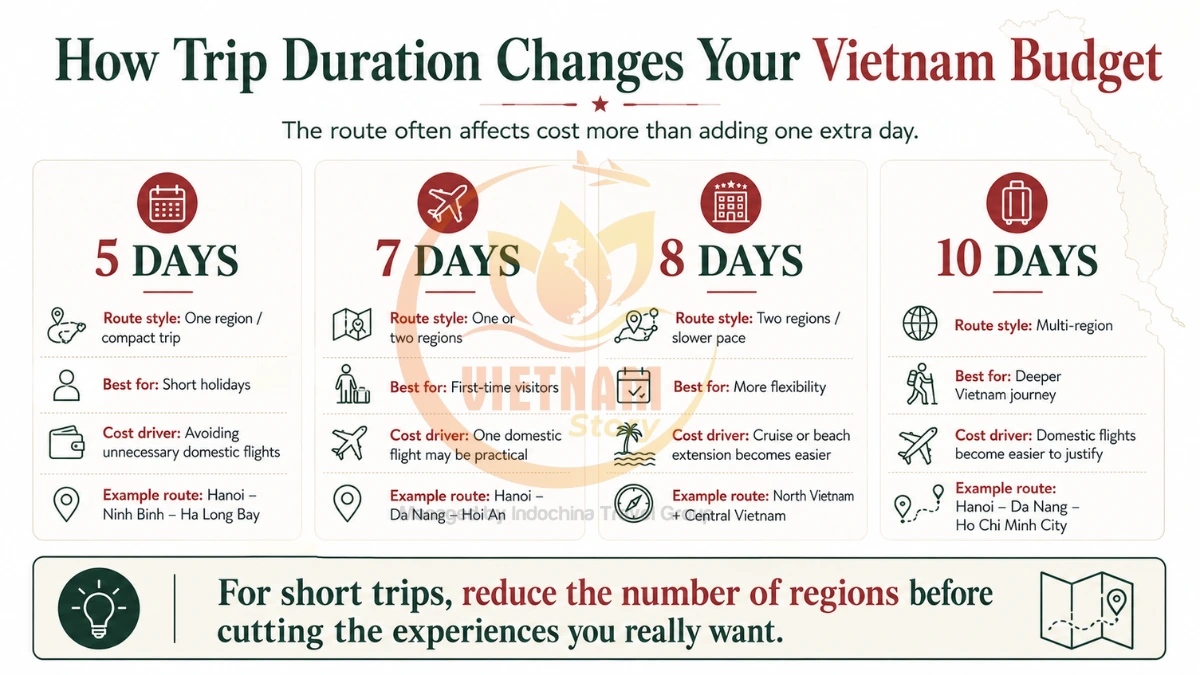
Trip length changes the number of hotel nights and sightseeing days, but the route often affects the budget even more. Adding another region can mean another domestic flight, airport transfers and hotel change, while adding one extra night in the same destination may have a much smaller effect.
5 Days: Keep the Route Focused
For most Indian travellers with five days, we recommend concentrating on one region rather than trying to cover Vietnam from north to south.
Routes such as Hanoi–Ninh Binh–Ha Long Bay, Da Nang–Hoi An or Phu Quoc can work well because they reduce unnecessary airport movement and leave more usable time for the trip itself. If Phu Quoc is the one-region option you are considering, use our Phu Quoc Trip Cost From India guide for the island-specific budget, then the Phu Quoc travel guide for zones and trip length.
Compare 5-day Vietnam packages
7 Days: A Practical First-Trip Duration
Seven days is often the first duration where combining two regions becomes practical without sacrificing too much sightseeing time. Travellers can still choose one region in more depth or introduce a domestic flight when the arrival and departure schedule makes sense.
Compare 7-day Vietnam packages
8 Days: More Flexibility Without Rushing
An extra day becomes valuable when you want to add an overnight Ha Long Bay cruise, combine two regions or include some beach time without compressing transfers into an already busy itinerary.
Compare 8-day Vietnam packages
10 Days: Better for Multi-Region Vietnam
With ten days, domestic flights become easier to justify because they can open up a North–Central–South journey without turning most of the holiday into transfer time. This duration is also more suitable for beach extensions or a slower multi-region trip.
Compare 10-day Vietnam packages
Why Your Vietnam Route Changes the Budget
Two Vietnam holidays with the same number of days can have very different total costs. The difference often comes from domestic flights, airport transfers, hotel changes and the type of experiences included.
One-Region Route
Example: Hanoi – Ninh Binh – Ha Long Bay.
A one-region itinerary can reduce domestic flights, airport transfers and hotel changes while leaving more time for sightseeing. This is often the better structure for a short first trip.
Two-Region Route
Example: Hanoi – Da Nang – Hoi An.
Moving to a second region usually introduces a domestic flight or longer intercity journey, another transfer and a second hotel base. You gain destination variety, but the cost structure also becomes more complex.
Three-Region Route
Example: Hanoi – Da Nang – Ho Chi Minh City.
A three-region itinerary gives you a broader view of Vietnam but generally works better when you have more time. For shorter trips, we usually recommend reducing the number of regions before reducing the hotel quality or experiences that matter most to you.
Plan Your Vietnam Budget by Cost Component
Use the overall trip-cost guide as the hub, then open the component that is actually changing your budget. This keeps flights, food, transport, visa and payment planning separate instead of mixing them into one daily average.
Detailed Breakdown of Vietnam Trip Costs From India
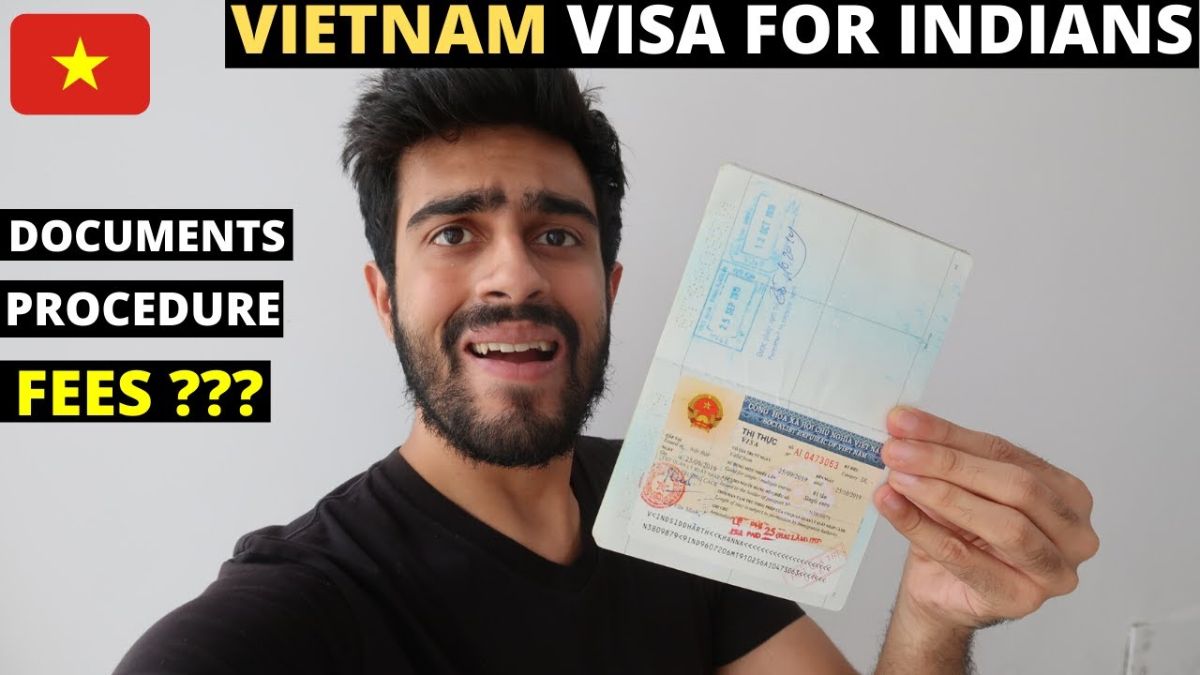
1. Vietnam eVisa Fees for Indian Travellers
Vietnam’s official electronic visa system states that a Vietnam eVisa can be valid for up to 90 days and can be issued for single or multiple entry.
- Single-entry eVisa: US$25.
- Multiple-entry eVisa: US$50.
Treat the visa fee as a separate trip expense unless your written quotation specifically states that a visa-related service is included.
Before travelling, verify the current rules through the official Vietnam eVisa portal.
Source checked: Vietnam National Electronic Visa System.
Last verified: 12 August 2026.
For the application itself, use the dedicated eVisa guidance rather than treating visa cost as part of a generic daily budget.
2. International Flights From India
International airfare is usually one of the biggest variables in the total Vietnam trip cost from India.
What you pay can change according to:
- your departure city in India;
- your arrival city in Vietnam;
- direct or connecting flights;
- airline and baggage allowance;
- travel dates and demand;
- how far ahead you book;
- whether you return from the same Vietnamese city.
For this reason, we do not recommend applying one permanent national airfare estimate to every traveller. The flight structure from Delhi can be very different from Mumbai, Kolkata, Bengaluru or another Indian departure city.
Budgeting tip: Keep international flights as a separate line item unless your selected package and written quotation clearly state that they are included.
3. Accommodation: What Are You Actually Paying For?
A hotel price only becomes useful for budgeting when the calculation basis is clear. Check whether the amount is per room, per person, per night or per stay.
Accommodation costs can change according to:
- destination;
- hotel category;
- room type;
- twin, double, triple or single occupancy;
- travel dates;
- child and extra-bed policy;
- breakfast inclusion;
- holiday or resort surcharges;
- number of hotel nights versus cruise nights.
For package travellers: if the confirmed land package already includes your hotel, keep that accommodation inside the package total rather than adding it again.
For DIY travellers: calculate each hotel stay separately and confirm exactly what the displayed rate includes.
4. Local and Intercity Transport
Transport is easier to budget when you separate movement inside a destination from travel between different destinations.
Local transport may include airport transfers, taxis, ride-hailing services and short city transfers.
Intercity transport may include domestic flights, trains, sleeper buses and long-distance private transfers.
For example, Hanoi–Da Nang–Ho Chi Minh City has a very different transport structure from Hanoi–Ninh Binh–Ha Long Bay, even when the total number of travel days is similar.
If airport transfers, sightseeing vehicles or selected intercity services are already included in your land package, keep them inside the package cost rather than adding them again.
For transport planning, compare the route, number of airport transitions and intercity sectors rather than relying on one transport allowance for every itinerary.
5. Food and Dining
Food spending varies considerably between travellers. Someone eating mainly local Vietnamese meals will have a different daily budget from a traveller choosing Indian restaurants, premium dining or specialised Jain meals.
Before creating a separate food allowance, first check how many meals are already included in your itinerary. A land package may include breakfast and selected lunches or dinners, depending on the confirmed programme.
For Indian, vegetarian or Jain meal requirements, we recommend discussing the exact requirement during trip planning because availability can differ by destination, hotel, restaurant and supplier.
6. Sightseeing, Cruises and Activities
Sightseeing costs depend more on what you choose to do than on a generic daily activity allowance.
A museum visit, Ba Na Hills programme, overnight Ha Long Bay cruise, theme park or Phu Quoc island tour all have different price structures and inclusions.
When reviewing a package, check whether it already includes:
- entrance tickets;
- sightseeing transfers;
- English-speaking guide;
- boat trip or cruise;
- meals attached to the activity.
For DIY travel, it is more useful to calculate the major paid experiences individually than to apply one broad sightseeing figure to every day.
7. SIM, eSIM and Connectivity
SIM and eSIM plans change according to provider, data allowance and validity. Instead of relying on an old fixed INR estimate, check the available plans shortly before travelling.
Mobile data is particularly useful for navigation, ride-hailing, messaging, online tickets and contacting hotels or tour providers while travelling between destinations.
8. Insurance and Personal Spending
Keep insurance and personal expenses outside the core land-package comparison unless they are clearly listed as included in the quotation.
Additional spending can include travel insurance, tips, shopping, drinks, laundry, optional activities, baggage charges, early check-in, late check-out and services added after the itinerary is confirmed.
Shopping should not be treated as a compulsory fixed trip cost because it varies entirely by traveller.
Vietnam Currency and Payments for Indian Travellers
Vietnam uses the Vietnamese Dong (VND). Exchange rates move continuously, so a fixed INR-to-VND conversion published months earlier should not be used as the basis for your complete trip budget.
Before travelling, check the current exchange rate together with any international card or ATM charges that may apply. It is also practical to carry some VND for smaller businesses, markets and cash-based purchases.
Use the dedicated payment guidance for cash, cards and payment-method decisions rather than treating currency conversion as a fixed part of the trip budget.

How Traveller Type Changes Your Budget
The same itinerary can produce a different per-person cost depending on who is travelling and how accommodation and private services are shared.
| Traveller type | Typical cost effect | Why |
|---|---|---|
| Solo | Usually higher per person | Room and some private-service costs are not shared. |
| Couple | Main comparison benchmark | Twin-sharing allows accommodation cost to be shared between two adults. |
| Family | Depends on child ages and room setup | Child policy, extra beds and number of rooms change the quotation. |
| Group | Requires quotation | Vehicle, guide and some service costs may be shared across more travellers. |
When Vietnam Story plans a family itinerary, the actual ages of the children and required room arrangement matter because hotel, cruise and airfare policies can change the final quotation significantly.
Does Your Departure City Change the Vietnam Trip Cost?
Yes. Your departure city in India mainly affects international airfare, direct-flight availability, connection options and flight timing.
A traveller from Delhi should not automatically use the same flight assumptions as someone departing from Mumbai, Kolkata, Bengaluru or another Indian city.
If you are departing from Ahmedabad, use our Vietnam trip cost from Ahmedabad guide for the AMD-specific flight, gateway and land-package calculation.
If you are departing specifically from Delhi, use our Vietnam tour cost from Delhi guide for city-specific budget planning.
For flight routes, airport choices and connection planning, continue to how to reach Vietnam from Delhi.
This page remains the national cost-and-package planning guide for travellers departing from India generally.
GST, TCS and What Your Quotation Actually Includes
Two travel quotations can show similar headline prices while covering different services. The better comparison is therefore the complete scope of the quotation, not only the first number shown.
When reviewing a quotation, check how it treats:
- GST;
- TCS;
- hotel taxes and surcharges;
- international flights;
- domestic flights;
- cruise supplements;
- private or shared transfers;
- entrance tickets;
- included meals;
- visa-related services;
- insurance;
- other exclusions.
For a Vietnam Story booking, use the final written itinerary and quotation as the source of truth for the hotel, room type, transfers, sightseeing, meals and other services confirmed for your trip.
How to Save Money Without Making the Trip Worse
The most useful savings usually come from improving the structure of the trip rather than choosing the cheapest option in every category.
- Choose fewer regions on a short trip. Adding another city is not always better value if it requires another flight and several hours of airport time.
- Check package inclusions before adding extra costs. A transfer, hotel night or attraction ticket that is already included should stay inside the package total.
- Use flight timings that protect sightseeing days. A cheaper flight may be poor value when it removes most of your first or last day.
- Compare room arrangements correctly. Twin-sharing, triple occupancy and solo rooms produce different per-person costs.
- Choose the cruise format that fits the itinerary. A day cruise and an overnight cruise affect hotel nights, transfers and the overall pace differently.
- Compare the complete quotation. A lower headline price can become less attractive once essential excluded services are added.
- Keep the experiences that matter most. Remove low-priority inclusions before cutting the parts of Vietnam you are actually travelling to experience.
Frequently Asked Questions About Vietnam Trip Cost From India
How much does a Vietnam trip from India cost?
There is no single fixed amount that applies to every traveller. The final cost depends on airfare, duration, route, hotel level, domestic transport and whether you book a land package or arrange the trip independently. For a reliable calculation, start with one booking model and add only the services that remain outside it.
What is usually not included in a Vietnam land-package price?
Depending on the selected package, international flights, visa fees, domestic flights, optional activities, some meals, insurance and personal expenses may remain separate. The individual itinerary and final written quotation should confirm the exact scope.
Is a Vietnam package cheaper than DIY travel?
Not necessarily. A package may bundle hotels, transfers, sightseeing and guides, while DIY travel offers greater independent control. Compare the same route, hotel standard and service scope before deciding which option gives you better value.
Are international flights included in Vietnam tour packages?
They may or may not be included. Check the selected itinerary and final quotation instead of assuming that the displayed land-package price includes flights from India.
How much is the Vietnam eVisa for Indian travellers?
Vietnam’s official eVisa system currently lists US$25 for a single-entry eVisa and US$50 for a multiple-entry eVisa. An eVisa can be valid for up to 90 days depending on the approved application.
Is five days enough for Vietnam?
Yes, when you focus on one region or a compact route. Five days is generally too short for a comfortable North–Central–South journey.
Is seven or eight days better for a first Vietnam trip?
For many first-time travellers, seven to eight days creates a better balance because two regions can be combined without compressing every sightseeing day.
Does travelling from Delhi change the cost?
Yes. Flight availability, schedules and airfare differ by departure city, which is why Delhi-specific flight and cost planning is handled separately from this national India guide.
Should a family use the same per-person estimate as a couple?
No. Family pricing depends on the ages of the children, airfare rules, room configuration, extra beds and hotel child policies. A quotation using the family’s actual details is more reliable.
Get a Vietnam Trip Cost Estimate for Your Travel Plan
A useful trip-cost estimate needs your actual travel details rather than a generic national average.
Share your:
- departure city in India;
- travel dates;
- number of travellers;
- ages of children, if any;
- preferred trip duration;
- Vietnam route or must-see destinations;
- hotel category;
- room-sharing arrangement;
- vegetarian, Indian or Jain meal requirements;
- private or shared-service preference.
Vietnam Story’s Vietnam-based planning team can use these details to prepare a proposed itinerary and written quotation showing what is included in the land package and which expenses remain separate.
Request My Vietnam Cost & Itinerary