
Vietnam or Thailand? For Indian travellers planning a first Southeast Asian holiday, both can work well – but they often suit different kinds of trips. The useful question is not: “Which country is better?” Ask instead: “Which country better matches the holiday I want to take?” Vietnam is particularly interesting when you want culture, landscapes, heritage, cities and perhaps a beach within one multi-region journey. Thailand can make sense when beaches, islands, resorts and city-plus-beach combinations are central to the holiday.
A quick comparison between two countries
| Factor | Vietnam | Thailand |
| Route style | Often multi-region and linear | Often city/hub + beach/island |
| Culture & heritage | Strong route component | Strong, but route-dependent |
| Beaches | Da Nang, Phu Quoc and others | Extensive beach/island choice |
| Landscapes | Limestone, mountains, caves, coast | Islands, mountains, national parks |
| Indian food | Easy in major cities; plan ahead elsewhere | Strong presence in major tourism centres |
| Visa | Indian travellers generally need an appropriate visa | Check current Indian-passport rules before travel |
| Best fit | Travellers wanting contrast across regions | Travellers wanting beach/resort-led combinations |
This is a decision framework – not a scorecard.
Vietnam vs Thailand: Which Costs Less?
There is no reliable universal answer to Thailand vs Vietnam cost. The biggest mistake is comparing 1 hotel room in Bangkok with 1 in Hanoi and deciding which country is cheaper.
Compare the complete trip:
- For Vietnam, that may mean: India flights + visa + hotels + Hanoi–Da Nang flight + transfers + Ha Long cruise + sightseeing + meals.
- A Thailand trip might involve: India flights + hotels + Bangkok + domestic flight/ferry + island resort + activities + meals.
A focused Vietnam trip can be excellent value, but a route covering North, Central and South adds domestic transport.
Similarly, a simple Bangkok-plus-one-beach Thailand holiday can control transport costs, while an island-heavy itinerary with premium resorts and several transfers can cost considerably more.
For a realistic Vietnam budget, our Vietnam trip cost from India guide breaks the calculation into flights, accommodation, internal transport, sightseeing and food rather than relying on one misleading daily figure.
The useful comparison is therefore: same dates + similar hotel level + similar number of nights + actual route + actual activities. Only then does “cheaper” mean anything.
Visa: Check current rules, Not last year’s advice
Visa rules are one part of this comparison that should always be checked close to travel.
For Vietnam, Indian passport holders normally need an appropriate visa. The official Vietnam electronic visa system currently lists an application fee of US$25 for single entry and US$50 for multiple entry.
Thailand’s entry arrangements have changed several times in recent years, including another revision effective in September 2026. For that reason, we would not choose between Vietnam and Thailand based on a visa rule remembered from an old trip, reel or blog post.
Before purchasing non-refundable travel services: check the official immigration/consular source → confirm your passport category → check permitted stay → verify any entry conditions. Treat visa convenience as one planning factor, not the entire holiday decision.
Food: Think beyond “Can I find Indian restaurants?”
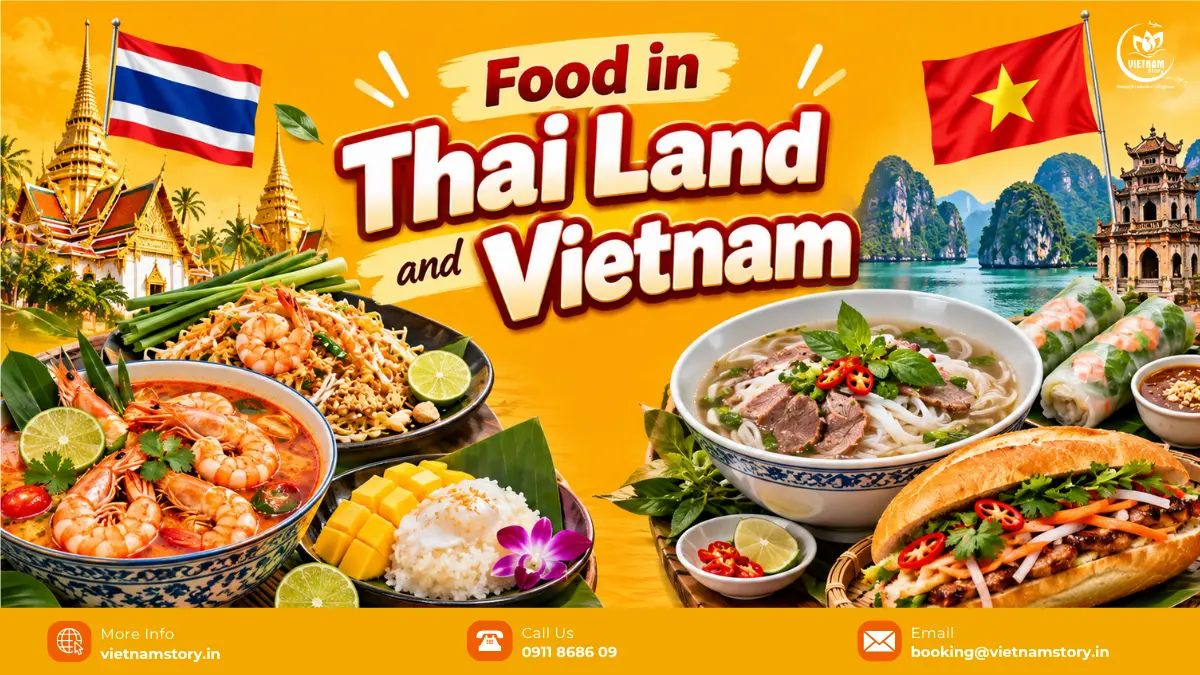
Indian food is available in the major tourism centres of both countries but for a Vietnam itinerary, the more useful question is: Where will I be at mealtimes?
Hanoi, Da Nang and Ho Chi Minh City offer considerably more flexibility than a cruise, remote mountain stay or excursion day. At Vietnam Story, we therefore use major cities as food anchors and plan more carefully around travel-heavy sections.
Our Vietnam itinerary with Indian food options shows how Hanoi, Da Nang, Hoi An and Ho Chi Minh City can provide familiar-meal flexibility while excursions such as Ha Long Bay or Ninh Binh are planned in advance. Vegetarian and Jain travellers should also avoid treating those requirements as interchangeable. “No meat” does not automatically communicate Jain requirements concerning onion, garlic, root vegetables or preparation.
Thailand also has established Indian dining options in major tourist areas, but dietary requirements should still be checked at the actual hotel, restaurant or resort you intend to use.
Choose the route first, then check whether your food requirements work throughout that route – not only in the arrival city.
Route style is the bigger difference
This is where Vietnam or Thailand from India becomes a more interesting comparison. A classic first Vietnam journey might progress: Hanoi → Ha Long Bay/Ninh Binh → Da Nang/Hoi An → Ho Chi Minh City The experience changes as you travel.
Hanoi introduces Northern culture and street life. Ninh Binh and Ha Long Bay add limestone landscapes. Central Vietnam brings Hoi An heritage and Da Nang beaches. Ho Chi Minh City introduces a different urban atmosphere in the South.
Thailand can be structured differently, including city-plus-beach or island combinations. Neither route structure is inherently better. Vietnam becomes particularly appealing when progression and contrast are part of what you want from the holiday.
If that sounds like your travel style, start with our Vietnam itinerary for first-time Indian travellers before choosing individual hotels or attractions. It compares realistic regional combinations according to the number of days available.
What if you only have 5 – 7 days?
This changes the decision significantly. Do not assume that choosing Vietnam means you need to see the whole country. With 6 or 7 days, Vietnam works much better when geographically focused. For example: North: Hanoi + Ninh Binh + Ha Long Bay or North + Central: Hanoi/Ha Long Bay + Da Nang/Hoi An. Trying to cover Hanoi, Da Nang and Ho Chi Minh City simply because they are famous can turn a short holiday into airports, check-ins and luggage handling.
Our Vietnam 7 day itinerary explains how two well-connected regions can provide a more balanced first trip than trying to cover North, Central and South in one week.
The same principle applies to Thailand: adding multiple islands and transfers can make an apparently relaxing holiday surprisingly transport-heavy. For either country: fewer well-connected destinations usually beat a longer checklist.
Beaches: Decide whether they are the holiday or part of it
Thailand has a large and mature beach-and-island tourism offering. If your ideal holiday revolves mainly around: resort → beach → island time → nightlife → relaxation. Thailand is clearly relevant to your shortlist.
Vietnam offers a different route proposition. Da Nang can add beach downtime while keeping Hoi An and Central Vietnam heritage close by. Phu Quoc can become an island finish after a city or multi-region journey.
So instead of asking which country has the “better beach”, ask: Is the beach the purpose of my holiday, or one chapter of a wider trip? That distinction can make the decision much easier.
Nature and culture: What kind of variety do you want?
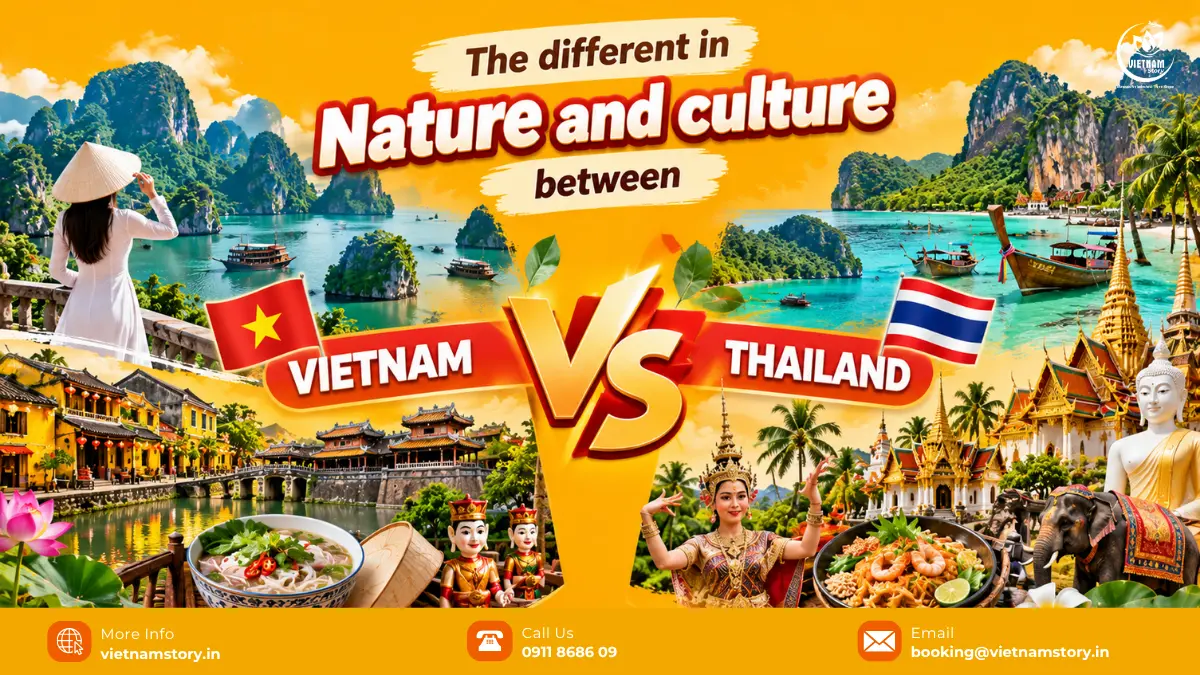
Vietnam’s geography makes contrasting landscapes relatively easy to combine conceptually within one longer journey.
You might move between: Hanoi streets → Ninh Binh limestone scenery → Ha Long Bay → Hoi An heritage → Central Vietnam coast. Longer journeys can add mountain regions or Southern Vietnam.
Thailand also offers substantial natural and cultural diversity, from cities and historical sites to mountains, national parks and tropical islands.
Again, the useful comparison is not which country has “more”. It is which landscapes and experiences naturally fit your available days.
A practical Vietnam vs Thailand decision framework
| If your priority is… | Think about… |
| City + beach/island holiday | Thailand route may fit naturally |
| Culture + landscapes + heritage | Vietnam route may fit naturally |
| Resort-heavy relaxation | Compare Thailand beach options |
| Linear multi-region journey | Explore Vietnam |
| Limestone and mountain scenery | Explore Vietnam |
| Only 5–6 days | Keep either country geographically focused |
| 7 days in Vietnam | Usually limit the route to one or two regions |
| 8–10 days + contrasting experiences | Vietnam offers more room for a multi-region route |
| Strict dietary requirements | Compare meals along the actual itinerary |
| Budget is the deciding factor | Price the complete trip, not one hotel or flight |
If the Vietnam side of this table matches your travel style, compare Vietnam tour packages from India only after deciding how many regions genuinely fit your available days. The package should support the route—not dictate it.
FAQs
Is Vietnam better than Thailand for Indians?
Neither is universally better. Vietnam may fit travellers looking for a multi-region journey combining culture, landscapes and heritage, while Thailand may fit travellers whose holiday is more strongly centred on resorts, beaches and islands. Your available days, current entry rules, budget and food requirements should influence the choice.
Which is cheaper: Thailand or Vietnam?
There is no universal winner. Compare the total trip for your dates, including international flights, accommodation, visas where applicable, domestic transport, activities and food. Route complexity can change the result substantially.
Is Indian food easily available in Vietnam?
Indian food is readily available in major tourism centres such as Hanoi, Da Nang and Ho Chi Minh City. Cruises, mountain areas and remote excursions require more planning. Vegetarian and Jain requirements should be communicated specifically.
How many days are enough for Vietnam?
Five to seven days can work well when you focus geographically. Around 8–10 days gives you more freedom to combine contrasting regions without making every second day a major transfer.
Should first-time travellers choose Vietnam or Thailand?
Start with the experience you want rather than the country name. If you want a beach- or resort-led holiday, explore Thailand routes. If you want several contrasting cultural and landscape experiences connected within one journey, explore Vietnam routes.
Conclusion
The most useful way to compare Vietnam vs Thailand for Indian travellers is to stop looking for an overall winner. Your ideal choice can change from one holiday to another. Thailand may fit a trip where islands, resorts and beach time dominate. Vietnam may fit a journey where you want to move from Hanoi’s streets to limestone landscapes, Hoi An heritage and perhaps a beach ending. If Vietnam matches that travel style, explore our Vietnam tour packages from India to compare routes by duration, region and travel style rather than choosing a package only by headline price.
At Vietnam Story, we would make the decision in this order: available days → desired experiences → realistic route → food requirements → total trip cost → current entry requirements. Then choose the country whose route naturally delivers the holiday you actually want.