
Ba Trai Dao (Three Peaches) is a group of limestone islets and tidal beaches in Lan Ha Bay, off Cat Ba Island. The distinctive three-islet scenery is worth noticing on a route that passes the area. But a boat passing Ba Trai Dao, a permitted beach landing, swimming and kayaking are four different things. Do not assume that buying a “Three Peaches” cruise includes all of them.
The practical question in 2026 is whether a licensed vessel can include the area on your date, and what guests are actually allowed to do when they arrive. Some operators still advertise swimming at Ba Trai Dao; others have changed their programmes or describe access as conditional. Recent destination references also note past restrictions on landing. For a Vietnam Story itinerary, we would confirm the exact stop and permitted activities with the named boat operator before presenting Ba Trai Dao as a beach day.
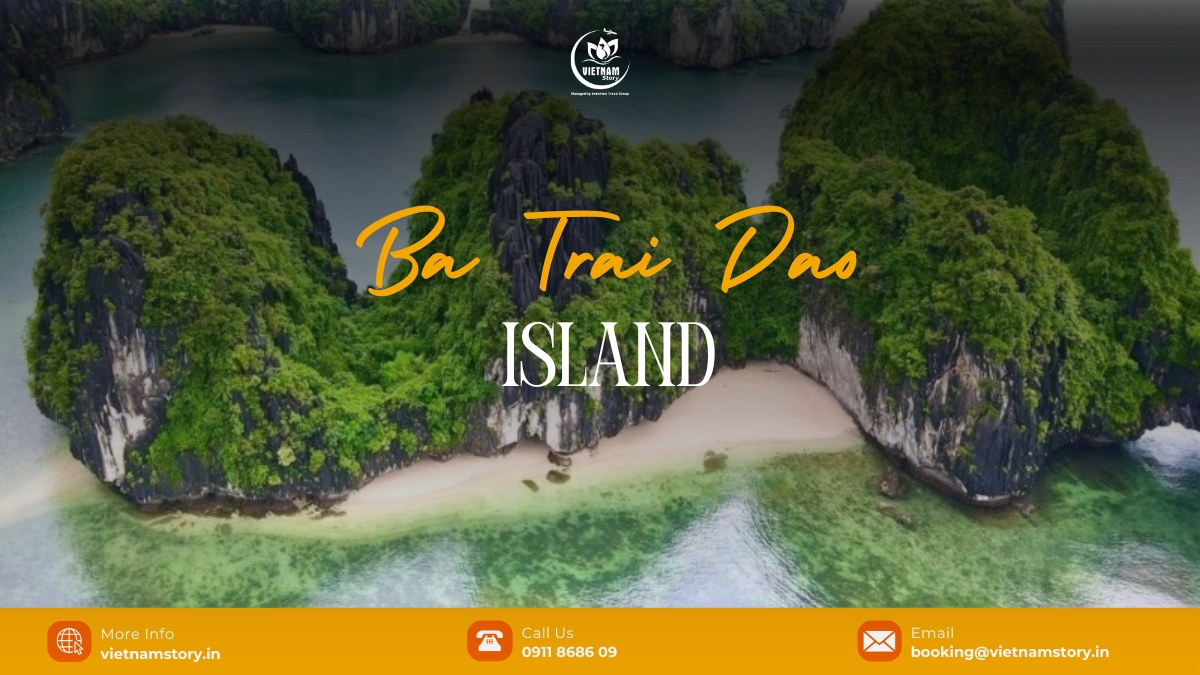
Where is Ba Trai Dao Island?
Ba Trai Dao, literally “Three Peaches”, lies within the Lan Ha Bay area associated with Cat Ba Island in Hai Phong, northern Vietnam. Despite the singular English name “island”, travellers are usually referring to a distinctive group of three limestone islets and the small beaches around them, not an inhabited island with a town, hotels or a regular passenger-ferry stop.
You cannot reach Ba Trai Dao by taking a normal road transfer on Cat Ba. It is a boat-based destination. If you are looking at a tour brochure, ask whether Ba Trai Dao is actually an approved stop, a place the vessel passes for photographs, or only a general attraction shown in promotional copy.
Our Lan Ha Bay location and cruise-port guide explains how the bay relates to Cat Ba, Ha Long and different passenger boarding points. It is more useful to confirm your boat’s departure port than to navigate to a map pin for Three Peaches.
Can you visit Ba Trai Dao Beach in 2026?
You may be able to see the area by boat, but a beach landing or swim must be verified for your specific sailing. The information available to travellers is not fully consistent. Some 2026 tour listings advertise Ba Trai Dao swimming, while other recent guides describe the beach as subject to earlier access restrictions, tides and operator decisions. That is not enough evidence to promise unrestricted landing.
A Green Ruby Cruises access guide, checked in late October 2026, says sand exposure, swimming and beach access all depend on tide, permissions and crew confirmation. It also explains that Ba Trai Dao is not part of its own standard Green Ruby 2 itinerary. Meanwhile, Flamingo Cat Ba’s updated guide notes that some boats change the beach stop seasonally, so even a trip that usually visits this area may substitute another location.
The January 2026 tourism regulations for the Cat Ba archipelago emphasise that boat routes and recreational activities must operate only within areas authorised by the relevant authorities. See the Cat Hai administration’s regulation notice. For a guest, the sensible test is a current written confirmation from the operator, not an old beach photo or an unsourced blog timetable.
What does a Ba Trai Dao visit actually include?
| Experience | What it means | What needs confirmation |
|---|---|---|
| Pass-by sightseeing | The boat approaches or sails past the three limestone islets for a view or photographs | Whether the route passes close enough and if the vessel can pause |
| Beach landing | Guests leave the boat or tender onto an authorised sand area | Current permission, tide level, boarding conditions and time ashore |
| Swimming | A supervised water stop from a licensed vessel or approved beach | Exact swimming location, sea conditions, crew supervision and safety equipment |
| Kayaking | Guests paddle independently or in pairs in an approved activity zone | Whether the activity is currently permitted; multiple operators have suspended it |
| Private charter | A boat arranged for your group rather than a shared itinerary | Operator licence, authorised route and activities; charter does not override restrictions |
A brochure that lists “Ba Trai Dao” does not establish which row applies. If swimming is the reason you are choosing this area, ask the supplier to state the actual swimming stop and contingency if access is not granted. If a boat only passes the islets, that can still be attractive scenery, but it should be sold as a scenic view rather than an included beach landing.
How do the tides affect Three Peaches Beach?
Sand at Ba Trai Dao changes with the tide. At higher water levels, parts of a beach may narrow or be submerged; at lower water levels, more sand may be visible. This explains the older descriptions of a “disappearing beach”, but it should not be turned into a rigid claim that the beach is open for exactly two to four hours every day.
The tide is only one constraint. Safe access also depends on wind, waves, approved stopping areas, boat handling, local notices and the operator’s itinerary. Even a low-tide window does not automatically authorise a landing or make the sea safe for swimming. Likewise, summer is not guaranteed to produce the longest or most convenient low-tide window on the date you travel.
Is kayaking at Ba Trai Dao permitted now?
Do not treat kayaking as a standard Ba Trai Dao activity in 2026. The current Indochina Sails notice reports that kayaking across Lan Ha Bay, including the Dark & Bright Cave area, remains temporarily suspended from 1 February 2026 until further notice, citing the Cat Hai authority’s notice. Amanda–Le Journey has also publicly announced the suspension on its Lan Ha itineraries.
Some third-party tour pages still display kayak photos or list a kayak as included. There are reports of some operators offering paddling in other designated areas, but these do not establish a general permission at Ba Trai Dao. We would not infer a legal exception from a sales listing; ask the named vessel for the specific authorised location, written activity programme and substitution policy.
If your operator cannot confirm kayaking at this stop, consider a vessel whose route offers the scenery or another permitted activity you value. The Lan Ha Bay activities guide explains why a current route and activity list is more useful than a gallery of earlier kayak photographs.
Is swimming at Ba Trai Dao safe for children?
No beach or bay stop should be described as “perfectly safe” or reliably calm for every family. Water depth, current, boat movements and visibility can change during the day. A crescent-shaped beach may look sheltered without being an approved swimming area or being suitable for someone who is not confident in the water.
If you are travelling with children or older guests, confirm who supervises the stop, whether correctly sized life jackets are available, how passengers get off the boat or tender, and what happens if the captain cancels swimming. A child who cannot swim should not be left to enter open water because the beach is described as shallow in a travel guide.
The swimming conditions and safety guide gives broader checks for Ha Long and nearby bay cruises. Treat your crew’s instructions and local authorisations as the deciding factor on the day.
Can you hike up the three peach-shaped islets?
We would not recommend climbing Ba Trai Dao’s limestone islets. The older VNS article suggested undeveloped cliff hikes for a “360-degree view” without verifying a permitted trail, guide or safe access. Steep exposed limestone can be sharp and unstable, and an attractive rocky silhouette is not an invitation to scramble up it.
If you want a genuine elevated viewpoint while staying on Cat Ba, choose an established open route instead of improvising a cliff climb from a cruise stop. Our Lan Ha Bay viewpoints and Cat Ba access guide compares forest peaks, historical lookouts and the current restrictions affecting some famous viewpoints.
How do you get to Ba Trai Dao from Cat Ba or Ha Long?
From Cat Ba Island
Visitors staying in Cat Ba Town can ask licensed local operators about a Lan Ha day programme from an authorised pier, commonly the Ben Beo/Cai Beo area. Some routes may include Ba Trai Dao or pass the three islets. There is no ordinary scheduled passenger ferry that takes you directly to a Ba Trai Dao hotel or town, because it is not that kind of destination.
Before buying a ticket, ask the operator for the exact boarding pier, the named boat, the approved itinerary, whether Ba Trai Dao is a pass-by or landable stop, and the actual activities included. A fixed “1.5-hour boat ride” in a general article should not be treated as a guarantee; boat type, route and conditions affect travel time.
From Ha Long, Hanoi or an overnight cruise
If you are starting in Hanoi or Ha Long, your first decision is the booked vessel and its departure port. Some Lan Ha itineraries may board on the Ha Long side, while others use Cat Hai or Cat Ba arrangements. You cannot assume that a cruise sold in Ha Long automatically visits Ba Trai Dao, or that every Cat Ba-based operator can depart from Tuan Chau.
For the exact port question, consult our Ha Long harbour guide; if you are staying on Cat Ba and need transport from Tuan Chau, see Tuan Chau to Cat Ba ferry guide.
Does a private boat guarantee a beach stop?
No. A charter may give your group control over seating, timing preferences and a proposed itinerary, but the boat must still follow permitted routes and local activity rules. If your priority is Ba Trai Dao, request written confirmation that the authorised itinerary can include it and specify what the backup stop will be if the tide, weather or official access rules prevent the plan.

What is the story behind the name Ba Trai Dao?
“Ba Trái Đào” translates as “Three Peaches”. The name describes three rounded limestone forms and is linked to local folklore about a fairy who gave heavenly peaches to a human lover before the fruit was turned to stone. That story is part of how the landmark is described by guides, but it should be presented as a legend, not as a documented geological explanation.
The real rock formations belong to the same long limestone-karst landscape as the wider Ha Long Bay–Cat Ba Archipelago World Heritage area. The scenery is a good reason to enjoy a licensed cruise route, but the legend does not establish that a particular beach is open or that the area is untouched by tourism.
When is Ba Trai Dao worth adding to a Lan Ha itinerary?
| Your priority | Our recommendation | Why |
|---|---|---|
| Three-islet scenery and photographs | Choose a boat whose route explicitly approaches or passes the landmark | A pass-by may satisfy the view without a landing |
| Swimming and beach time | Only book after confirming a permitted swim/beach stop and an alternative | Access is disputed and dependent on tide, weather and operator |
| Kayaking | Do not choose Ba Trai Dao on the assumption that paddling is included | Lan Ha kayaking restrictions are still publicly reported |
| A quiet family boat day | Compare vessel comfort, shade, supervision and stops rather than the “secluded” label | Crowding, conditions and facilities vary |
| A longer Lan Ha or Cat Ba holiday | Place Ba Trai Dao within an already suitable licensed route, not as a standalone island stay | There is no regular town-style access or overnight accommodation on the islets |
If you are comparing the entire region rather than one landmark, the Ha Long Bay vs Lan Ha Bay guide helps decide which water area and itinerary fit your trip. Ba Trai Dao should be a possible stop within that plan, not a reason to ignore the route’s other experiences.
What should you pack or check before a boat trip?
- Booking: vessel name, departure pier, trip date, approved route and specific Ba Trai Dao access description.
- Conditions: current marine weather, tide and the operator’s backup activity if the intended beach cannot be used.
- Water safety: suitable life jackets, crew supervision, boat transfer arrangements and the group’s swimming ability.
- Comfort: sun protection, secure footwear, drinking water and a dry bag if the operator permits one.
- Children and older guests: check tender steps, walking surfaces, shade, bathrooms and whether anyone will need to stay on board.
- Food: confirm what lunch is included and any vegetarian or Jain request for the specific kitchen; no isolated beach should be assumed to have suitable food service.
- Environmental care: take rubbish back to the boat, avoid disturbing wildlife, and do not enter unapproved sand, reef or rock areas.
How Vietnam Story would plan Ba Trai Dao for travellers from India
Vietnam Story would start by checking whether your group is based on Cat Ba, staying in Ha Long, or joining an overnight cruise. We would then ask whether you mainly want a scenic boat passage, a beach landing, swimming or a family-friendly day on the water. Those requirements lead to different itinerary choices and different questions for the vessel operator.
For couples and families, we would not sell Ba Trai Dao as a guaranteed private beach or promise Jain meals on a beach stop. Instead, we can ask the selected boat to confirm the permitted route and stop, boarding logistics, menu and the alternative if beach or water access is unavailable. This fits the wider North Vietnam itinerary without treating Ba Trai Dao as a mandatory stop.
Ask Vietnam Story to check a Ba Trai Dao cruise stop
Would you like to see the Three Peaches area of Lan Ha Bay? Tell Vietnam Story your travel date, where you will start (Hanoi, Ha Long or Cat Ba), group size, preferred day or overnight cruise and whether swimming or simply seeing the three islets is most important. Add any children, mobility or vegetarian/Jain meal requirements. We can check the named vessel’s currently permitted route, activity programme and alternatives before you commit.
For wider options rather than one island stop, see our Ha Long Bay cruise guide and Vietnam tour packages from India when you want help placing Lan Ha within a complete itinerary.
Ba Trai Dao Island: frequently asked questions
Where is Ba Trai Dao Island?
It is a group of three limestone islets in Lan Ha Bay beside Cat Ba Island in Hai Phong, northern Vietnam. It is reached as part of a licensed boat itinerary, not by road.
Can I land on Ba Trai Dao Beach in 2026?
Do not assume so. Some cruise itineraries still list the beach, but recent access information is inconsistent and landings depend on current permissions, weather and tide. Get confirmation from your specific boat operator.
Why does the Ba Trai Dao beach disappear?
Parts of the sand may be covered at higher tide. There is no reliable universal two-to-four-hour access window; ask about conditions and whether a landing is permitted on your day.
Is kayaking currently allowed at Ba Trai Dao?
Do not plan on it. Operators including Indochina Sails and Amanda–Le Journey continue to publish Lan Ha Bay kayak-suspension notices. A boat’s kayak photo does not confirm a permitted activity at Ba Trai Dao.
Is Ba Trai Dao good for swimming with children?
Only if the stop is authorised, sea conditions are suitable and the crew confirms supervision and safety arrangements. Water that looks calm in promotional photos is not a safety guarantee.
Can I hike to the summit of Ba Trai Dao?
Do not attempt an unverified cliff climb. The old descriptions of casual island summit hikes do not establish an authorised or safe route.
Does every Lan Ha Bay cruise include Ba Trai Dao?
No. Some ships pass the area, some offer different stops and others do not visit it. Confirm the named operator’s current route before booking.
Ba Trai Dao can be a memorable part of a Lan Ha journey for its limestone forms and changing coastline. Choose the boat for what it can actually deliver on your travel date, and treat beach landings and water activities as confirmed inclusions rather than assumptions.