
Six days is where a short Vietnam trip starts to feel less like a compromise. You still do not have enough time to cover North, Central and South well, but you do have enough room to make one region feel complete—or, if your flights line up, make one carefully controlled jump to a second region.
For most first trips from India, we would use the sixth day to improve the route before adding another airport. In Central Vietnam, that can mean giving Hue proper space. In the North, it can mean slowing down Hanoi, Ninh Binh and Ha Long instead of stacking Sapa on top. In the South, it can make Ho Chi Minh City + Phu Quoc feel like two distinct halves of the same holiday.
The useful question is not “How many famous places fit into six days?” It is “What does the sixth day let us do properly that five days did not?”
Is 6 days enough for Vietnam?
Yes—if you plan around usable days rather than six boxes on a calendar. A late international arrival can turn Day 1 into dinner and sleep; an early flight home can turn Day 6 into an airport morning. That usually leaves four or five meaningful sightseeing blocks.
With that amount of time, one region can feel complete. Two regions can work when the move between them is simple and the second region adds something genuinely different. Three regions usually turn the holiday into repeated check-outs, airports and shallow city stops.
Our six-day rule: add depth first. Add distance only when the extra transfer earns its place.
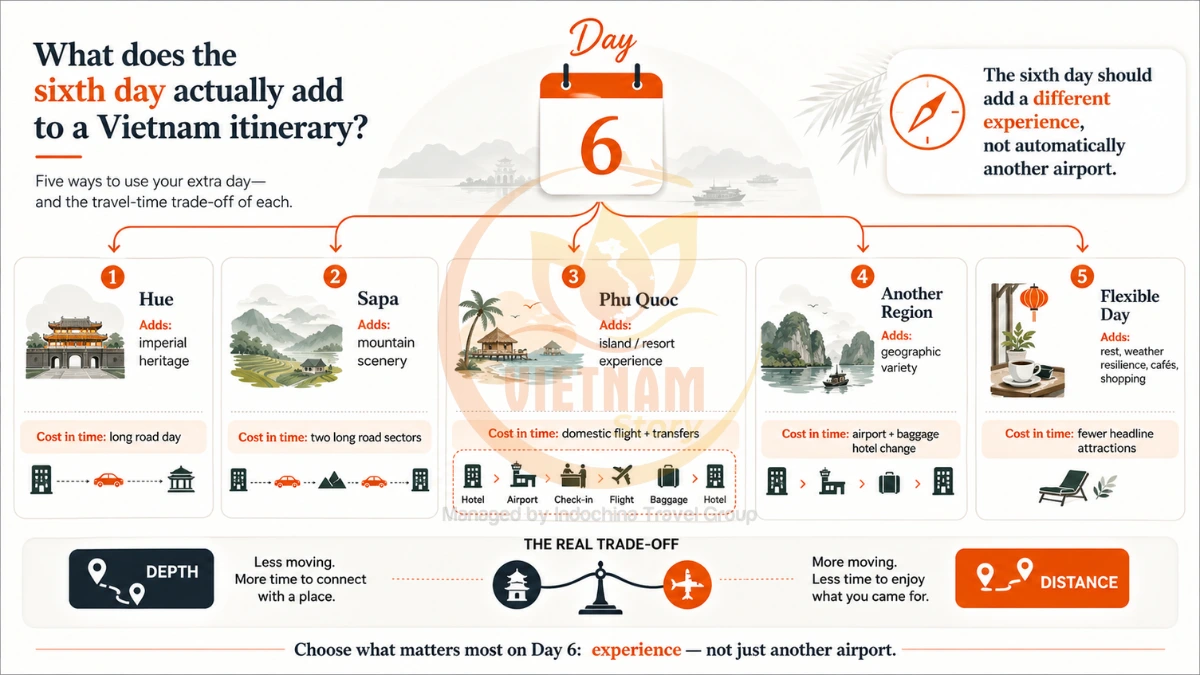
What does the sixth day actually change?
The sixth day should fix the weakest part of a five-day route. It can create depth, absorb a long excursion, protect recovery time or make one regional jump more defensible. It does not need to become another destination.
| Use Day 6 for | What improves | What it costs |
|---|---|---|
| Hue | Central Vietnam gets a real heritage day | A longer road day from Da Nang/Hoi An |
| A slower North | Hanoi, Ninh Binh and a bay cruise stop competing for time | You still leave Sapa for another trip |
| Phu Quoc | The holiday gains a genuine resort/beach half | One domestic flight plus airport transfers |
| A second region | You gain stronger geographic contrast | Another airport block and usually another hotel base |
| Flex time | Weather, family pacing and late arrivals hurt less | Fewer headline attractions on paper |
If you are comparing directly with a shorter trip, the 5-day Vietnam itinerary is the cleaner reference point: five days is mainly a prioritisation problem; six days gives you your first real choice between more depth and more distance.
Central Vietnam: the easiest 6-day route to keep balanced
Da Nang + Hoi An + Hue is the six-day route we would test first when easier logistics matter. You can get city, beach, heritage and an iconic day trip without adding a domestic flight inside the route.
Keep the first evening light. Beach, riverfront, coffee or dinner is enough if the international journey has already used most of the day.
Ba Na Hills deserves most of the day when it is a priority. If it is not, use the time for the beach, Son Tra, cafés or city sightseeing.
Protect the late afternoon and evening. Hoi An works better when it is experienced as a place to spend time, not a short photo stop.
This is the day six days makes easier. Give the imperial city proper space instead of squeezing it beside another full-day attraction.
Use it for Marble Mountains, countryside, a second Hoi An period, beach time or whatever your group discovered after arrival.
Use only the time your flight really leaves available. An early departure is an airport day, not a hidden sixth sightseeing day.
The strength of this route is not that every famous Central Vietnam attraction fits. It is that the region gives you several different experiences without making airports the centre of the holiday.
North Vietnam: use six days for depth, not for stacking everything
For a first northern trip, we would usually keep Hanoi + Ninh Binh + an overnight Ha Long or Lan Ha Bay cruise. Six days makes that route feel noticeably better than five because Hanoi no longer has to fight the excursions for every usable hour.
Settle in, walk the Old Quarter or Hoan Kiem area and keep the evening easy.
Give the capital one real day instead of treating it only as the transfer base for northern excursions.
Choose one boat area and one meaningful cultural or viewpoint stop. Return to Hanoi unless an overnight stay has a clear purpose.
Start an overnight cruise so the bay becomes part of the trip rather than a long out-and-back road day.
Let the evening remain simple. The road transfer back is already part of the day.
Use a late flight for shopping, cafés or one final city stop; protect the airport buffer first.
What about Sapa? If Sapa is one of the reasons you are travelling, swap rather than stack. Hanoi + Sapa can be a strong six-day trip, but adding Sapa, Ninh Binh and an overnight bay cruise together usually spends the extra day on roads rather than on the places themselves.
Ho Chi Minh City + Phu Quoc: when six days should slow down
This route works when beach and resort time are part of the purpose of the trip. The city gives the first half energy; Phu Quoc should then simplify the second half rather than fill it with another long checklist.
Stay central and keep the first evening close to the hotel.
Do not force city sightseeing, Cu Chi and the Mekong into the same short block. Pick the experience your group values most.
Count check-out, airport time, baggage and the resort transfer as part of the day. Keep the evening local.
Choose a southern-island outing, cable-car area, boat activity or another main experience according to current conditions.
Leave room for the beach, resort, cafés, spa, markets or a weather fallback. This is where the route earns its different rhythm.
If you connect through Ho Chi Minh City, protect enough buffer for the full transfer rather than planning a distant final activity.
Can you combine two regions in 6 days?
Yes, but we would treat it as the fast option—not the default. A simple Hanoi + Da Nang/Hoi An route can work when the international gateways are efficient, the domestic flight falls cleanly in the middle and you are comfortable giving each region only a small number of priorities.
A realistic fast two-region shape
The route becomes poor value when you add both Ninh Binh and a bay cruise before the flight, or try to fit Hoi An, Hue and Ba Na Hills after it. Six days can support two regions only by reducing depth somewhere.
If you are deciding whether the flight itself is worth the time it saves, use our domestic flights in Vietnam guide for the door-to-door trade-off rather than looking only at scheduled flying time.
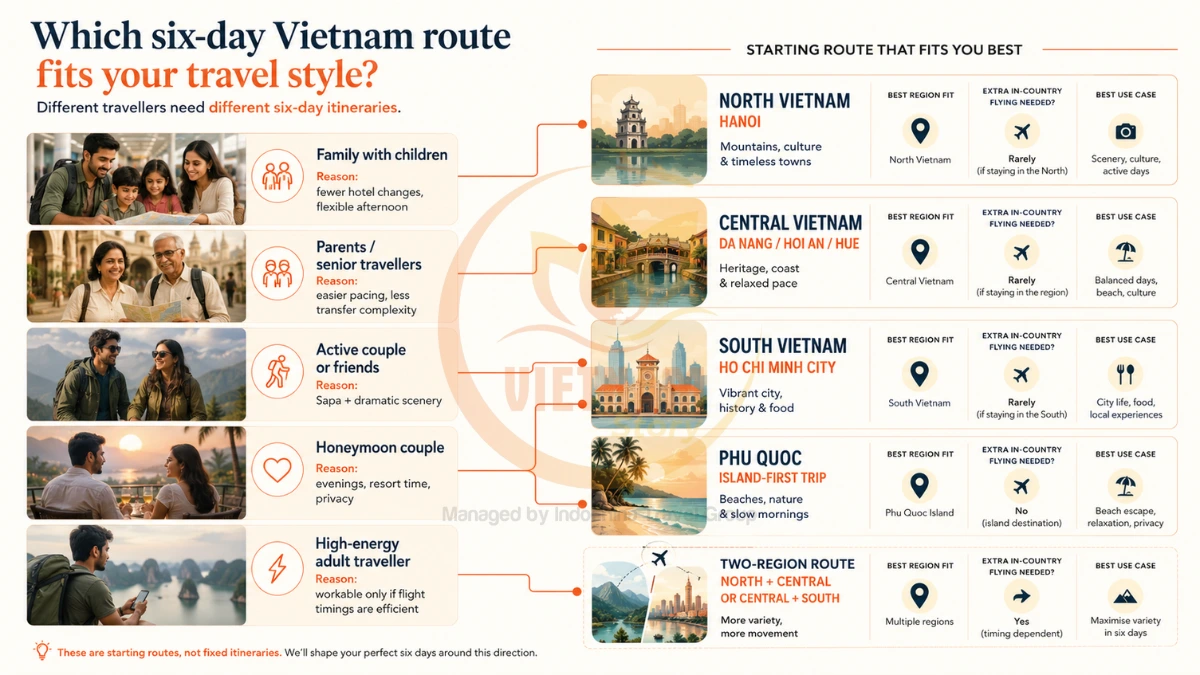
Which 6-day route fits your travel style?
Choose by pace and transfer tolerance before choosing by attraction count. The same six days can feel spacious or exhausting depending on how often you move hotel and how much of the trip is tied to fixed transport.
| Traveller | Route to test first | Why |
|---|---|---|
| First-time couple | Central or North | Choose easier logistics versus stronger landscape contrast |
| Family with children | Central | Fewer long transfer days and easier flex time |
| Parents / senior travellers | Central or slower North | Reduce hotel changes, steps and consecutive long days |
| Honeymoon / resort-first | Ho Chi Minh City + Phu Quoc | City energy followed by real downtime |
| High-energy adults | Conditional North + Central | More contrast if you accept one airport day |
What would we leave out of a 6-day Vietnam itinerary?
We would remove the transfer that adds the least new value. In practice, that usually means resisting the temptation to add one more famous place simply because it is possible on paper.
- Do not make North + Central + South the default. Two domestic flights and three bases dominate too much of a six-day holiday.
- Do not stack Sapa + Ninh Binh + an overnight bay cruise. Choose the northern landscape experience that matters most.
- Do not force Hue + Ba Na Hills + Hoi An into consecutive full days. Keep one Central day flexible.
- Do not add Phu Quoc for one night. The island makes more sense when it gets enough time to change the pace of the trip.
Is 6 days or 7 days better for Vietnam?
The seventh day matters most when you want two regions. Six days can support a controlled regional jump; seven days gives that route more recovery time and makes it easier to protect a full experience on both sides of the flight.
If your leave allows one more day, compare the 7-day Vietnam itinerary before booking the extra domestic sector. If the seventh day only adds another attraction to an already balanced one-region route, six days may already be enough.
Before you book a 6-day Vietnam trip
Lock the international gateways first, then count the real transfer blocks. Arrival time, departure time and the location of any domestic flight can change which route is realistic far more than another attraction list can.
Once the route shape is clear, compare current package options, hotels, transfers and inclusions on the Vietnam 6-day tour options. We would settle the pace and geography first, then compare the packages that actually fit that trip.