
If you are travelling from India, your Vietnam food budget depends less on finding one “average meal price” and more on how often you choose local food versus Indian restaurants.
For most trips, we would first count the meals you still need to pay for, then decide how many of those need to be Indian meals. A self-paid food day can range from roughly ₹600 to ₹3,000+ per person. Hotel breakfasts, cruise meals and selected tour lunches can reduce the amount you actually spend.
Vietnam Food Prices in Indian Rupees at a Glance
When we estimate food spending for an itinerary, three eating patterns are usually more useful than one national average:
| How you plan to eat | Approx. VND/person/day | Approx. INR/person/day |
|---|---|---|
| Mostly Vietnamese local food | 180,000–350,000 VND | ₹600–1,300 |
| Vietnamese food + one Indian meal | 300,000–550,000 VND | ₹1,100–2,100 |
| Mostly Indian meals | 450,000–800,000+ VND | ₹1,600–3,000+ |
A neighbourhood meal can cost far less than a restaurant in a tourist zone or resort, so treat these as planning bands rather than fixed prices. If you are working out the whole holiday budget rather than only food, our Vietnam Trip Cost From India guide covers flights, hotels, transport and sightseeing as well.
Once you know the food budget, choose the next planning layer
Food is only one part of the total spend. The useful next step depends on how much of the trip you have already decided.
Compare flights, hotels, local transport, sightseeing and food together in the Vietnam trip cost guide.
See what realistically fits into 5 days in Vietnam before adding more cities.
Compare the route depth and travel pace on the 7-day Vietnam tours page.
How Much Does Local Vietnamese Food Cost?
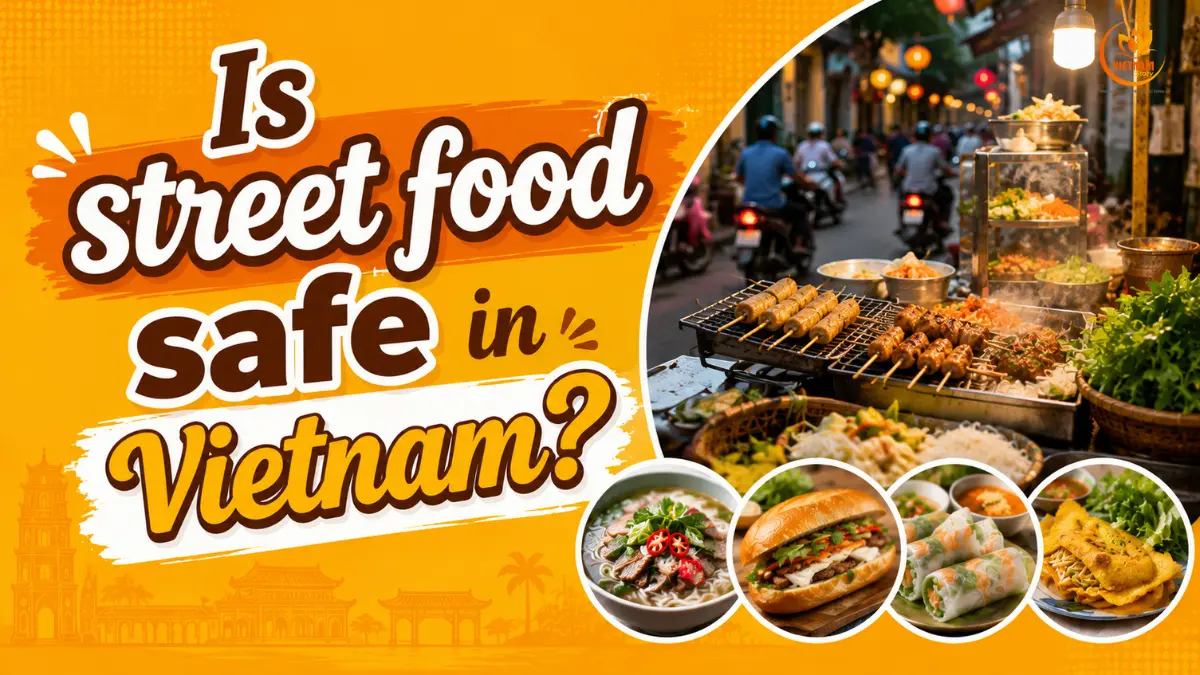
Local Vietnamese food is usually the easiest way to keep your meal budget low. For current 2026 planning, a neighbourhood bowl of pho is commonly around 35,000–80,000 VND, banh mi around 20,000–50,000 VND, and a local rice or noodle meal around 35,000–90,000 VND. Tourist-facing cafés and sit-down restaurants can be higher even when the dish itself is similar.
How Much Is One Local Meal in Vietnam?
| Food or drink | Useful 2026 planning range | Approx. INR |
|---|---|---|
| Banh mi | 20,000–50,000 VND | ₹75–185 |
| Pho/noodle soup | 35,000–80,000 VND | ₹130–295 |
| Local rice/noodle meal | 35,000–90,000 VND | ₹130–330 |
| Vietnamese coffee | 20,000–50,000 VND | ₹75–185 |
| Juice/coconut | 15,000–40,000 VND | ₹55–150 |
| Bottled water, 1.5L | 8,000–13,000 VND | ₹30–50 |
If you eat at neighbourhood stalls and local restaurants, one simple meal can stay near the lower end. An air-conditioned restaurant, café or venue next to a major attraction can charge more for the same type of dish. We would therefore budget with a range rather than assume every local meal costs ₹200.
How Much Does Indian Food Cost in Vietnam?
Indian food is widely available in the main tourist cities, but a complete Indian restaurant meal normally costs more than a simple Vietnamese local meal. The useful comparison is the whole meal, not the price of one curry.
Current restaurant menus show the pattern clearly. At Maharaja in Da Nang, Dal Tadka starts at 109,000 VND, Chana Masala at 139,000 VND, Palak Paneer at 149,000 VND, plain naan at 55,000 VND and biryani at 135,000 VND. Indus in Da Nang lists Dal Tadka at 109,000 VND, Chana Masala at 139,000 VND and Butter Chicken at 149,000 VND. In Hanoi, Vande lists Chole Masala at 65,000/130,000 VND for half/full portions and Paneer Tikka at 175,000 VND.
How Much Is One Indian Meal in Vietnam?
| Item | Current menu examples | Approx. INR |
|---|---|---|
| Dal | ~109,000 VND | ~₹400 |
| Chana/Rajma | 129,000–139,000 VND | ~₹475–515 |
| Paneer curry | 149,000–200,000 VND | ~₹550–740 |
| Naan | 49,000–69,000 VND | ~₹180–255 |
| Biryani | 135,000–145,000 VND | ~₹500–535 |
The important point is that a curry price is not a meal price. Dal + naan + a drink can reach roughly 200,000–250,000 VND, or about ₹740–925. A paneer main with bread or rice and drinks can move closer to 250,000–350,000 VND, roughly ₹925–1,300.
If you mainly want to know where Indian restaurants fit into your route, our Indian Food in Vietnam: City-by-City Guide is the better next step.
How Much Should You Budget for Food Per Day in Vietnam?
Your daily budget should reflect the meal pattern you are likely to repeat. If you are comfortable with local meals, the lower end is realistic. The budget rises much faster when an Indian restaurant becomes part of every day. For many trips, a local lunch plus an Indian dinner is a practical middle ground.
Mostly Local Vietnamese Food
A local-food-heavy day can often fit within 180,000–350,000 VND (about ₹600–1,300) per person. This assumes casual Vietnamese meals, simple drinks and no premium restaurant dining. If hotel breakfast is included, your self-paid amount may be lower.
Vietnamese Food + One Indian Meal
For many travellers, this is the most practical pattern. A day might include hotel breakfast, a Vietnamese lunch, coffee or a snack, and an Indian dinner. In that case, around 300,000–550,000 VND (about ₹1,100–2,100) per person gives you a useful planning buffer.
It also keeps the itinerary flexible: you can eat locally while sightseeing and use Hanoi, Da Nang or Ho Chi Minh City as convenient Indian-food anchors in the evening.
Mostly Indian Meals
If you want Indian food for most major meals, allow roughly 450,000–800,000+ VND (about ₹1,600–3,000+) per person per day. The upper end becomes more relevant when you choose premium restaurants, resort dining or add frequent drinks, desserts and snacks.
How Much Will You Actually Pay for Food?
Count the meals you still need to buy first, then apply the eating style you expect to use. This is more accurate than multiplying breakfast, lunch and dinner by every day of the trip.
Check Meal Inclusions First
Hotel breakfast: many itineraries include it, so do not budget a second breakfast automatically.
Ha Long Bay cruise: an overnight cruise may include lunch, dinner, breakfast or brunch, depending on the selected programme.
Day tours: some full-day excursions include lunch, while others leave meals free.
Package meals: use the exact itinerary and written quotation as the source of truth. Meal inclusions vary by product.
Also keep a small buffer for bottled water, coffee, fruit and snacks. These are inexpensive individually but easy to forget when you build the budget meal by meal.
How Much Should Two People Budget for 7 Days?
Imagine a couple travelling Hanoi → Ha Long Bay → Da Nang → Hoi An. Their hotels include breakfast and their overnight cruise includes several meals. On normal self-paid days, a mixed Vietnamese-plus-Indian pattern might require around ₹2,200–4,200 for two people. On the cruise day, the amount paid separately may be much lower.
This is why the better formula is:
self-paid local meals + self-paid Indian meals + drinks/snacks
rather than:
3 meals × 7 days × 2 people.
For families, do not automatically multiply an adult à-la-carte order by every person. Indian mains, rice and breads may be shared, while children may eat smaller portions. At the same time, juices, desserts and café stops can push the group bill higher.
Is Food Cheaper in Hanoi or Ho Chi Minh City?
Hanoi local food is often slightly cheaper, but the bigger difference is usually where and how you eat. A neighbourhood stall and a tourist-facing restaurant in the same city can differ more than two comparable local stalls in Hanoi and Ho Chi Minh City.
Hanoi: easy to combine inexpensive local food with Indian restaurants, especially for North Vietnam itineraries.
Da Nang and Hoi An: convenient for a mixed-food strategy; Da Nang has strong Indian-food availability, while Hoi An has a large tourist-facing dining scene.
Ho Chi Minh City: offers the widest range, from inexpensive street food to premium restaurants.
Phu Quoc: allow more flexibility if you stay in resort areas or eat seafood regularly. For seafood, check whether the quoted price is per dish, per 100 grams or per kilogram before ordering.
What About Vegetarian and Jain Food Costs?
Local Vietnamese vegetarian food, often labelled chay, can be economical for flexible vegetarian travellers. Indian vegetarian dining usually costs more because you are using specialist restaurants.
Strict Jain requirements are different from general vegetarian preferences. The main planning issue is whether a kitchen can prepare food to your requirements and whether advance notice is needed. For a dedicated budget and planning breakdown, see our Vegetarian and Jain Vietnam Food Budget.
Should You Budget in INR or VND?
Plan in INR, but expect everyday food prices to be shown and paid in VND. At the 30 September 2026 reference rate, ₹1 ≈ 270.7 VND. The following rounded conversions are useful for trip planning:
| VND | Approx. INR planning value |
|---|---|
| 50,000 VND | ~₹185 |
| 100,000 VND | ~₹370 |
| 200,000 VND | ~₹740 |
| 500,000 VND | ~₹1,850 |
Your actual ATM, card or cash-exchange rate may differ, so use INR as a planning reference rather than expecting the exact same conversion during the trip. For cash, cards, QR payments and UPI-related questions, use our Vietnam Payment Methods Guide for Indian Tourists.
DAILY FOOD BUDGET → WHOLE TRIP BUDGET
Once the meal budget is clear, calculate it inside the route—not as a separate holiday
Food cost changes with the number of self-paid meals, the cities in the route and how often you want Indian dining. Use the daily figure as one layer of the whole trip budget, then choose the duration that still fits comfortably.
Build the full Vietnam budget →
Choose the number of days →
See a veg-friendly itinerary →
Frequently Asked Questions
What can 20,000 VND buy in Vietnam?
At the current reference rate, 20,000 VND is roughly ₹74. It can cover a bottle of water, a simple local drink or, in some places, the lower end of a basic snack or banh mi. It is not a useful budget for an Indian restaurant meal.
Are meals included in Vietnam tour packages?
It depends on the selected itinerary. Hotel breakfast is common, while cruises and some day tours may include additional meals. Always check the exact inclusions and the final written quotation rather than assuming every package follows the same meal plan.
Will restaurants in Vietnam show prices in Indian rupees?
Usually not. Restaurant and street-food prices are generally shown in Vietnamese Dong. Use INR to plan your holiday budget before travelling, but expect to read and pay local food prices in VND.
The simplest way to control food spending is not to chase the cheapest meal. Use included breakfasts, try local food when it suits you, and keep familiar Indian meals for the parts of the day where they matter most to your comfort.
FROM FOOD BUDGET TO THE WHOLE TRIP
Once the meal budget is clear, choose the trip length
Food is only one part of the total cost. The next useful step is to compare the whole holiday by duration so hotels, transport and sightseeing are counted together rather than meal by meal.
- Vietnam trip cost from India — combine food with flights, hotels, transfers and sightseeing.
- 5-day Vietnam tours — compact routes when usable leave is limited.
- 7-day Vietnam tours — a more balanced first-trip window.
- 10-day Vietnam tours — more room for multiple regions without compressing every day.
Planning rule: decide the route and number of days first, then calculate the meals that are not already included.
When comparing Vietnam tour packages from India, check meal inclusions together with the route, hotels, transport and sightseeing. VietnamStory can confirm the meal scope in the selected itinerary and written quotation, so you can budget for the meals you still need to buy.