
For Indian travellers visiting Vietnam, a travel eSIM is often the easiest way to arrange mobile data before landing; a registered local SIM or carrier eSIM may suit you better if you need a Vietnamese phone number; Indian roaming can be simplest when you want to keep your existing setup. The right choice depends on your exact phone model, arrival airport, trip length, need for bank OTPs and travel route. At Vietnam Story, we would confirm what your connection needs to do before suggesting any paid package. A large data allowance alone does not make one SIM the best option.
Vietnam SIM vs eSIM vs Roaming: Quick comparison
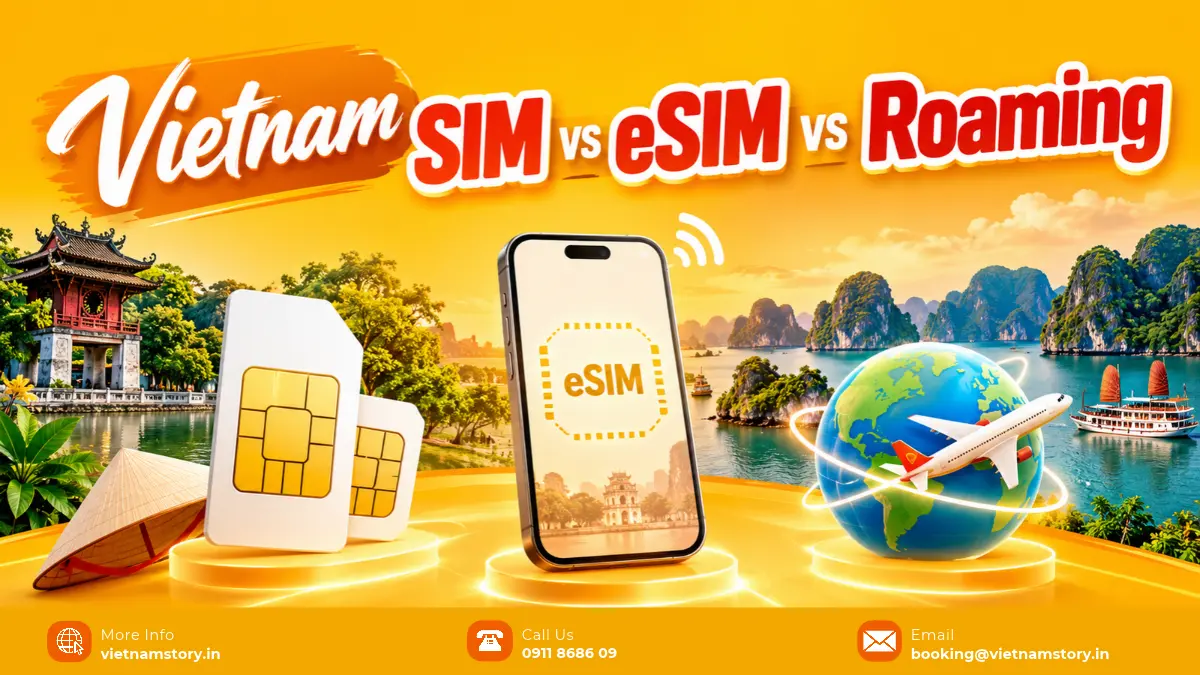
| Option | Best for | Main advantage | Check first |
| Physical Vietnam SIM | Travellers comfortable buying locally | Local connection | Registration + phone compatibility |
| Vietnam eSIM | Travellers wanting data ready quickly | No SIM swap | eSIM compatibility |
| Indian roaming | Short trips / existing-number priority | Minimal setup | Current roaming charges |
| Dual-SIM setup | Travellers needing Indian number + local data | Flexibility | Device configuration |
For many tourists, there is no universal “best Vietnam SIM”. Instead ask: How do I want my phone to work from the moment I land? Choosing a SIM is easier when the rest of your trip logistics are already clear. Our Vietnam Travel Guide for Indian Travellers covers the wider practical planning around transport, money, weather, food and other essentials for a first trip from India.
Option 1: Buy a physical SIM in Vietnam
A physical SIM from Viettel, VinaPhone or MobiFone can be practical when you want a locally registered service or your phone does not support eSIM. Buy from an authorised operator or official retail channel, and bring your original passport. Viettel’s traveller registration guide explains passport and identity-verification steps for tourist eSIMs; requirements can vary by product and channel.
Before paying, ask the seller to show the operator, exact plan, daily high-speed allowance, any speed reduction after the cap, activation date, validity, hotspot allowance, voice/SMS features and total price. If you need a +84 number to receive ordinary local calls, confirm the actual number and service type; do not assume every tourist SIM has one. Complete the required passport or identity verification rather than accepting a pre-activated SIM of unclear ownership. Our Vietnam travel scams guide also explains how to verify unfamiliar suppliers and payment requests.
Before leaving the counter, switch off Wi-Fi and test mobile data. Also check whether your Indian SIM will remain active for calls or OTPs and which line the phone will use for data. If your phone supports dual SIM, you may be able to use the Vietnam SIM for mobile data while keeping your Indian connection available, depending on your device and operator settings.
If you physically remove your Indian SIM, store it somewhere secure. Losing your primary Indian SIM abroad can create unnecessary problems.
Option 2: Use a Vietnam eSIM
A travel eSIM lets a compatible, unlocked phone install a mobile-data profile using a QR code or app, often before leaving India. However, many international travel eSIMs provide data only, with no Vietnamese phone number, ordinary calls or SMS. A local carrier-issued eSIM can have different features and identity-verification rules. Check the exact device model and country variant; a device marketed under a familiar model name may still have different eSIM support. Confirm the network, data cap, validity, tethering and whether a +84 phone number is actually included.
Read the product’s activation instructions while you have reliable Wi-Fi. Some eSIMs start their validity when installed; others start when the profile connects to a Vietnamese network or after a separate activation step. Installing an eSIM and turning on mobile-data roaming for that specific eSIM are not necessarily the same action. Do not delete the profile while troubleshooting without checking whether the provider allows reinstallation.
Option 3: Keep your Indian SIM on international roaming
Indian roaming is worth comparing when you need your existing number for calls or OTPs and prefer not to change your phone configuration. Check your Indian provider’s Vietnam-specific roaming pack before departure and do not assume receiving an OTP, sending SMS and using mobile data are billed or supported in the same way.
You retain your existing number and, depending on your operator and current plan, may be able to use supported calls, SMS and data in Vietnam. Before leaving India, check: Vietnam coverage → data allowance → validity → call charges → SMS/OTP requirements → total cost. Do not assume your normal domestic Indian plan works internationally.
Roaming can be particularly practical for a short Vietnam trip or for travellers who depend heavily on their existing number.
What about OTPs and your Indian number?
This is an important consideration for Indian travellers. You may need your Indian number for banking messages, OTPs or other account verification while abroad. That does not necessarily mean your Indian SIM also has to provide your mobile data.
On a compatible dual-SIM phone, one setup is Vietnam eSIM for data + Indian SIM kept active for your Indian number. Check whether your Indian operator needs international roaming or a specific balance to receive OTPs, and whether your phone supports both lines simultaneously. Set the travel eSIM as the data line and review automatic data switching to avoid accidental Indian roaming charges. A Vietnamese number does not replace the Indian number registered with your bank. Test the setup before you need an urgent payment or login.
WhatsApp usually continues to work on a new data connection while keeping your existing registered Indian number; you do not need to change that number just because you installed a Vietnam SIM. If the app needs to verify your account again, access to the original Indian number can matter. Save driver, hotel and tour contacts offline instead of relying on one app or connection.
Should you buy a SIM at Vietnam airport?
An airport SIM can help when you land without mobile data, especially if you need to message your driver, find your hotel, use maps or reach the tour operator. But you do not need to buy one if your travel eSIM or Indian roaming is already working.
A sensible arrival sequence is immigration → baggage → customs → mobile data or airport Wi-Fi → pickup or transport → hotel. If you buy a SIM at the airport, ask whether the counter is an authorised outlet, complete the identity checks, and test mobile data with Wi-Fi switched off before leaving. If you already have a working eSIM or Indian roaming, you can go straight to your transfer without purchasing another plan.
Reliable mobile data makes meeting a driver or arranging onward transport easier, but you should still save your pickup details offline. If you are already connected, continue to your hotel. There is no benefit in creating another mobile setup unnecessarily. If this is your first visit, our Vietnam airport arrival guide for Indian tourists explains the full sequence from immigration and baggage collection to connectivity, transport and hotel arrival.
How much mobile data do you need?
For ordinary sightseeing, plan around maps, WhatsApp, ride-hailing, translation, restaurant searches and meeting your driver. Daily usage can be modest when you use hotel Wi-Fi, but large photo uploads, video calls, streaming and personal hotspots quickly change the requirement. Compare the actual high-speed data allowance, not a headline such as “unlimited” without reading any fair-use or speed-reduction terms.
Streaming video, remote work, cloud backups and frequent social-media uploads increase usage much faster. Instead of asking: “Which tourist SIM has the most data?”, ask: “What will I actually use when I am away from hotel Wi-Fi?” Then compare current packages accordingly.
Does everyone in a family need a Vietnam SIM?
Usually not.
A family of four does not automatically need four tourist SIMs. The useful principle is one independently working connection for every subgroup that may separate, plus an offline fallback for airport pickup and hotel information. For children or senior relatives travelling separately, make sure the responsible adult’s phone can place or receive an appropriate call—not just use mobile data—when that is necessary.
If family members regularly split for shopping, sightseeing or separate activities, more independent connections become useful. The same logic applies to group tours. The tour leader and key group members should remain connected even if every traveller does not purchase a separate SIM.
For families and groups, mobile connectivity works best when it is planned together with airport transfers, hotels, sightseeing and local coordination. For a family or group, ask whether a Vietnam Story proposal includes airport coordination and any SIM or eSIM assistance as specific line items. A mobile-data plan should never be assumed included merely because the tour covers airport pickup and hotels.
What about internet outside major cities?
Do not assume mobile signal will be continuous on mountain passes, remote village roads or caves. Coverage is generally easier to arrange in central Hanoi, Da Nang and Ho Chi Minh City than in parts of Sapa and Ha Giang. If your itinerary includes remote road travel, check the provider’s coverage map and ask the local guide about the specific route; a network’s national 4G or 5G marketing does not guarantee every valley has service.
Do not select a connection solely because it offers the cheapest or largest data package. Check current coverage information for the destinations on your actual route and always prepare for periods of weaker connectivity.
If your itinerary continues into Northern Vietnam’s mountains, the connectivity question becomes more important. When comparing Sapa vs Ha Giang, consider road time and remote travel alongside mobile coverage.
Keep important information offline
Mobile internet should make your trip easier. It should not become a single point of failure. Before travelling, save offline copies of:
- Hotel names and addresses
- Airport pickup information
- Key booking confirmations
- Important telephone numbers
- Travel insurance information
- Emergency contacts.
Downloading offline map areas can also be useful. If your battery dies or the network becomes temporarily unavailable, you should still know where you are going and whom to contact.
Along with offline hotel and booking details, save the key Vietnam emergency numbers for Indian tourists so essential contacts remain available even when mobile data is not.
Common Vietnam SIM Mistakes
- Buying an eSIM without checking phone compatibility or network lock. Confirm your exact model, region variant and carrier-unlocked status first.
- Choosing only by data allowance. Coverage, validity and convenience can matter more.
- Activating an eSIM too early. Check whether the clock starts at installation, first network connection or a separate activation step.
- Leaving an airport counter without testing the SIM. Confirm mobile data works before leaving.
- Losing your Indian SIM. Store it securely if you remove it.
- Assuming everyone needs a SIM. Plan connectivity around how your family or group will move.
- Depending entirely on mobile internet. Keep essential travel information offline.
Your phone setup should be checked alongside chargers, adapters and other electronics before departure. Use our guide on What to pack for Vietnam from India to organise these essentials according to your route, season and traveller type.
Can Vietnam Story help arrange a travel eSIM?
Vietnam Story has published a travel eSIM option for guests who prefer to arrange mobile data before arriving. This can be convenient, but it is not automatically cheaper or better than a carrier plan. We would first check your device, dates and the exact SIM features you need. eSIM supply is a separate service from the Vietnam itinerary unless it is specifically included in your written tour quotation.
The example package currently listed on this page has the following advertised terms, subject to reconfirmation before payment:
- Price: US$13
- Data allowance: 4GB per day
- Validity: 15 days
These figures describe the published VNS offer, not a live-verified stock, price or coverage guarantee. Before ordering, request written confirmation of the total USD price, current validity, high-speed daily limit and speed after 4GB, provider network, data-only versus calls/SMS, activation instructions, device compatibility, refund terms and support contact. You may also compare independent options: MobiFone’s official travel eSIM programme currently advertises a free 10GB/24-hour introductory tourist eSIM with verification and separate top-ups. That short offer is not a substitute for a full 15-day data plan; confirm current eligibility and terms directly with MobiFone.
Interested in the Vietnam Story eSIM? Ask Vietnam Story on WhatsApp for the current package sheet and confirmation of your phone model, dates and activation conditions before paying. If you only need temporary data after arrival, checking official carrier options first may be sufficient.
FAQs
Should I buy a SIM at Vietnam airport?
It can be convenient if you arrive without working mobile data. Verify the network, validity, allowance and price, and test the connection before leaving the counter.
Is an eSIM better for Vietnam?
An eSIM is particularly convenient for travellers who want connectivity prepared before arrival and have a compatible phone. Physical SIMs and Indian roaming can still be better for other travel styles.
Can I use WhatsApp with a Vietnam SIM?
Yes. Using another SIM or eSIM for mobile data does not automatically require changing your WhatsApp registered number. Follow the app’s prompts carefully.
Can I keep my Indian SIM active in Vietnam?
Potentially, depending on your phone, operator and roaming configuration. Dual-SIM travellers may choose local/eSIM data while retaining their Indian number for supported SMS or other services.
Is mobile internet good outside Vietnamese cities?
Coverage varies by network, individual road and terrain. Check the provider’s current coverage information for remote destinations, save maps offline and agree on a meeting plan when travelling through mountain areas.
Does a Vietnam travel eSIM include a local phone number?
Not always. Many international travel eSIMs are data-only, whereas a registered carrier eSIM can have a Vietnamese number and calls or SMS under its own conditions. Ask the seller to confirm the exact product. Keep your Indian SIM active where possible if you need bank OTPs sent to your Indian number.
Conclusion
Keep the final decision simple.
- Choose eSIM if you want connectivity prepared before landing and your phone supports it.
- Choose a physical Vietnam SIM if you are comfortable arranging a local connection after arrival.
- Choose Indian international roaming if keeping your existing setup with minimal changes is the priority and the current roaming terms suit your trip.
Planning a Vietnam holiday from India? Decide first how you will reach your hotel and keep in contact after landing, then compare SIM, eSIM and roaming options on their actual terms. Browse Vietnam tour packages from India and tell Vietnam Story your Indian departure city, arrival airport, dates, group size and connectivity needs if you want the phone setup considered alongside transport and hotels. Confirm in the written proposal whether an eSIM, airport assistance, local calls or specialist support is included; none should be assumed simply because it is mentioned in this guide.