
If you are looking at an India-to-Vietnam map, the most useful thing to notice is Vietnam’s long north-to-south shape. Hanoi sits in the north, Da Nang on the central coast and Ho Chi Minh City in the south. For Indian travellers, those three cities work as the main gateways into three different travel zones rather than as interchangeable bases for the whole country.
That geography explains why a good Vietnam route usually moves in one direction. Short trips stay inside one region; longer trips use one or two domestic flights to move between regions. The map should help you choose the entry city first, then the route inside Vietnam—not the other way around.
Where is Vietnam on the map from India?
Vietnam lies east of India on the eastern edge of mainland Southeast Asia. The country stretches in a long north-to-south shape, with Hanoi in the north, Da Nang on the central coast and Ho Chi Minh City in the south.
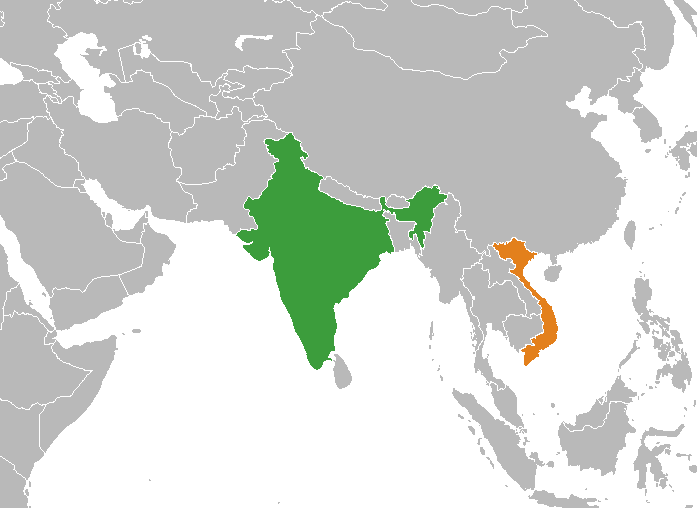
This shape affects every itinerary. Vietnam is not organised around one central tourism hub, so Hanoi cannot serve as a convenient base for Hoi An or Ho Chi Minh City. North, Central and South Vietnam each have their own airport gateways, regional road circuits and weather patterns.
For a first-time route, Hanoi’s Noi Bai International Airport is the main northern gateway, Da Nang International Airport is the simplest gateway for Da Nang and Hoi An, and Ho Chi Minh City’s Tan Son Nhat International Airport anchors most southern itineraries. Other regional airports can be useful for specific destinations, but these three gateways make the national route easiest to understand.
Airlines may operate direct India–Vietnam services on selected routes and dates, including connections involving Delhi, Mumbai, Hanoi and Ho Chi Minh City. Frequencies can change, so the route should be based on the timetable available for the actual travel dates rather than a permanent assumption about direct flights.
Vietnam Story planning note: A geographic map shows the order of destinations, but the flight schedule determines usable holiday time. A direct flight arriving close to midnight may be less valuable than a well-timed connection arriving in the morning.
Can you travel from India to Vietnam by road?
For a normal Vietnam holiday, flying is the practical way to travel from India. There is no simple direct India–Vietnam road crossing: an overland journey would pass through multiple countries and depend on each country’s current border, visa and vehicle rules. That makes it a specialist overland trip rather than a useful alternative to a flight for most travellers.
If your goal is simply to reach Vietnam efficiently, choose the Vietnam gateway that fits the route you want—Hanoi for the North, Da Nang for Central Vietnam or Ho Chi Minh City for the South. If you are researching an overland expedition, verify every border and vehicle requirement from current official sources before treating the route as bookable.
Vietnam route map at a glance
The simplest Vietnam route follows three regional clusters connected by one or two domestic flights. Road transfers work inside each cluster, while flights are normally used to move between North, Central and South Vietnam.

| Route section | Logical order | Main transport | Optional extension |
|---|---|---|---|
| North Vietnam | Hanoi → Ninh Binh → Ha Long Bay → Hanoi | Road, train and cruise transfer | Sapa with additional nights |
| North to Central | Hanoi → Da Nang | Domestic flight or long-distance train | None needed for a standard route |
| Central Vietnam | Da Nang → Hoi An → optional Hue | Road or regional train | Hue when the trip has enough time |
| Central to South | Da Nang → Ho Chi Minh City | Domestic flight | None needed for a standard route |
| South Vietnam | Ho Chi Minh City → Mekong Delta | Road and local boat | Phu Quoc by domestic flight |
A full linear journey therefore follows one of two directions:
- North to South: India → Hanoi → Ninh Binh → Ha Long Bay → Da Nang → Hoi An → Ho Chi Minh City → Mekong Delta.
- South to North: India → Ho Chi Minh City → Mekong Delta → Da Nang → Hoi An → Hanoi → Ninh Binh → Ha Long Bay.
Phu Quoc and Sapa should be treated as extensions rather than compulsory stops. Each destination requires additional travel time and usually works best when another major component is removed or the trip is extended. If the island follows a northern route, compare our Hanoi → Phu Quoc guide; if it follows a southern mainland block, use the Ho Chi Minh City → Phu Quoc guide instead.
The core route rule: travel in one direction
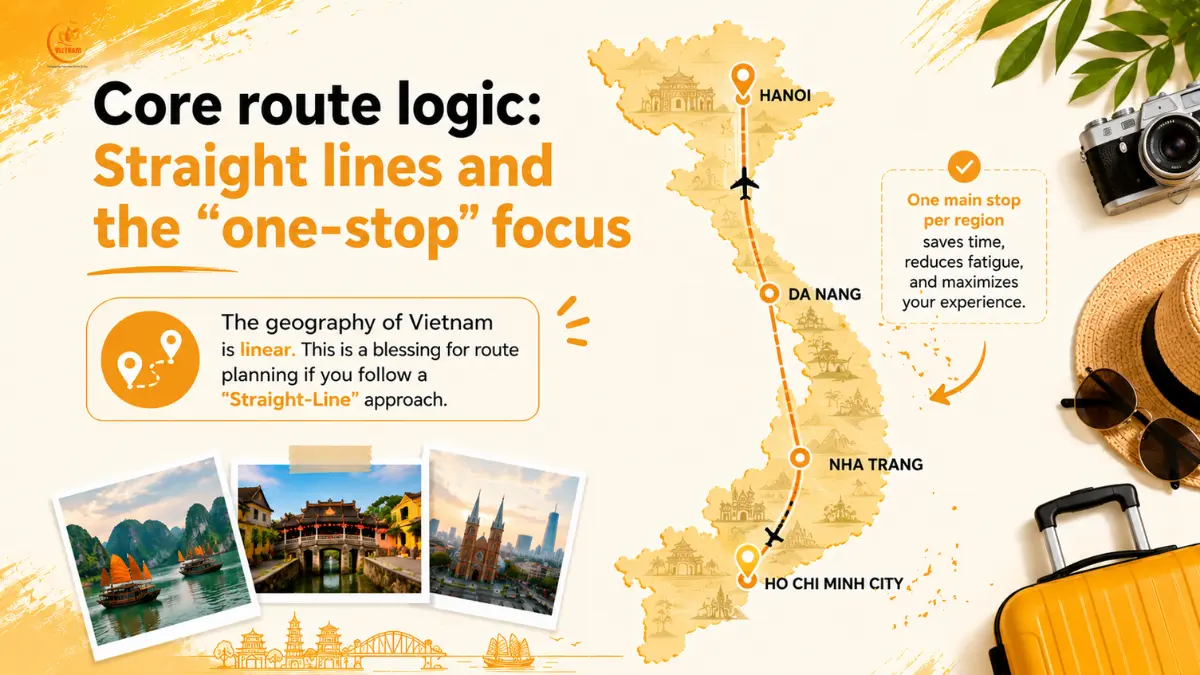
A practical Vietnam route moves steadily north to south, south to north or remains within one region. Backtracking is justified only when the flight schedule or international fare creates a clear overall advantage.
North-to-south route
A north-to-south itinerary normally begins in Hanoi, continues to Da Nang and finishes in Ho Chi Minh City. The sequence moves from traditional northern city culture and limestone scenery to Central Vietnam’s beaches and heritage towns, followed by the warmer urban and river landscapes of the south.
North-to-south works well when the flight from India arrives conveniently in Hanoi and the return journey can depart from Ho Chi Minh City. The route also keeps heavier shopping towards the end, which can simplify baggage management on domestic flights.
South-to-north route
A south-to-north itinerary begins in Ho Chi Minh City, moves to Da Nang and finishes in Hanoi. This order may be better when the most practical flight from India lands in Ho Chi Minh City or when the traveller wants the final part of the trip to include Ha Long Bay or cooler northern conditions.
A couple beginning in Ho Chi Minh City can start with restaurants and city experiences, slow down in Hoi An and finish with an overnight northern cruise. The same destinations feel different because the emotional pace of the trip changes.
One-region route
A one-region route is usually the strongest choice for 5 to 6 days. North Vietnam offers the greatest landscape contrast, Central Vietnam creates the easiest beach-and-heritage holiday, and South Vietnam combines a major city with river or island experiences.
The zigzag route to remove
A route such as Hanoi → Ho Chi Minh City → Da Nang → Hanoi repeats part of the country and creates avoidable airport sectors. A lower individual airfare does not necessarily produce a cheaper holiday after baggage, airport transfers, additional hotel nights and lost sightseeing time are included.
Vietnam Story planning note: List every overnight base in order before buying flights. When the route crosses back over itself, test whether a different arrival airport, departure airport or destination sequence removes the backtracking.
Which Vietnam airport should Indian travellers use?
Hanoi is the simplest gateway for North Vietnam, Da Nang for a Da Nang–Hoi An route and Ho Chi Minh City for South Vietnam. Multi-region itineraries are generally more efficient when the traveller arrives through one gateway and departs through another.
If you need the airport names, IATA codes or a destination-by-destination gateway comparison, use our Vietnam airport names and codes guide.
| Trip plan | Recommended arrival | Recommended departure | Route logic |
|---|---|---|---|
| North Vietnam only | Hanoi | Hanoi | Hanoi connects naturally with Ninh Binh, Ha Long Bay and Sapa |
| Central Vietnam only | Da Nang | Da Nang | Da Nang is the nearest major airport for Hoi An |
| South Vietnam only | Ho Chi Minh City | Ho Chi Minh City | The city connects with the Mekong Delta and flights to Phu Quoc |
| North and Central | Hanoi | Da Nang | Removes a return flight to Hanoi |
| Central and South | Da Nang | Ho Chi Minh City | Creates a linear beach-to-city route |
| Full Vietnam | Hanoi | Ho Chi Minh City | Supports a continuous north-to-south journey |
When an open-jaw flight is useful
An open-jaw journey means arriving in one Vietnamese city and returning to India from another. For example, a traveller may enter through Hanoi and depart through Ho Chi Minh City instead of taking another domestic flight back to Hanoi.
Open-jaw tickets are not automatically cheaper. Their value comes from reducing backtracking, airport time and the risk created by a separate final connection. Compare the complete fare and baggage rules with the cost of returning to the original gateway.
When a round-trip ticket is simpler
A round-trip ticket is usually practical for a one-region journey. A five-night North Vietnam itinerary can begin and end in Hanoi, while a Da Nang and Hoi An holiday can use Da Nang in both directions when suitable flights are available.
Travellers departing from an Indian city with a direct service on their dates may preserve more usable time. Travellers beginning in Bengaluru, Chennai, Hyderabad, Jaipur, Guwahati or another city that requires a connection should calculate the trip from their first Indian departure, not only from the international gateway.
If the international flight is still undecided, compare the country-level options in our India to Vietnam flight guide before choosing the entry airport. This page should then be used to decide how that airport fits the Vietnam route itself.
When should travellers fly, drive or take the train?
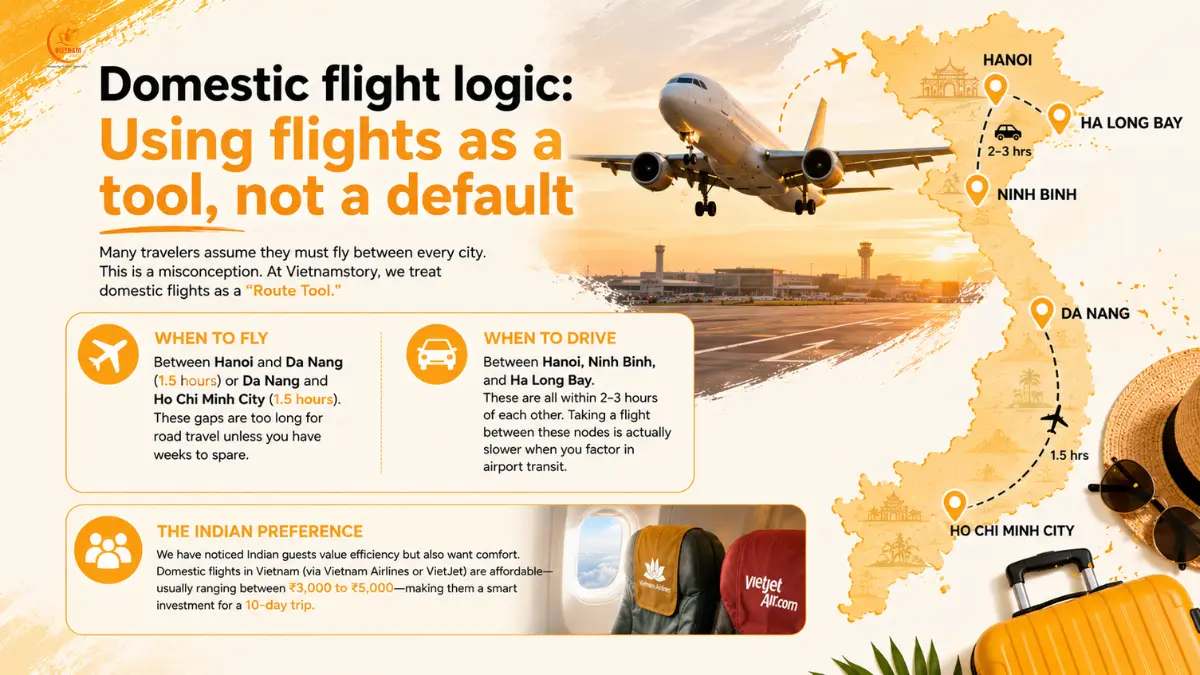
Flights are most useful between North, Central and South Vietnam. Road transfers work better inside regional clusters. Trains can add scenery and local experience, but they require more time and should not be selected only to avoid flying.
If you are still choosing the transport mode rather than the route itself, compare our Vietnam transportation guide. It separates the role of road, rail and air transport after the route has already been chosen.
\n\n\nFor long North–Central–South sectors, the domestic flights guide explains when flying saves enough door-to-door time to justify the airport transition.
| Connection | Practical transport | Planning logic |
|---|---|---|
| Hanoi to Ninh Binh | Road or train | Both destinations belong to the northern cluster |
| Hanoi to Ha Long Bay | Road transfer | The cruise transfer forms part of the northern route |
| Hanoi to Sapa | Road or overnight train | The decision depends on comfort and available nights |
| Hanoi to Da Nang | Flight or long-distance train | Flying saves time; rail suits a slower itinerary |
| Da Nang to Hoi An | Road transfer | Hoi An uses Da Nang as its main airport gateway |
| Da Nang to Hue | Road or train | The journey can become part of the Central Vietnam experience |
| Da Nang to Ho Chi Minh City | Flight | The cities belong to different regional clusters |
| Ho Chi Minh City to Mekong Delta | Road and local boat | The Mekong belongs to the southern mainland circuit |
| Ho Chi Minh City to Phu Quoc | Flight or overland-and-ferry route | Flying is normally more practical in a limited holiday |
A short flight is not always the fastest option. Hanoi, Ninh Binh and Ha Long Bay connect by road, so airport procedures would make those sectors less efficient. Hanoi and Da Nang belong to different regions, making a flight more useful when time is limited.
A senior traveller may prefer a daytime regional flight rather than an overnight train. A younger couple with a longer trip may enjoy the rail journey and accept the slower pace. The transport decision should match the traveller’s comfort, not only the map.
How trip length changes the geography of the route
Trip length matters here only because it limits how many regional transfers the route can absorb. The detailed question — “is five, seven or ten days enough?” — belongs in our Vietnam trip-length guide. On this page, the more useful question is what geographic shape still makes sense after the airport and hotel transitions are counted.
| Available time | Route shape that usually works | Typical gateway logic | Transfer pattern |
|---|---|---|---|
| 4–5 days | One region | Arrive and depart through Hanoi, Da Nang or Ho Chi Minh City according to the chosen region | Mostly road or rail inside the regional cluster |
| 6 days | One complete region, or one controlled second region | Round trip for a focused trip; open-jaw only when the second region clearly earns the move | Usually zero or one domestic flight |
| 7–9 days | Two regions is the natural structure; three regions becomes a faster breadth-first option | Different arrival and departure gateways become more useful | Usually one domestic flight for two regions, two for three |
| 10 days | Linear North–Central–South route becomes practical | Hanoi in / Ho Chi Minh City out, or the reverse | Two long regional flights plus ground travel inside each cluster |
| 12–14 days | The same three-region route with more depth | Open-jaw remains the cleanest shape | Two long regional flights, with more room for Ninh Binh, Hue or slower days |
| 15+ days | Keep the linear core and add depth rather than extra zigzags | Open-jaw remains useful | Add Sapa, Phong Nha or Phu Quoc only when the extension receives enough nights |
MAP → TRIP LENGTH
Once the geography is clear, compare the route by the number of days you actually have
The map tells you which regions connect naturally. The duration pages tell you how much of that map can fit without turning airports and hotel changes into the main experience.
For a short trip, the map should become smaller rather than busier. A northern route can stay around Hanoi, Ninh Binh and Ha Long Bay; Central Vietnam can stay around Da Nang, Hoi An and optional Hue; the South can centre on Ho Chi Minh City with one mainland excursion. These are regional clusters, not instructions to collect every stop inside them.
Once the trip can support two regions, the cleanest combinations are usually North + Central or Central + South. They create a clear change of scenery with one long flight. A three-region trip should remain linear — Hanoi → Da Nang → Ho Chi Minh City, or the reverse — so each airport moves the journey forward instead of undoing distance already travelled.
If you already know the exact number of days, open the matching itinerary from the Vietnam itinerary decision guide. That is where the day-by-day trade-offs belong; this route map should stay focused on geography, gateways and the transfer logic between regions.
How to test whether a Vietnam route is realistic
A realistic route gives every major destination enough usable time, limits hotel changes and protects the international departure. A route that looks attractive as a list may become impractical after nights and transport blocks are added.
| Keep in the route | Remove or reconsider |
|---|---|
| Arrival airport and realistic hotel arrival time | Three regions in five to seven days |
| Every overnight base, including cruise nights | An ordinary city stop with only one night |
| Regional road transfers and domestic flights | Phu Quoc as a quick one-night addition |
| Weather-dependent cruises and boat trips | Sapa inside a compressed full-country route |
| At least one three-night base in a longer trip | A cruise return followed by a tight regional flight |
| A buffer before the international departure | A separate domestic flight immediately before flying home |
An ordinary city stop generally needs at least two nights to justify another hotel check-in and transfer. A one-night cruise is different because the accommodation itself is part of the experience.
Fewer hotels do not automatically create a relaxed route. Ho Chi Minh City with two long road excursions can still feel tiring, while an overnight cruise followed by a three-night Hoi An stay may create a better rhythm despite using more properties.
A Jain couple may benefit from longer stays because reliable meal arrangements do not need to be explained to a new kitchen every night. A family with children may value unpacking for three nights even when another destination looks close on the map.
Practical route-mapping checklist

A route should be tested against flight times, hotel nights, meal needs and weather before it becomes a confirmed itinerary.
- Mark the international arrival time, not only the arrival date.
- Count usable sightseeing days after late arrivals and early departures.
- Keep one region for most trips of 5 to 6 days.
- Use one regional flight for most 8 to 10-day itineraries.
- Keep at least one three-night accommodation base.
- Do not combine a cruise return with a tight flight.
- Protect the international departure from a separate domestic ticket.
For broader destination, transport and trip-preparation context, consult the Vietnam travel guide for Indian travellers.
Frequently asked questions about the Vietnam route map from India
What is the best Vietnam route from India?
The best route depends on usable days. Keep four to five days inside one region; six days can support one controlled regional jump; seven to nine days works naturally for two regions; and at ten days a linear Hanoi–Da Nang–Ho Chi Minh City route becomes practical.
Should I start Vietnam in Hanoi or Ho Chi Minh City?
Start in Hanoi for North Vietnam or a north-to-south journey. Start in Ho Chi Minh City for South Vietnam or a south-to-north journey. When either direction works, use the gateway with the better flight schedule and route order.
Can I cover North and South Vietnam in seven days?
North and South Vietnam can be connected by air in seven days, but the route will omit Central Vietnam and feel structured. Most first-time travellers receive more value from one region or two simple bases within a week.
Is an open-jaw flight better than a round trip?
An open-jaw flight is useful when it removes backtracking in a multi-region itinerary. A round trip is simpler for a one-region holiday. Compare the total airfare and baggage rules with the cost of returning to the original airport.
Build the route before selecting the package
A useful Vietnam route map does more than show where destinations are located. It explains which places belong together, when a flight saves time, how many nights each regional cluster needs and which addition would place unnecessary pressure on the trip.
For most Indian travellers, the clearest geographic rule is simple: keep short trips inside one region, use one regional flight when a one-week trip genuinely needs two regions, and let a ten-day first trip move in a straight North → Central → South line. The right map should remove backtracking, not encourage more pins.
If the route is clear but coordinating gateways, domestic flights, hotels, transfers, sightseeing and meal requirements would be difficult, compare the Vietnam tour packages for Indian travellers and use the preferred route as the basis for a customised trip.