

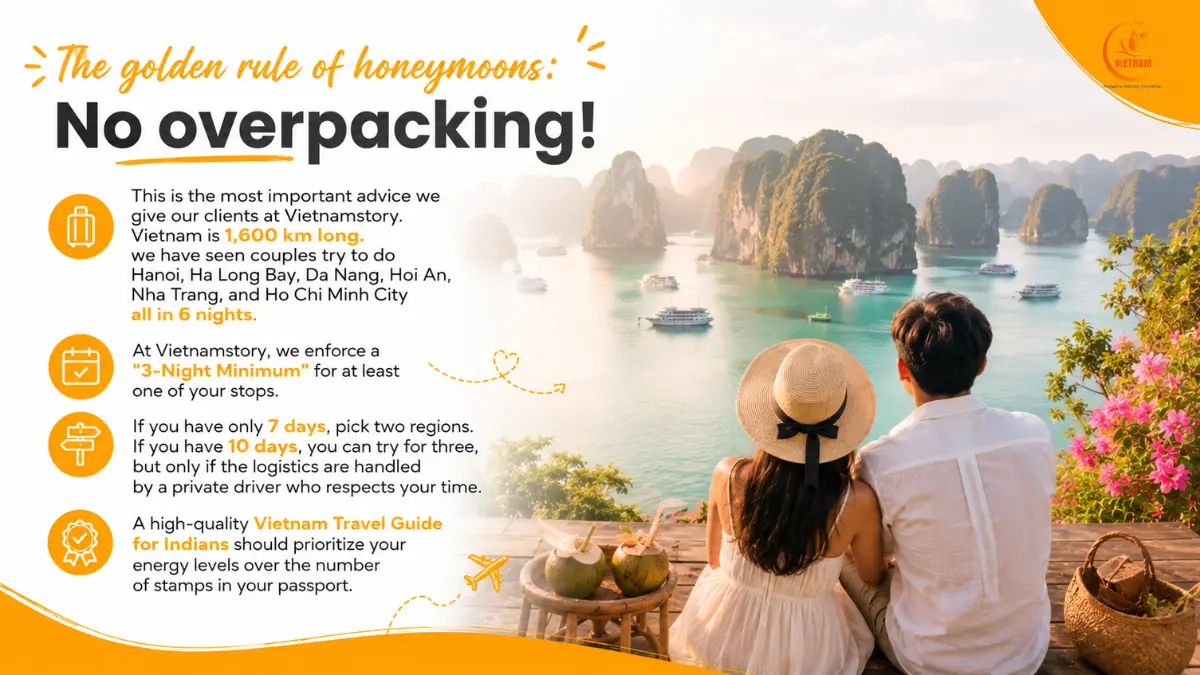
For most Indian couples, the best Vietnam honeymoon itinerary lasts 7 to 10 days and covers no more than two regions. North and Central Vietnam are ideal for couples who want limestone scenery, an overnight cruise and relaxed evenings in Hoi An. Da Nang and Hoi An work better for a slower beach-led honeymoon, while Central and South Vietnam combine resort time with city energy. The biggest mistake is fitting Hanoi, Ha Long Bay, Da Nang, Hoi An, Ho Chi Minh City and an island into one rushed week.
If you are leaving soon after the wedding, allow a gentle start before adding busy sightseeing days. Your flight times, food preferences and the amount of beach or resort time you want will help you choose between the routes below.
Is Vietnam good for a honeymoon?

Vietnam is a strong honeymoon destination for couples who want more variety than a single-resort holiday. One itinerary can combine historic neighbourhoods, calm river landscapes, an overnight cruise, beach hotels, food experiences and lively evenings without requiring another international flight between each setting.
Vietnam also suits couples who do not share exactly the same travel style. One partner may want local food, history and full sightseeing days. The other may value a hotel pool, a late breakfast and an evening without reservations. A well-paced route can provide both without turning every day into a compromise.
If you want to unpack once and stay at a resort, focus on one beach destination. Phu Quoc or a beach-led stay around Da Nang can offer a slower experience, but a classic multi-city Vietnam trip naturally involves transfers, domestic flights and several hotel check-ins.
For Indian honeymooners, accessibility is another advantage. Airlines currently advertise direct services on selected India–Vietnam routes, including connections from Delhi and Mumbai to Hanoi or Ho Chi Minh City. Other departure cities may have seasonal, limited-frequency or one-stop options, so schedules should be reconfirmed before the itinerary is built. A direct flight can make the first day usable; an overnight connection may turn the same calendar date into a recovery day.
Vietnam Story planning note: A honeymoon should not be measured by the number of attractions completed. A better test is whether the itinerary leaves enough energy for a slow breakfast, an unplanned evening and at least one day without an early departure.
How many days are enough for a Vietnam honeymoon?
Seven days are enough for one region or two closely connected bases. Ten days allow two regions at a comfortable pace. Twelve to fourteen days make it possible to combine North, Central and South Vietnam, provided the flights and arrival airports prevent unnecessary backtracking.
| Honeymoon length | Realistic geographic scope | Recommended accommodation bases | Best suited to |
|---|---|---|---|
| 5 to 6 days | One region | One or two | A mini-moon, beach stay or couples with limited leave |
| 7 to 9 days | One region in depth or two connected regions | Two or three | Most first-time couples travelling from India |
| 10 to 11 days | Two regions comfortably | Three or four | Couples wanting scenery, culture and downtime |
| 12 to 14 days | Three regions with careful flight planning | Four or five | Couples taking a longer post-wedding holiday |
A seven-night booking does not always provide seven sightseeing days. A couple arriving in Hanoi in the morning may have time for a relaxed Old Quarter walk on day one. A couple reaching the hotel after a late one-stop journey from Bengaluru, Chennai, Jaipur or Guwahati may need the same evening for dinner and sleep.
The final day also matters. A morning international departure can remove almost an entire day from the itinerary, while an evening flight may leave time for breakfast and a short local activity. Count usable days rather than hotel nights before adding another destination.
For a broader comparison between trip duration and regional coverage, use the guide to how many days are enough for Vietnam.
What makes a honeymoon itinerary feel comfortable?
A comfortable Vietnam honeymoon itinerary usually includes no more than one major activity per half-day, one base of at least three nights and no unnecessary domestic flights. Vietnam is long and narrow, so destinations that look close on a country map may still require a flight, a long road transfer or both.
Three hotel changes over ten nights can feel manageable. Five hotel changes over the same period often make the trip feel like a chain of receptions, luggage counters and check-in forms. An overnight cruise can justify a one-night stay because the accommodation is part of the experience. An ordinary one-night city hotel rarely creates the same value.
A couple leaving India immediately after several days of wedding functions may enjoy Vietnam more by starting with three nights in one comfortable base. Flying to another region on the morning after arrival may be efficient on paper, but it gives the couple almost no time to recover from the wedding, airport journey and immigration process.
Vietnam Story planning note: Calculate a domestic flight from hotel door to hotel door, not only by the time printed on the airline ticket. Packing, check-out, airport transfer, security, baggage collection and another hotel transfer can occupy most of a morning or afternoon.
Where should couples go in Vietnam?
For a first honeymoon in Vietnam, start by comparing four options: North and Central Vietnam, Da Nang and Hoi An, Central and South Vietnam, or a beach-led stay. The right route depends on the travel month, available leave, international flight schedule and whether the couple values a cruise, beach, heritage town or major city most.
A Delhi couple finding a convenient Hanoi arrival may naturally begin in North Vietnam. A Mumbai couple with a better Ho Chi Minh City schedule may find a south-to-central route more efficient. A couple travelling from a city that requires a connection should prioritise total journey time over forcing the itinerary to begin at a famous destination.
Couples comparing regional combinations can use the Vietnam route map for Indian travellers to understand which destinations connect naturally and which combinations create avoidable transfers.
Quick comparison of the best Vietnam honeymoon routes
North and Central Vietnam provide the greatest landscape variety. Da Nang and Hoi An offer the easiest slow-paced honeymoon. Central and South Vietnam combine beach time with an energetic city finish. A Phu Quoc-led route provides the most resort downtime but less cultural depth.
| Route | Recommended length | Main experiences | Pace | Main trade-off |
|---|---|---|---|---|
| Hanoi, Ninh Binh, Ha Long Bay and Hoi An | 9 to 11 days | Old Quarter, river scenery, overnight cruise and lantern evenings | Moderate | Several road transfers and one domestic flight |
| Da Nang and Hoi An | 5 to 7 days | Beach hotel, cafés, old town evenings and short excursions | Slow | Less regional variety |
| Da Nang, Hoi An and Ho Chi Minh City | 8 to 10 days | Beach time, old town, food, rooftops and southern history | Relaxed to moderate | Less limestone and mountain scenery |
| Hanoi, Ninh Binh and Ha Long Bay | 6 to 8 days | Culture, countryside and cruise | Moderate | Northern weather may affect visibility or outdoor plans |
| Phu Quoc with one city stop | 7 to 9 days | Resort, beach, spa and light sightseeing | Slow | Fewer cultural experiences |
Route 1: North and Central Vietnam for scenery and variety
Choose North and Central Vietnam if you want to combine limestone scenery, a cruise and evenings in Hoi An. Hanoi brings architecture, local food and street life. Ninh Binh slows the pace with river and countryside scenery. Ha Long Bay or Lan Ha Bay adds a night on the water. Hoi An gives the trip a gentler final chapter.
Suggested 10-day North and Central Vietnam honeymoon itinerary
- Day 1: Arrive in Hanoi. Check in, rest and take a gentle walk around Hoan Kiem Lake if the arrival time allows.
- Day 2: Explore Hanoi. Combine one cultural area with café time, local food and an unhurried evening.
- Day 3: Visit Ninh Binh. Take a river journey through Trang An or Tam Coc and return to Hanoi, or stay overnight for a slower countryside experience.
- Day 4: Travel to Ha Long Bay or Lan Ha Bay. Board an overnight cruise and spend the afternoon on the water.
- Day 5: Finish the cruise and return to Hanoi. Keep the evening light because disembarkation and the road journey take time.
- Day 6: Fly to Da Nang and continue to Hoi An. Plan only dinner or a short old town walk after checking in.
- Day 7: Explore Hoi An. Visit the old town during the quieter morning and return after the afternoon heat eases.
- Day 8: Add one shared experience. A cooking class, spa, countryside ride or beach afternoon is enough for one day.
- Day 9: Keep a flexible day. Add Da Nang, shopping, a beach stay or nothing beyond lunch and time by the pool.
- Day 10: Depart from Da Nang. Leave a realistic buffer between the hotel and airport.
After a quiet morning on the water in Ninh Binh, returning to Hanoi for dinner still feels manageable. Flying to another region that evening does not. Returning to Hanoi leaves you time for dinner and rest. An evening flight adds packing, airport transfers and another hotel check-in.
A couple who enjoys active mornings may add the Hang Mua viewpoint. A couple still tired after wedding events may prefer the Trang An boat journey and skip the steep climb. Choose the boat trip on its own if you would rather save your energy for the evening.
For activity ideas and mobility considerations, see the best things to do in Ninh Binh.
Ha Long Bay or Lan Ha Bay for a honeymoon?
Ha Long Bay has greater name recognition and a wider selection of cruise styles. Lan Ha Bay may appeal to couples who prefer a quieter visual atmosphere, although the actual experience depends on the sailing route, vessel, cabin category and conditions on the day.
An overnight cruise usually suits a honeymoon better than a rushed day trip because couples can experience sunset, dinner and the quieter early morning. Before confirming, check the cabin layout, balcony type, transfer arrangement, meal process and weather-related cancellation policy.
A Jain couple should not wait until boarding to explain food restrictions. Cruise meals are prepared within a fixed operating schedule, so requirements involving onion, garlic, root vegetables, egg or shared cooking surfaces need written confirmation in advance.
The Ha Long Bay and Lan Ha Bay comparison explains the practical differences in more detail.
Route 2: Da Nang and Hoi An for a slower honeymoon
Da Nang and Hoi An form the easiest Vietnam honeymoon route for couples who want fewer hotel changes, beach access and evenings that do not require detailed planning. The destinations are close enough to combine without another domestic flight during the stay.
This route is especially relevant for couples travelling in July or August. Vietnam’s official tourism guidance notes that Da Nang generally sees little rain from June to August, with clearer and calmer sea conditions. Hoi An can be hot during the same period, but Central Vietnam often provides a useful seasonal contrast for Indian couples travelling during the monsoon months at home.
You may still get short showers and very hot afternoons, so leave some flexibility for a spa, café or time at the hotel. If you add Hue, check its weather separately from Da Nang.
Suggested 6-day Da Nang and Hoi An mini-moon
- Day 1: Arrive in Da Nang. Transfer to a beachfront hotel or continue to Hoi An, depending on the preferred atmosphere.
- Day 2: Begin slowly. Add a spa, pool session or beach walk before spending the evening in Hoi An Ancient Town.
- Day 3: Explore local culture. Select a cooking class, countryside ride or craft activity rather than combining all three.
- Day 4: Take one larger excursion. Ba Na Hills, My Son Sanctuary or the Marble Mountains can fit here, but each creates a different pace.
- Day 5: Leave the day partly unplanned. Return to the beach, shop for tailored clothing or book a quiet dinner.
- Day 6: Depart from Da Nang. Do not place a distant excursion before the flight.
Hoi An is one of the few places where leaving an evening open can be more rewarding than buying another ticket. A couple may begin with coffee, walk through the old streets, stop for dinner and decide on a short river ride only after reaching the waterfront.
Couples who enjoy photography may visit Hoi An once in daylight and again after dinner. During the day, the old houses and workshops are easier to notice. In the evening, the pace changes and the couple can walk without treating every corner as a scheduled photo stop.
A couple travelling with parents for part of the honeymoon may value a Da Nang resort with lifts, vehicle access and a pool. A couple travelling alone may prefer a smaller Hoi An property within walking distance of cafés. The better base depends on daily comfort, not only the room photographs.
Compare beach time and city excursions in the guide to things to do in Da Nang.
Couples planning several old town evenings can also explore the best things to do in Hoi An.
Route 3: Central and South Vietnam for beach and city energy
Central and South Vietnam suit couples who want a resort stay followed by a livelier city finish. Da Nang and Hoi An provide beach access and slower evenings, while Ho Chi Minh City adds restaurants, markets, museums, rooftop views and possible day trips.
Suggested 9-day Central and South Vietnam honeymoon itinerary
- Days 1 to 3: Stay in Hoi An or Da Nang. Combine one excursion with beach time, a spa and at least one free evening.
- Day 4: Use a flexible Central Vietnam day. Visit Ba Na Hills, explore Da Nang or remain at the resort.
- Day 5: Fly to Ho Chi Minh City. Plan only dinner or a short evening walk after arrival.
- Day 6: Explore central Ho Chi Minh City. Select a few meaningful stops and leave time for cafés or a rooftop evening.
- Day 7: Take one day trip. The Mekong Delta and Cu Chi Tunnels involve different themes and travel patterns, so combining both may feel rushed.
- Day 8: Keep a city leisure day. Add shopping, a food experience, a spa or a long lunch.
- Day 9: Depart. Allow additional transfer time because city traffic can affect the airport journey.
A beach morning in Da Nang followed by a late flight and a full Ho Chi Minh City tour the next day may look efficient on paper. In practice, the couple may remember the alarms and luggage more clearly than the beach. Keeping the arrival evening empty makes the city section feel fresher.
Ho Chi Minh City requires fewer hotel changes than a multi-stop northern journey, but two long road excursions can still make the stay feel busy. A couple interested in history may value one excursion. A couple who has already spent several days sightseeing may get more from an unplanned afternoon and a special dinner.
Route 4: A beach-led honeymoon with maximum downtime
A beach-led itinerary is the strongest choice for couples who feel exhausted after a large wedding, dislike frequent packing or value privacy more than destination count. Phu Quoc or a Central Vietnam beach hotel can serve as the main base, with one city added only when the flight route and total duration support it. If Phu Quoc is the base, use our Where to Stay in Phu Quoc guide to choose between Long Beach, Ong Lang, the north and the south before comparing individual resorts.
A practical seven-night structure could include two nights in Ho Chi Minh City and five nights at a beach resort. Another option is to spend the entire stay around Da Nang and Hoi An, where beach time and cultural evenings can be combined without another domestic flight.
A couple arriving after a one-stop journey should treat the first night as a transfer night rather than scheduling a sunset cruise or formal dinner. The holiday begins more comfortably the next morning, when neither partner is checking the time after immigration and baggage collection.
Beach conditions vary by region and month. A resort photograph does not guarantee calm water or clear skies on every date. Select the coast after reviewing regional weather, then reconfirm the short-term forecast close to departure.
If you prefer to keep the whole trip on the island, compare the 5-day Phu Quoc honeymoon itinerary with the longer beach-and-city route above. Check how much resort time remains around the listed excursions, and confirm the room, transfers, flights and any honeymoon extras in your written quotation.
What should couples see on a Vietnam honeymoon?
The most rewarding honeymoon sights create a change of atmosphere rather than another checklist entry. You do not need every kind of experience on one honeymoon. Pick the places you both enjoy, whether that means a cruise, an old-town walk or several quiet beach days.
- Hanoi Old Quarter and Hoan Kiem Lake for walkable city atmosphere, cafés and local food.
- Trang An or Tam Coc in Ninh Binh for a calm river journey among limestone formations.
- Ha Long Bay or Lan Ha Bay for an overnight cruise and time away from city traffic.
- Hoi An Ancient Town for late-afternoon walks, riverside evenings and a slower daily rhythm.
- Da Nang coastline for beach hotels, modern facilities and access to Central Vietnam excursions.
- Ho Chi Minh City for food, history, markets and energetic evenings.
What should couples do in Vietnam?

The best honeymoon activities give the couple a shared experience without making every day tiring. One meaningful activity per day is often enough when it is combined with time to eat, rest and explore independently.
Spend one night on the water
An overnight bay cruise creates a natural pause between city stays. Select the cabin and schedule carefully, especially if a private balcony, quieter route or dietary arrangement matters more than the number of onboard activities.
Leave one Hoi An evening open
Hoi An does not need a minute-by-minute evening plan. Walk through the old town after the heat eases, stop where the atmosphere feels right and decide later whether to take a short boat ride, have dessert or return to the hotel.
Make time for a couples’ spa
A couples’ spa session works well after a transfer day or midway through the itinerary. Confirm the treatment length, privacy, therapist preferences and whether the property has a dedicated couples’ room.
Share a food or craft activity
A cooking class, coffee workshop or lantern-making session can create a more personal memory than another viewpoint. Vegetarian and Jain couples should explain ingredient restrictions before booking because sauces, broths and cooking surfaces may need clarification.
Plan photographs without turning the trip into a photo shoot
A short photography session in Hanoi, Hoi An or Da Nang can provide polished photographs without taking over the day. Sunrise may offer softer light and fewer crowds, but only when an early start will not reduce the enjoyment of the previous evening.
What should couples skip?
Couples should skip any stop that creates more transfer time than shared experience. The common problem is not selecting the wrong attraction. It is adding too many worthwhile attractions to an itinerary that cannot hold them comfortably.
- Three regions in seven days. The itinerary may be technically possible, but airports and hotel transitions will dominate the holiday.
- Back-to-back sunrise starts. One early morning can be worthwhile. Several in a row shorten the evenings and increase fatigue.
- Two long road excursions from the same city. Remaining in one hotel does not create a relaxed itinerary when every day includes hours in a vehicle.
- An attraction selected only for photographs. Check transfer time, queues, walking load and weather exposure before adding it.
- A late domestic flight before an international departure. Separate tickets and tight connections leave little room for disruption.
- A new hotel for one ordinary night. Add a one-night stay only when the accommodation is an important part of the experience.
Where should honeymoon couples stay?
Choose a hotel that makes your days easier as well as giving you a room you look forward to returning to. Location, sound insulation, lift access, breakfast timing, room layout and transfer convenience can affect the trip more than decorative extras.
| Destination | Useful base | Best for | What to confirm |
|---|---|---|---|
| Hanoi | Old Quarter edge or French Quarter | Walkability with easier vehicle access | Street noise, lift access and airport pickup point |
| Ninh Binh | Tam Coc or Trang An area | Countryside atmosphere and slower mornings | Restaurant access and evening transport |
| Ha Long Bay or Lan Ha Bay | Overnight cruise cabin | Scenery and a distinct one-night experience | Cabin category, balcony, meals and transfer method |
| Hoi An | Old town edge, riverside or nearby beach | Atmospheric evenings and cafés | Walking distance, shuttle service and seasonal conditions |
| Da Nang | Beachfront or riverside | Resort facilities and airport convenience | Road noise, beach access and distance from restaurants |
| Ho Chi Minh City | Central area with convenient road access | Dining, history and nightlife | Traffic noise and airport transfer timing |
A hotel pool may matter more than an additional museum after several transfer days. A central hotel may save more usable time than a larger room far from the places the couple plans to visit. The best room supports the itinerary rather than competing with it.
How July and August weather affects a Vietnam honeymoon
July and August can be good months for a Central Vietnam honeymoon, particularly around Da Nang and Hoi An. Official Vietnam tourism guidance describes June to August in Da Nang as a period with relatively little rain and generally clearer, calmer sea conditions. Hoi An is usually hot during these months, so outdoor activities are more comfortable in the morning or later afternoon.
This seasonal pattern can work well for Indian couples travelling during the monsoon period at home. A couple from Mumbai planning a late-July beach honeymoon may find Da Nang and Hoi An more suitable than building the entire trip around weather-sensitive northern scenery.
North Vietnam remains possible in July and August, but rain, heat, cloud and tropical weather systems can affect visibility or cruise operations. A northern route needs a stronger fallback plan than a Central Vietnam itinerary focused on cafés, spas, beach hotels and Hoi An evenings.
Vietnam does not have one nationwide climate. Hue, Da Nang, Hoi An, Hanoi and Phu Quoc can experience different conditions during the same week. Review the regional guide to Vietnam’s weather before selecting the route, then check the short-term forecast again before departure.
What is the fallback plan if weather affects the main activity?
For a cruise, island outing or viewpoint, keep a quieter alternative in mind in case the weather changes. Cruise operations, island excursions, cable cars and outdoor viewpoints may change because of local conditions or operating decisions.
- If a bay cruise changes, keep an additional Hanoi or Ninh Binh plan available instead of immediately adding a distant city.
- If beach weather is poor, use a flexible day for a spa, cooking activity, café route, museum or long meal.
- If an outdoor viewpoint becomes unsuitable, replace it with a lower-intensity experience rather than changing the whole route.
- If a domestic flight changes, protect the international departure by spending the final night in the departure city where practical.
Vietnam Story planning note: Do not make one weather-dependent activity the only reason for visiting a region. Every accommodation base should have at least one indoor, low-intensity or flexible alternative.
What affects the cost of a Vietnam honeymoon from India?
The cost of a Vietnam honeymoon depends more on travel style and the number of flights and hotel changes than on the number of attractions alone. International flights, hotel category, domestic flights, cruise cabin, private transfers, resort location and seasonal demand generally have the greatest impact.
| Cost factor | Why it matters | Practical decision |
|---|---|---|
| Departure city in India | Direct and one-stop schedules create different fares and usable travel time | Compare total journey time, baggage and arrival hour |
| Number of regions | Each additional region may require another flight and transfer | Remove one region before reducing every hotel category |
| Hotel location | Beachfront, central and heritage locations carry different premiums | Spend more where the setting improves the daily experience |
| Overnight cruise | Cabin type, vessel standard and inclusions vary | Compare cabin, meals, transfer and sailing route together |
| Private transport | Private transfers improve convenience but cost more than shared transport | Prioritise them for arrival, departure and complex transfer days |
| Dietary arrangements | Special meals may require advance coordination or selected restaurants | Value reliability over finding the cheapest meal every time |
| Travel dates | Flights and hotels may rise around holidays and high-demand periods | Confirm key components earlier when dates are fixed |
A couple may save more by visiting two regions instead of three than by reducing every hotel to a lower category. Fewer transfers also create more usable time, which is often the more valuable honeymoon upgrade.
Use the Vietnam trip cost guide for travellers from India to compare the main budget components without confusing a planning estimate with a fixed package price.
Package or DIY planning for a Vietnam honeymoon?
Independent planning suits couples who enjoy comparing hotels, arranging transfers and managing backup decisions. A coordinated package becomes more useful when the route includes several cities, a cruise, domestic flights, dietary requirements or limited planning time before the wedding.
A couple managing invitations, outfits, ceremonies and family logistics may have little appetite for coordinating cruise pickup points and domestic baggage rules. Another couple may enjoy planning every café and hotel independently. The better method depends on how much decision-making the couple wants to carry into the weeks before departure.
| Planning style | Best suited to | Main advantage | Main responsibility |
|---|---|---|---|
| Independent trip | Couples comfortable booking every element separately | Maximum control over hotels and daily plans | Managing suppliers, changes and communication |
| Partly coordinated trip | Couples wanting free days with support on the longer journeys | Balance between flexibility and logistics | Keeping separately booked elements compatible |
| Private customised package | Couples with multiple stops, dietary needs or limited planning time | One connected itinerary and local coordination | Providing clear preferences before confirmation |
A package does not need to schedule every hour. Hotels, transfers, cruise nights and key excursions can be coordinated while selected evenings and one half-day remain deliberately open.
How to personalise the itinerary for Indian couples
A useful honeymoon itinerary reflects the couple’s departure city, wedding schedule, food restrictions, energy level and preferred balance between privacy and sightseeing. The same ten-day route will not feel the same for every traveller.
For couples leaving immediately after the wedding
Start with two or three nights in one comfortable base rather than adding a domestic flight on the morning after arrival. Da Nang and Hoi An work well because the first days can remain light without feeling empty.
For couples departing from Delhi or Mumbai
Selected direct services may make Hanoi-first or Ho Chi Minh City-first routes practical, depending on the date. The best arrival city is the one with the most useful schedule, not automatically the city that appears first in a sample itinerary. Reconfirm current airline operations before making non-refundable bookings.
For couples departing from Bengaluru, Chennai, Hyderabad or other Indian cities
A connection can reduce usable holiday time even when the total airfare is attractive. A traveller reaching Vietnam late at night should not plan a domestic connection or major excursion the next morning. Adding one recovery night may improve the entire itinerary.
For vegetarian travellers
Vegetarian meals are available in major destinations, but the word “vegetarian” may not answer every ingredient question. Confirm whether broths, fish sauce, egg and shared cooking surfaces are acceptable. Send written requirements to cruise operators, cooking classes and remote properties before arrival.
For Jain travellers
Jain meal planning requires more detail than a general vegetarian request. Specify excluded root vegetables, onion, garlic, egg and any additional restrictions. A three-night stay in Hoi An allows a couple to establish one or two reliable meal arrangements. A one-night-per-city route forces the same explanation to begin again at every stop.
For senior couples or travellers with limited mobility
Select hotels with lifts, reduce steep viewpoints and ask how close vehicles can approach each attraction. Trang An can provide a scenic boat experience without the Hang Mua climb, while Hoi An may require planning around walking distance, heat and uneven surfaces.
For couples with different travel styles
Alternate structured and unstructured days. One partner may enjoy a full Hanoi sightseeing day, while the other values a late start and an evening without reservations. Building both preferences into the itinerary is easier than making every day a compromise.
Planning a Vietnam honeymoon from India

Planning from India starts with the international flight, not the hotel wish list. Arrival airport, departure airport and usable flight times determine whether a north-to-south route, a return journey or a single-region honeymoon makes sense.
Consider an open-jaw flight plan
Arriving in Hanoi and departing from Da Nang or Ho Chi Minh City may reduce backtracking. Compare the full fare, baggage conditions and schedules before assuming that a return ticket to the same city offers better value.
Verify direct flights for the actual travel date
Airlines advertise direct India–Vietnam services on selected routes, but operating days and frequencies can change. Check the airline’s current timetable before building the itinerary around a specific connection. A direct flight with a poor arrival time may still be less useful than a well-timed one-stop option.
Confirm visa details before non-refundable bookings
Vietnam operates an official electronic visa system, but eligibility, entry points, fees and processing procedures should be verified through the official immigration portal before payment. Names, passport numbers and travel dates must match the submitted documents.
The Vietnam e-visa guide for Indian passport holders explains the preparation steps and the details that need reconfirmation.
Allow recovery time after the wedding
A departure immediately after the final wedding function may look efficient but can make the first part of the honeymoon exhausting. Even one day at home can reduce the pressure of repacking, checking documents and reaching the airport after several busy events.
Check passport and booking-name consistency
Flight, visa and hotel bookings should use the name shown on the passport. Do not assume a name change connected to the wedding can be used immediately across every travel document. Verify all details before tickets and visa applications are submitted.
The Vietnam trip planning timeline can help sequence flights, documents, hotels, activities and final checks.
What should be booked in advance, and what should remain flexible?
International flights, distinctive accommodation, overnight cruises and complex transfers deserve early attention. Ordinary city activities, some restaurant choices and at least one leisure period should remain flexible.
| Book earlier | Keep flexible |
|---|---|
| International flights with useful arrival and departure times | One evening in Hoi An or Hanoi |
| Specific resort rooms or suites | One beach or pool half-day |
| Overnight cruise and preferred cabin category | Café, shopping and casual dining choices |
| Domestic flights connecting distant regions | Low-priority museums or viewpoints |
| Private transfers on complicated travel days | Activities affected by short-term weather |
| Special dietary arrangements for cruises or remote stays | One recovery period after a late arrival |
Leaving space does not mean failing to plan. It protects the itinerary from fatigue, weather changes and the possibility that the couple simply wants to stay longer somewhere they enjoy.
Practical Vietnam honeymoon checklist
Before you book, check your flight times, hotel changes and meal arrangements. Leave a little space to rest, especially if you are travelling straight after the wedding.
- Confirm the arrival and departure airports before selecting the route.
- Check direct-flight schedules for the actual travel dates.
- Count usable sightseeing days rather than only hotel nights.
- Limit a one-week itinerary to one or two regions.
- Keep at least one three-night accommodation base where possible.
- Check how much climbing and walking each outing involves.
- Share vegetarian, Jain, halal or allergy requirements in writing.
- Review regional weather for the actual month of travel.
- Confirm the fallback process for weather-dependent activities.
- Keep the final night near the international departure city when connections are complex.
- Leave one evening and one half-day unstructured.
For wider destination, transport and preparation guidance, consult the Vietnam travel guide for Indian travellers.
Frequently asked questions about a Vietnam honeymoon itinerary
Is Vietnam good for a honeymoon from India?
Vietnam is a strong honeymoon choice for Indian couples who want scenery, culture, beach time and city experiences in one trip. The country is most enjoyable when the itinerary covers one or two regions rather than attempting a countrywide sightseeing race.
What is the best Vietnam honeymoon itinerary for seven days?
For seven days, select either Hanoi, Ninh Binh and Ha Long Bay or Da Nang and Hoi An. The northern route provides more landscape variety and an overnight cruise. The Central Vietnam route offers fewer transfers, more beach time and slower evenings.
What is the best Vietnam honeymoon itinerary for ten days?
A ten-day honeymoon can comfortably combine Hanoi, Ninh Binh, an overnight bay cruise and Hoi An. Couples who prefer beach time and city energy may instead combine Da Nang, Hoi An and Ho Chi Minh City.
Is July or August good for a Vietnam honeymoon?
July and August can be good for a Da Nang and Hoi An honeymoon because the Central Vietnam coast generally experiences relatively sunny conditions during this period. The weather is hot, and short showers remain possible. North Vietnam can also be visited, but cruise and outdoor plans need more flexibility.
Is Ha Long Bay worth including on a honeymoon?
Ha Long Bay or Lan Ha Bay is worth including when the couple values an overnight cruise and can allow enough time for road transfers. A bay cruise is less suitable when the trip is very short or when adding it removes essential downtime elsewhere.
Should honeymooners stay in Da Nang or Hoi An?
Da Nang is better for modern beachfront hotels, airport convenience and a city-resort atmosphere. Hoi An is better for atmospheric evenings, smaller properties and walkable heritage streets. Remaining in one hotel may feel more relaxing than splitting a short stay.
How many hotel changes are reasonable in ten days?
Three or four accommodation bases are reasonable in ten days when one base is an overnight cruise. More frequent changes reduce relaxation unless every stop adds a clearly different experience.
Can vegetarian and Jain couples travel comfortably in Vietnam?
Vegetarian and Jain couples can travel comfortably with advance communication. Requirements should be shared in writing with hotels, cruise operators, guides and activity providers, especially outside major cities or when restrictions go beyond avoiding meat.
How early should a Vietnam honeymoon be booked?
Book earlier when wedding dates fix the travel window, when the trip overlaps a high-demand period or when a specific resort, suite or cruise cabin matters. International flights and distinctive accommodation normally deserve attention before flexible day tours.
Build the honeymoon around your pace, not a checklist
The best Vietnam honeymoon itinerary is not the one with the most cities. It is the one that gives both partners enough variety to feel they have travelled and enough space to feel they have had a honeymoon. For most Indian couples, that means 7 to 10 days, no more than two regions, one memorable overnight experience and several hours that remain deliberately unplanned.
If the route already feels right but coordinating hotels, transfers, a cruise, sightseeing and dietary requirements would add unnecessary pressure before the wedding, compare the Vietnam honeymoon options for Indian couples and use the preferred itinerary as the starting point for a customised trip.
Which honeymoon plan would you like to explore?
Would you rather stay by the beach or combine a cruise with a few days exploring? Start with the option you would both look forward to.
An island mini-moon
If five days on Phu Quoc sound closer to your ideal break, review the programme before adding a mainland city.
A cruise, some sightseeing or a beach stay?
Compare the honeymoon collection, then check hotel changes, free time and each package’s exact inclusions.
Your trip, your pace
Let’s shape your Vietnam honeymoon
Share your dates, departure city and budget for two. Tell us whether you prefer beach time, a cruise or cultural stops, plus any vegetarian or Jain requirements.
- 1. Share your plansDates, travellers and priorities.
- 2. Discuss the routeBalance sightseeing with rest.
- 3. Review the detailsCheck the itinerary and written inclusions.
We’ll use your contact details to discuss your travel request. Flights, rooms, meals and private or shared services should be confirmed in your written quotation.