
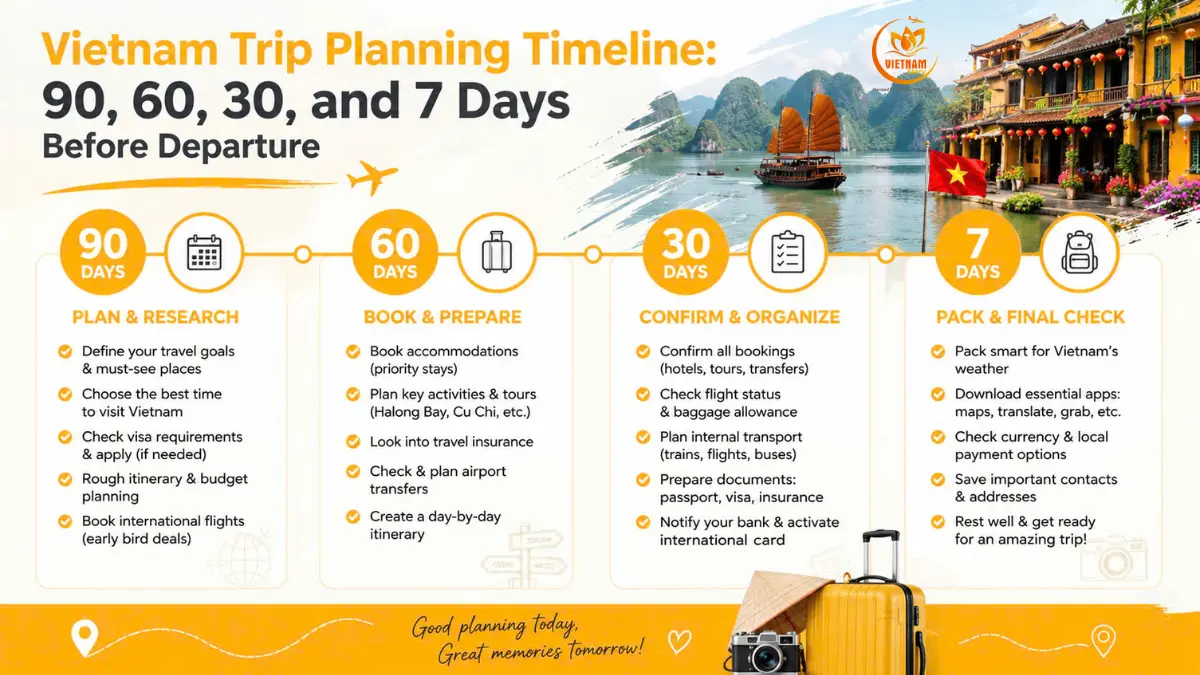
Start planning a Vietnam trip from India three to six months before departure when the dates are fixed. Confirm usable sightseeing days and the regional route first, compare international flights next, and apply for the Vietnam e-visa only after the passport details, entry point and expected departure date are clear. Book route-defining hotels, cruises and domestic flights before filling the itinerary with day tours. The biggest mistake is paying for separate components before checking that they form one workable journey.
This Vietnam trip planning timeline is designed for first-time Indian visitors, couples, families, multigenerational groups, senior travellers and travellers with vegetarian or Jain requirements. It explains which decisions need early commitment, which details can remain flexible and how each booking affects the next stage of the trip.
How early should you start planning a Vietnam trip from India?
Most Indian travellers should begin serious planning 90 to 180 days before departure. A straightforward five-day trip within one region can usually be organised later than a 12- or 14-day itinerary involving North, Central and South Vietnam, domestic flights, an overnight cruise and several accommodation bases.
Starting early does not mean paying for everything immediately. The first stage is for checking whether the dates, passport status, available leave and preferred route are compatible. Payments should follow only after the connected parts of the journey make sense together.
Vietnam trip planning timeline at a glance
A practical planning sequence moves from high-impact decisions to flexible daily details. Passports, trip duration and route come first because flights, visas, hotels, costs and transfers all depend on them.
| Time before departure | Main decision | Complete at this stage | Keep flexible |
|---|---|---|---|
| 4 to 6 months | Is the trip workable? | Passports, leave window, trip length and traveller requirements | Daily sightseeing and ordinary restaurants |
| 90 days | Where will the trip go? | Regions, route direction, weather fit and budget structure | Weather-dependent activities |
| 60 days | Which bookings control the route? | International flights, key hotels, cruises and domestic sectors | Low-priority attractions and free evenings |
| 30 to 45 days | Are the visa details clear? | E-visa application, insurance and fixed arrangements | Casual meals and minor outdoor plans |
| 30 days | Which local details need coordination? | Activities, transfers, dietary requests and payment readiness | Weather-sensitive experiences |
| 14 days | Does every booking connect correctly? | Names, dates, airports, baggage, transfers and meal notes | New itinerary additions |
| 7 days | Is every traveller ready? | Documents, apps, packing, medicine and regional forecasts | Major route changes unless necessary |
| 24 to 48 hours | Has anything operational changed? | Flight status, check-in, pickup contact and first-day plan | A tight activity after arrival |
A couple travelling immediately after a wedding may know the dates six months ahead but still prefer refundable arrangements until the ceremony schedule is stable. A family waiting for a school calendar can begin route research without paying for every hotel. Early planning creates options; it should not create unnecessary financial pressure.
Vietnam Story planning note: Separate decisions from payments. The route can be selected before every hotel is booked, and dietary requirements can be documented before individual restaurants are chosen.
4 to 6 months before departure: check passports, leave dates and trip feasibility
Four to six months before departure is the right time to check the constraints that could change the entire trip. Passport readiness, leave dates, school calendars, wedding schedules, mobility needs and usable sightseeing days should be clear before destinations are shortlisted.
Check every traveller’s passport details
Check each passport’s validity, physical condition, blank pages and spelling of the full name before purchasing non-refundable travel. Entry and airline requirements can change, so verify the current rules through official sources for the intended travel dates.
Families need to inspect every passport individually. One child’s expiring passport can affect the trip even when the adults’ documents are ready. Travellers leaving soon after marriage should book flights and apply for the visa using the identity shown on the passport that will be used for travel.
Calculate usable sightseeing days, not only hotel nights
Count the holiday from the first departure in India until the final return home. A seven-day trip may provide only five or six usable sightseeing days after an evening departure, immigration, baggage collection, hotel transfer and an early flight home are included.
A traveller using a one-stop flight from Bengaluru, Chennai, Hyderabad or another connecting city may have less usable time than someone arriving on a well-timed direct service. International travel days belong inside the holiday calculation, not outside it.
Use the guide to how many days are enough for Vietnam before treating every hotel night as a complete sightseeing day.
Identify mobility, room and dietary needs before selecting the Vietnam route
Record mobility, room, food and pacing requirements before selecting destinations. These attributes often shape the itinerary more than a list of famous attractions.
- A senior traveller may need daytime transfers, lifts, vehicle access and shorter walking periods.
- A family with children may value fewer hotel changes, a pool and an afternoon rest period.
- A Jain traveller may need written meal confirmation for cruises, remote lodges and fixed lunches.
- A honeymoon couple may prefer one three-night base and an evening without a scheduled activity.
- A large group may need room configurations and vehicle capacity confirmed earlier than a couple.
90 days before departure: choose the Vietnam route, season and budget
Ninety days before departure is the stage for deciding the geographic shape of the journey. The regions, route direction, likely arrival and departure airports and target spending range should be clear before connected flights and hotels are confirmed.
Select a realistic geographic scope for the available days
Trips of 5 to 6 days normally work best within one region. Seven days can cover one region in depth or a simple route with two accommodation bases. Eight to 10 days can combine two regions, while a balanced North–Central–South itinerary generally needs closer to 14 days.
A family with seven nights may enjoy Hanoi, Ninh Binh and Ha Long Bay without taking a domestic flight. Adding Da Nang and Ho Chi Minh City to the same week replaces several relaxed evenings with check-outs, airport transfers, security queues and baggage collection.
Compare the regional order in the Vietnam route map for Indian travellers before booking flights or hotels in separate cities.
Match the Vietnam route to regional weather
Vietnam does not have one nationwide weather pattern. North, Central and South Vietnam can experience different conditions during the same week, so the travel month should influence the route rather than only the packing list.
July and August can make Da Nang and Hoi An useful options for Indian travellers seeking Central Vietnam beach time during the monsoon period at home. Northern cruises and southern island activities may have different weather risks during the same dates. Seasonal patterns help with route selection; short-term forecasts help with daily scheduling.
Review the regional guide to Vietnam’s weather before making non-refundable decisions around cruises, beaches or outdoor excursions.
Estimate the Vietnam trip budget from India by cost category
A useful budget separates international flights, domestic transport, accommodation, major experiences, food, insurance and contingency funds. Live prices vary by route, date and availability, so one fixed evergreen total can be misleading.
| Budget category | Main cost driver | Decision required at 90 days |
|---|---|---|
| International flights | Departure city, schedule, baggage and travel date | Decide how much usable time matters compared with the lowest fare |
| Domestic transport | Number of regions and separate flight sectors | Remove backtracking before comparing ticket prices |
| Accommodation | Location, room type, family configuration and season | Identify the bases where a better hotel improves the trip |
| Cruises and distinctive stays | Cabin category, inclusions and availability | Decide whether the experience is essential |
| Food arrangements | Dietary restrictions and remote fixed meals | Allow for reliable arrangements rather than only low meal costs |
| Contingency | Weather, disruption and medical needs | Keep part of the budget uncommitted |
The Vietnam trip cost guide for Indian travellers explains the main cost drivers without presenting a planning estimate as a guaranteed package price.
60 days before departure: book flights and route-defining accommodation
Sixty days before departure is a practical stage for confirming the bookings that control the route: international flights, priority accommodation, domestic flights, cruises and important transfers. Fixed holidays, large groups and high-demand room categories may require earlier action.
Book India–Vietnam flights after the route and airports are clear
Compare the complete journey rather than the fare alone. Departure city, connection length, baggage allowance, arrival hour, destination airport and return schedule all affect usable holiday time.
A direct flight arriving near midnight may turn the first date into a transfer night. A one-stop service arriving in the morning may preserve more usable time despite the longer journey. The better ticket is the one that supports the itinerary, not automatically the shortest or cheapest result.
Compare round-trip and open-jaw flights for a multi-region Vietnam itinerary
An open-jaw journey arrives in one Vietnamese city and departs from another. A North-to-South itinerary may begin in Hanoi and finish in Ho Chi Minh City, removing the need for a final domestic flight back to Hanoi.
Open-jaw fares are not automatically cheaper. Compare the total price and baggage conditions with the cost, time and connection risk of returning to the original gateway.
Book route-defining hotels, cruises and family rooms first
Prioritise accommodation that affects the sequence: an overnight cruise, a resort with a specific room category, adjoining family rooms, a distinctive heritage property or a hotel required before an early departure. Ordinary city hotels with several alternatives can remain more flexible.
A multigenerational family should confirm lifts, room access, breakfast arrangements and vehicle pickup before focusing on decorative features. A honeymoon couple may get more value from one well-located three-night stay than from changing hotels for a slightly different view.
Compare Vietnam travel insurance before major non-refundable payments
Compare insurance early enough to understand cancellation, medical, baggage and disruption coverage. Policy wording, exclusions and treatment of pre-existing conditions differ, so the most suitable cover is not automatically the cheapest policy.
A senior traveller, a family carrying expensive equipment and a visitor taking remote excursions may need different protection from someone spending five days in major cities.
Vietnam Story planning note: Check how bookings depend on one another before paying for several non-refundable components. A changed international arrival can affect the first transfer, hotel and domestic flight on the same day.
30 to 45 days before departure: apply for the Vietnam e-visa
Thirty to 45 days before departure is a useful stage for reviewing the confirmed route and submitting the e-visa application with accurate passport, entry and departure details. Travellers should follow the current instructions on the official Vietnam National Electronic Visa system rather than relying on a fixed processing promise.
When should Indian passport holders apply for the Vietnam e-visa?
Apply after the passport identity, intended entry date, selected entry point and expected date of departure from Vietnam are clear. Leave enough time to identify and correct an error before the international departure.
Vietnam’s official electronic visa system states that an e-visa can be valid for a maximum of 90 days for single or multiple entries, depending on the approved application. The exact approved validity and entry conditions must match the complete trip.
Which entry date, entry point and expected departure date should be used?
The intended entry date is the planned date of arrival in Vietnam. The selected entry point should match an eligible airport or border gate used by the itinerary. The expected departure date is the date the traveller intends to exit Vietnam, not the date the journey begins in India.
A traveller entering Hanoi on 10 October and departing from Ho Chi Minh City on 19 October would normally use 19 October as the expected departure date. The complete form should still be checked against the final itinerary and the official application instructions before submission.
Which passport details must match the Vietnam e-visa application?
Review the full name, passport number, nationality, date of birth, sex, intended entry date, selected entry point and uploaded images character by character. Do not rely on a remembered spelling or a name used on another domestic document.
Couples travelling after marriage should make sure that the flight and visa application use the identity shown on the passport that will be valid for the trip.
The Vietnam e-visa guide for Indian passport holders explains the preparation steps and details that should be reconfirmed through the official system.
30 days before departure: confirm activities, meals and local logistics
Thirty days before departure is the time to confirm experiences that need coordination without filling every hour. Cruises, fixed-schedule activities, difficult transfers and dietary requests deserve attention, while casual cafés and weather-sensitive plans can remain flexible.
Confirm cruises and fixed-schedule activities
For a Ha Long Bay or Lan Ha Bay cruise, confirm the cabin category, transfer method, pickup point, boarding process, meal plan, cancellation terms and weather policy. Vessel layouts and inclusions differ, so the destination name alone does not describe the complete experience.
A senior traveller may need information about steps, tender boats and walking surfaces. A family may need a specific cabin configuration. A honeymoon couple may prioritise privacy or a balcony over a longer activity list.
Send vegetarian and Jain meal requirements in writing
Dietary requests need to be specific. “Vegetarian” may not clarify whether fish sauce, meat broth or egg is acceptable. Jain travellers should state restrictions involving onion, garlic, root vegetables, egg and shared preparation areas where relevant.
Major cities generally provide more alternatives than cruises, remote lodges or fixed-meal excursions. A Jain family may prefer a Mekong day trip returning to Ho Chi Minh City when an overnight property cannot confirm the required meals.
Prepare cards and cash for payments in Vietnam
Prepare a combination of accessible cash and cards rather than assuming every merchant or transport app will accept an Indian-issued card. Enable international transactions, review foreign-currency charges and notify the bank when required.
Exchange rates, card acceptance and cash procedures can change. Use authorised exchange services, check the displayed rate before completing a transaction and avoid building the budget around one fixed conversion shortcut.
Keep one evening or half-day flexible in the Vietnam itinerary
Keep one free evening in Hanoi, Hoi An or Ho Chi Minh City and one flexible half-day in a longer trip. Flexibility allows the itinerary to respond to weather, fatigue or a destination the group wants to enjoy for longer.
A honeymoon couple may remember an unplanned Hoi An dinner more clearly than another prepaid attraction. A family may need an afternoon at the hotel after several early starts. Leaving space is part of planning, not a failure to plan.
14 days before departure: audit flights, hotels, visa and transfers
Two weeks before departure, read the itinerary from the first airport in India to the final return home. Confirm that names, dates, airports, baggage limits, hotel nights, transfer points and visa details agree across every booking.
- Check that the international arrival date matches the first hotel and airport transfer.
- Confirm the correct airport and terminal for every domestic flight.
- Review baggage limits across international and domestic tickets.
- Confirm cruise pickup, hotel lobby details and supplier contact information.
- Check whether separate tickets provide a sensible connection buffer.
- Verify the e-visa entry point and approved validity against the final route.
- Reconfirm vegetarian, Jain, allergy, room and mobility notes.
This is also the right moment to remove an unrealistic addition. A Phu Quoc flight followed by a separate international departure may require an extra Ho Chi Minh City night. A bay cruise return followed by a tight regional flight may need to be separated.
7 days before departure: prepare documents, apps and regional packing
The final week is for travel readiness rather than redesigning the holiday. Prepare document access, download useful tools, check regional forecasts and pack for the destinations that appear in the itinerary.
Prepare digital and printed Vietnam travel documents
Keep clear digital copies of the passport information page, approved e-visa, flight tickets, hotel confirmations, insurance details and emergency contacts. Carry printed copies when official instructions or a confirmed supplier requests them.
Do not prepare an arrival form, health declaration or another document only because an outdated guide mentions it. Entry procedures can change, so check current immigration and airline instructions shortly before departure.
Download Vietnam travel apps before leaving India
- Airline apps for check-in, schedule changes and boarding passes.
- Offline maps for hotel areas and key destinations.
- Translation tools with Vietnamese available offline.
- Transport apps where available, with the account created before arrival.
- Messaging apps used by confirmed hotels, guides or drivers.
Card linking may work differently across Indian banks, so keep another payment option. Confirm the driver, vehicle or pickup point inside the official booking channel before entering a car.
Pack for North, Central and South Vietnam as separate climates
A North–Central–South journey may require rain protection, light layers and hot-weather clothing in the same suitcase. Check forecasts for each destination rather than packing from one national weather summary.
- Light, breathable clothing for warm and humid days.
- A light layer for flights, air-conditioned vehicles or cooler northern conditions.
- Comfortable footwear for uneven pavements and longer walking periods.
- Rain protection suited to the expected regional conditions.
- Prescription medicine in original packaging where practical.
- Dry snacks for long transfers, children, seniors or dietary-sensitive travellers.
- A suitable universal adapter rather than relying on one plug type at every property.
Travel time from India to Vietnam: time difference and usable hours
Vietnam is 1 hour and 30 minutes ahead of India, but the practical travel time is much longer than the scheduled flight duration. Travellers need to account for the journey to the Indian airport, check-in, immigration, baggage collection and the transfer to the first Vietnam hotel.
How many hours ahead is Vietnam from India?
India follows Indian Standard Time at UTC+5:30, while Vietnam follows Indochina Time at UTC+7. When it is 8:00 AM in Delhi, Mumbai, Bengaluru or Chennai, it is 9:30 AM in Hanoi, Da Nang and Ho Chi Minh City.
The difference generally remains consistent throughout the year because neither country normally uses seasonal clock changes.
How should door-to-door Vietnam travel time be calculated?
Vietnam travel hours should be calculated from one home or hotel door to the next hotel door, not only from the flight duration printed on a ticket. International and domestic journeys include airport arrival, check-in, security, immigration, baggage collection and road transfers.
| Travel sector | What the booking may show | What the itinerary must include |
|---|---|---|
| India to Vietnam | Scheduled flight duration | Travel to the Indian airport, check-in, immigration, time difference, baggage and hotel transfer |
| Hanoi to Da Nang | A short domestic flight | Hotel check-out, airport transfer, check-in, baggage collection and transfer to the next base |
| Hanoi to Ha Long Bay | A road transfer | Pickup time, road journey, cruise check-in and fixed boarding schedule |
| Da Nang to Hoi An | A regional road journey | Airport or hotel pickup and transfer to the accommodation |
| Ho Chi Minh City to Phu Quoc | A short domestic flight | City traffic, airport procedures, baggage and resort transfer |
How does the arrival time affect the first sightseeing day?
A morning arrival may leave enough time for lunch, hotel check-in and a gentle neighbourhood walk. A traveller reaching the hotel late at night should treat the arrival date as a transfer night rather than scheduling a prepaid tour or another domestic flight.
A family arriving after a one-stop journey may need breakfast and rest before sightseeing. A honeymoon couple leaving after a long wedding week may get more value from a slow first morning than from an early excursion booked months in advance.
Vietnam Story planning note: Do not place an important prepaid experience immediately after a flight unless the booking can tolerate a delay. A calm first evening often protects the rest of the itinerary better than an ambitious arrival-day plan.
24 to 48 hours before departure: complete the final operational check
The final 24 to 48 hours should confirm that flights, terminals, pickup contacts and first-day arrangements have not changed. This is not the time to add another destination or restructure the route.
- Complete airline check-in when available.
- Check passport, visa and ticket names one final time.
- Confirm the arrival terminal and transfer contact.
- Download tickets and hotel details for offline access.
- Charge phones and carry an accessible power source.
- Check the first few days of weather instead of changing the entire route because of one distant forecast.
- Share the first accommodation details with a trusted contact.
A family arriving after midnight should confirm late check-in and arrange the transfer in advance. A solo traveller may prefer a pre-confirmed airport transfer on arrival even when app-based transport will be used later.
Should you plan Vietnam independently or use a coordinated package?
Independent planning works well for a simple one-region trip when the traveller is comfortable comparing suppliers and managing changes. Coordinated planning becomes more useful when the journey includes several regions, an overnight cruise, children, senior travellers or detailed dietary requirements. If you decide to use an operator, compare the criteria in our Vietnam travel agency guide for Indian travellers before paying a deposit.
| Planning method | Best suited to | Main advantage | Main responsibility |
|---|---|---|---|
| Independent planning | Simple routes and experienced travellers | Direct control over each booking | Managing suppliers, transfers and disruptions |
| Partly coordinated trip | Travellers wanting free days with help on complex sectors | Balance between flexibility and logistical support | Keeping separate bookings compatible |
| Custom package | Multi-region, family, senior or dietary-sensitive trips | One connected sequence of services | Providing accurate needs before confirmation |
A package does not need to schedule every hour. Flights, route-defining hotels, cruise nights and difficult transfers can be coordinated while free evenings and weather-sensitive activities remain open.
Vietnam trip planning checklist for Indian travellers
The final checklist should confirm that the route, documents, usable days and special requirements agree with one another. Completing these checks is more valuable than adding another attraction.
- Passport details match the flight and e-visa records.
- The intended entry date and expected departure date cover the complete Vietnam stay.
- The route fits the number of usable sightseeing days.
- The arrival and departure airports follow a logical direction.
- Weather has been reviewed separately for each region.
- Domestic flights include realistic airport and transfer time.
- Separate tickets have an appropriate connection buffer.
- Vegetarian, Jain, allergy, room and mobility requirements are documented.
- Insurance, payment methods and emergency contacts are accessible.
- At least one evening or half-day remains unplanned.
For broader destination, transport and preparation guidance, use the Vietnam travel guide for Indian travellers.
Frequently asked questions about planning a Vietnam trip from India
Is two months enough to plan a Vietnam trip from India?
Two months are generally enough for a straightforward trip when passports are ready and suitable flights, accommodation and entry permission remain available. Large groups, fixed wedding dates, specific cruise cabins and multi-region routes benefit from starting earlier.
Can I plan a Vietnam trip in less than 30 days?
A last-minute Vietnam trip may be possible when the route is simple, passport details are ready and suitable flights, hotels and entry permission remain available. Travellers need to accept that specific resorts, cruise cabins, family rooms or preferred flight schedules may no longer be available.
Should I book flights before applying for the Vietnam e-visa?
The flight route and travel dates should be clear before the e-visa application is submitted because the application requires intended entry and departure information. Travellers should balance the need for confirmed itinerary details against the cancellation terms of the selected airfare.
What if the Vietnam arrival or departure city changes after the e-visa application?
Review whether the new entry point, dates and complete journey remain compatible with the approved e-visa. Do not assume a changed airport is automatically covered; verify the current official rules and the details shown on the approval before travel.
How early should a family or large group book Vietnam?
Families planning Vietnam holidays and large groups benefit from starting three to six months ahead when they need adjoining rooms, family suites, several flight seats, private vehicles or fixed dietary arrangements. Ordinary city activities can still remain flexible until closer to departure.
Final planning principle: secure the essentials and keep the itinerary flexible

A useful Vietnam trip planning timeline does not require every hour to be decided months ahead. Early planning should protect the important elements: a logical route, workable flights, correct documents, suitable accommodation bases and enough time between transfers.
Once those foundations are secure, the itinerary can still respond to a weather change, a slower morning for a senior traveller, an afternoon by the pool for children or an evening that the family decides together after arriving.
If the dates and preferred route are clear but coordinating flights, hotels, transfers, sightseeing and meal requirements would be difficult, compare the Vietnam packages tour from India and use the planning timeline to identify which services need support.