
One of the most frequent questions Vietnamstory receives via WhatsApp while planning itineraries is: “Can you swim in Halong Bay?” It is a natural curiosity – after all, when you see those emerald waters and white-sand beaches, who wouldn’t want to jump in? As we move into 2026, the answer is a resounding “Yes,” but the “story” of the water has evolved. It’s no longer just about finding a beach, it’s about understanding water quality, safety regulations, and the best “secret” spots that offer a pristine experience away from the crowds. At Vietnamstory, we specialize in providing total transparency for our Indian travelers. Whether you are looking for a luxury retreat or a family-friendly adventure, our curated Halong Bay Cruise options are selected based on their commitment to safety and their access to the clearest swimming zones. In this guide, we will share everything we have learned about the currents, the seasons, and the “jellyfish secrets” to ensure your dip in the bay is perfect.
Safety first: The realities of water quality when asking “Can you swim in Halong Bay?”
The environmental landscape of the bay has changed for the better. Following the UNESCO expansion of the heritage site to include the Cat Ba Archipelago, local authorities have implemented strict “Green Sails” policies. This has led to a significant 37% improvement in water clarity compared to 2023. However, the bay is a living, working waterway, and not every corner is ideal for a swim.
While the overall answer to “can you swim in halong bay” is yes, your safety depends on adhering to “Designated Zones.” The water in remote areas like Lan Ha and Bai Tu Long is pristine, while main hubs require a bit more caution regarding boat traffic and occasional debris.
To understand the safety of the water, you should consider these three critical factors before you pack your swimwear:
- The “designated zone” rule: For your safety, you are legally permitted to swim only in areas approved by the Ha Long Bay Management Board. These spots are chosen because they are protected from the heavy currents of the main shipping lanes. Your captain will anchor in calm coves where the water is between 15m and 29m deep, but the tidal currents are minimal.
- Jellyfish awareness: From late May to July, the bay experiences “sea nettle” season. While not dangerous, their stings can be itchy. We always tell our guests to ask the guide: “Sứa có không?” (Are there jellyfish?) before jumping. If you are stung, don’t panic! Our cruise staff are trained to apply a mixture of rice vinegar and lime to neutralize the itch immediately.
- Water clarity: If you want that crystal-clear experience, we recommend the Lan Ha Bay route. Because it is further from the mainland and has lower boat density, the water remains a deep, transparent emerald throughout the year.
Discovering paradise: Prime spots for those asking “Can you swim in Halong Bay?” in 2026
Since 2025, several “new” beaches have been opened to the public to reduce the overcrowding often seen at Titov Island. This is wonderful news for travelers who want a bit of privacy. Choosing the right spot depends on your vibe – do you want a lively beach with a view, or a silent lagoon where you can hear the birds in the karsts?
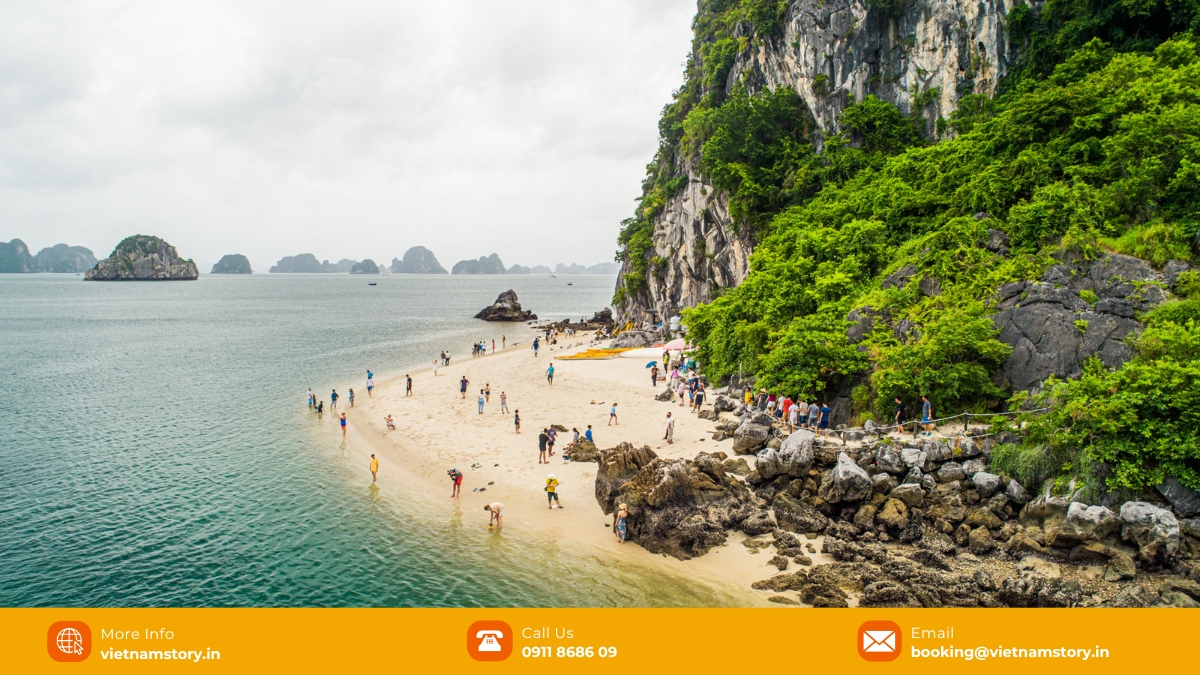
The top locations for swimming in 2026 range from the iconic Titov Island to the newly opened Trinh Nu (Virgin) Beach. Each spot offers a different depth and atmosphere. By using the following comparison, you can decide which stop on your cruise itinerary is best for your swimming style.
To help you plan your beach time, please refer to the following table which highlights the best swimming locations currently available:
| Spot | Vibe | Why go? |
| Titov Island beach | Iconic | Crescent-shaped and supervised; great for families but can be busy. |
| Trinh Nu(Virgin) beach | Serene | New for 2025/26; secluded and accessible only by boat or kayak. |
| Ba Trai Dao(Three Peaches) | Secluded | Crystal clear, shallow water—perfect for kids at low tide. |
| Hang Co(Thien Canh Son) | Hidden gem | Located in Bai Tu Long Bay; pristine sand far from the crowds. |
| Ao Ech(Frog Pond) | Lagoon | A natural enclosure in Lan Ha Bay with virtually zero waves. |
If you are traveling with children, our top recommendation is Ba Trai Dao. At low tide, the water stays waist-deep for a long distance, making it very safe for little ones to splash around. For honeymooners, Trinh Nu Beach offers a romantic, “deserted island” feel that is hard to find elsewhere in the world.
Timing the tide: Seasonal and daily windows
The weather in Northern Vietnam has four distinct seasons, and this affects the water temperature significantly. The “Goldilocks” zone for swimming is between April to June and September to October, when the water is a perfect 25°C – 28°C. For those asking “can you swim in halong bay” during the winter, be prepared for cooler temperatures around 18°C, which may require a heated pool or Jacuzzi on your cruise ship instead. When planning your daily swimming window, keep these 2026 seasonal insights in mind:
- Optimal months (Apr – Jun and Sep – Oct): This is when the water visibility is at its annual peak. The sea is calm, and the temperature is like a mild pool.
- Summer warmth (Jul – Aug): The water can reach a balmy 30°C. It feels like a warm bath! However, you must be alert for the “3:00 PM summer squalls” – brief but intense rain showers that can temporarily halt swimming activities.
- The “6 AM” secret: If your cruise allows it, try to swim between 6:00 AM and 9:00 AM. This is our favorite time. The water is at its clearest because the day-trip boats haven’t arrived yet to stir up the sediment from the seabed.
- Winter strategy: If you visit between December and March, the water drops to 18°C. Most of our Indian guests find this too cold. In this case, Vietnamstory recommends booking a “super-resort” cruise like Grand Pioneers or Ambassador, which features a heated four-season pool or a large Jacuzzi on the deck.
READ MORE: Your Ultimate Guide To Halong Bay Weather
The Vietnamstory checklist: Specialized advice for Indian travelers
Based on five years of feedback from our guests from across India, Vietnamstory.in has developed a specialized checklist. We understand the nuances of the Indian traveler – from skin sensitivity to the importance of safety equipment even for strong swimmers.

To ensure a comfortable experience, travelers must remember that life jackets are legally mandatory for all bay swims, regardless of skill level. Additionally, using reef-safe sunscreen and rinsing in freshwater immediately after your swim are essential steps to protect both your skin and the delicate marine environment. Here is what we always remind our guests to pack and prepare for their swim:
- Life jackets are mandatory: Because the coves are very deep (often 20m+) and the salt content makes you very buoyant, the Management Board requires everyone to wear a life jacket. It’s not just about safety, it’s the law.
- Sun and skin protection: The UV index in the bay is much higher than on the mainland because the water reflects the sun. Please use reef-safe sunscreen. This protects your skin from the intense Vietnamese sun while ensuring the UNESCO-protected coral reefs remain healthy.
- Rinse and hydrate: The salt levels in the Gulf of Tonkin are quite high. We suggest rinsing in the freshwater shower on the boat deck immediately after your swim. This prevents “sea itch” (dry skin irritation) which can be uncomfortable in the humidity.
- Footwear matters: If you are swimming near the limestone karsts, wear water shoes. The rocks are covered in sharp barnacles and sea urchins that can easily cut your feet.
Rare insights: What the competitors miss?
Beyond the basic question of “Can you swim in Halong Bay?,” you should be aware of the “15-Minute Rule” for salt-water dehydration and the specific advantage of Lan Ha Bay for clearer water. Furthermore, don’t rely solely on “nets” for jellyfish protection, a quick visual check from the boat deck is always your best defense.
- The 15-minute rule: Most people don’t realize that swimming in high-salinity water in 80% humidity can lead to “silent” dehydration. Don’t swim for more than 20 minutes at a time. Come back to the boat, drink some water or a fresh coconut, and then go back in. This prevents the sudden fatigue that can ruin your evening dinner.
- The Lan Ha advantage: If swimming is your absolute priority, book a cruise that sails the Lan Ha Bay route. It has 139 tiny beaches compared to only a few in the central Ha Long area. Lower boat density means less fuel runoff and much clearer emerald views.
- The “netted area” fallacy: Some beaches like Ti Tov have nets. Many tourists think these are “shark nets” (we have no dangerous sharks here!) or “jellyfish nets.” In reality, they are mostly to keep boats out and catch floating debris. Small jellyfish can still pass through. Your best protection is always a quick visual check of the water from the sundeck before jumping in.
Conclusion
Swimming in the bay is a spiritual experience. There is something about being surrounded by 500-million-year-old limestone giants while floating in the warm sea that makes all your worries disappear. So, the next time you ask, “Can you swim in Halong Bay?” remember that the answer is a joyous “Yes!” – provided you choose the right spot and the right season.
At Vietnamstory, we are here to make sure your transition from the land to the water is seamless. We will find you the quietest coves, the most comfortable cruises, and the best local tips to ensure your Vietnam holiday is exactly as you imagined it.
Top Halong Bay Tours You’ll Love


Vietnam Highlights 7 Days: From Hanoi to Phu Quoc
Hanoi - Halong bay - Da Nang - Hoi an ancient town - Phu Quoc


8 Days Vietnam Journey: Culture, Heritage & Natural Wonders


Hanoi - Halong - Sung Sot - Titop - Luon Cave - Hanoi


Serenity Grandeur Cat ba cruise
Lan Ha Bay - Cat Ba - Cai Beo Floating Village - Viet Hai Village - Turtle Island - Tai Keo Cave


Hanoi - Lan Ha Bay - Dark And Bright Cave - Hanoi