
Indian travellers in Da Nang have several practical ways to get Vietnamese Dong (VND): exchange foreign cash at the airport or in the city, use a bank, withdraw VND from an ATM, or pay by card where accepted.
If you are carrying Indian Rupees (INR), plan with a little more care. INR is not among the currencies currently listed by Da Nang International Airport, while direct INR-to-VND exchange in the city depends on the individual provider. It is better to confirm availability before travelling to a counter and keep an international card or ATM option as a backup.
The most useful comparison is not simply which counter advertises the highest exchange rate. What matters is how many VND you actually receive after the exchange rate, spread, commission and any other transaction fees.
Best Ways to Get Vietnamese Dong in Da Nang
The right option depends on the currency you carry, how quickly you need VND and the fees attached to each transaction. There is no single method that is automatically best for every traveller.
| Option | Best when | Main advantage | What to check |
|---|---|---|---|
| Airport exchange counter | You need VND soon after landing | Convenient on arrival | Accepted currency, exchange rate, spread and fees |
| Bank | You prefer a formal cash-exchange process | Clear transaction procedure | Branch hours, accepted currency, identification requirements and live rate |
| City money exchange service | You want to exchange cash near your hotel or sightseeing area | More locations to compare | Supported currency, displayed rate, fees and transaction details |
| ATM | You want VND directly from an international card | Quick access to local cash | Card network, ATM fee, issuer fee, withdrawal limit and DCC |
| Card payment | Your hotel, restaurant or shop accepts your card | Less cash to carry | Foreign-transaction fee, card acceptance and DCC |
One simple question makes cash-exchange options easier to compare:
“How many Vietnamese Dong will I receive after all fees?”
The final VND amount is usually more useful than comparing the headline exchange rate alone.
If Da Nang is only one stop in your trip, our Vietnam money guide for Indian travellers explains VND, card payments, ATMs and tipping across the country.
Currency Exchange at Da Nang International Airport
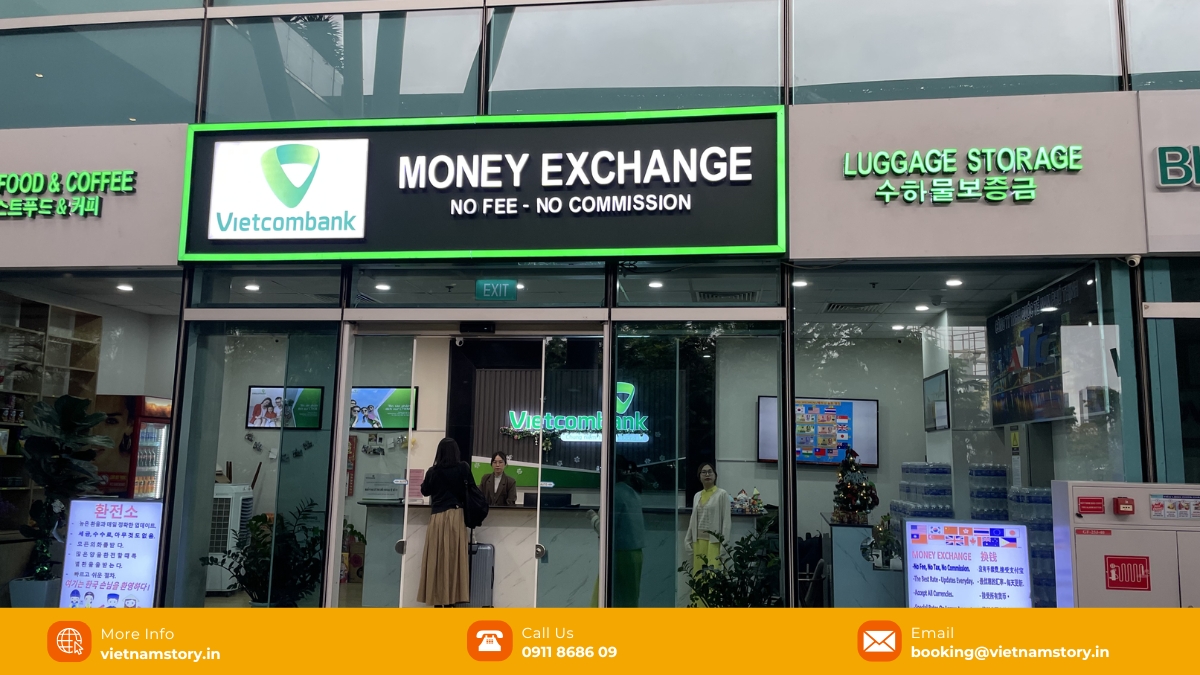
Da Nang International Airport has foreign-currency exchange counters and ATMs, making the airport a practical option if you arrive without VND and need local cash for transport, food or other immediate expenses.
Exchange counters and ATMs are located in different parts of the terminal. According to Da Nang International Airport’s current information, foreign-exchange services are available in the arrival area and other terminal locations.
The airport does not state that every counter offers the same rate or supports exactly the same services, so check the information displayed at the counter before completing a transaction.
Which Currencies Are Listed at Da Nang Airport?
Da Nang International Airport currently lists the following foreign currencies for its exchange services:
- Australian Dollar (AUD)
- Canadian Dollar (CAD)
- Swiss Franc (CHF)
- Euro (EUR)
- British Pound (GBP)
- Hong Kong Dollar (HKD)
- Japanese Yen (JPY)
- South Korean Won (KRW)
- Singapore Dollar (SGD)
- Thai Baht (THB)
- US Dollar (USD)
For the latest airport service information, check the official Da Nang Airport currency-exchange page before travelling.
If you only need VND for your first taxi, meal or other arrival expenses, exchange or withdraw an amount that suits those immediate needs. There is no need to follow a fixed rule such as changing exactly USD 50 or USD 100 at the airport.
Can You Exchange Indian Rupees in Da Nang?
Direct INR-to-VND exchange may be available in Da Nang, but it is provider-specific rather than guaranteed.
INR is not currently included in Da Nang Airport’s published list of currencies. Individual exchange services in the city may handle a wider range of currencies, so confirm before travelling to a particular counter with Indian Rupee cash.
Indian travellers should have at least one alternative way to access money:
- an international debit or credit card enabled for overseas use;
- access to an ATM compatible with the card network;
- a second payment card in case the main card is declined or temporarily blocked;
- another foreign currency only when the intended exchange service has already confirmed that it is accepted.
There is also no universal rule that converting INR into USD first and then exchanging USD into VND will save money. Two currency conversions can create two exchange-rate spreads and may introduce additional fees.
Compare the final amount of VND you will receive rather than focusing only on the intermediate currency.
Vietnam Story local tip: If you are travelling with our team and need practical guidance on nearby banking or ATM options, ask your trip consultant or local support team. For a cash exchange, always check the displayed rate and transaction terms yourself before proceeding.
Where to Exchange Money in Da Nang by Area
You do not necessarily need to cross the city just to get VND. Banks, ATMs and money exchange services are available across Da Nang’s main visitor areas, although the most convenient option depends on where you are staying.
Hai Chau and Da Nang City Centre
Hai Chau covers much of central Da Nang and is one of the most practical areas for finding bank branches and other commercial services. Travellers staying around the city centre may have several options within a relatively small area.
If you are visiting a bank specifically to exchange foreign cash, confirm that the branch handles your currency before travelling there. A branch having an ATM does not automatically mean every foreign currency can be exchanged over the counter.
My Khe, An Thuong and the Beach Area
Travellers staying around My Khe, An Thuong or nearby parts of Son Tra may find ATMs and money exchange services closer than travelling back into Hai Chau.
Hotels, restaurants and larger businesses around the beach area may also accept international cards. Smaller vendors can still prefer cash, so having some VND available remains useful.
If you find a money exchange counter through Maps, your hotel or a local recommendation, confirm that it handles your currency and check the current rate before making a special journey.
Around Han Market
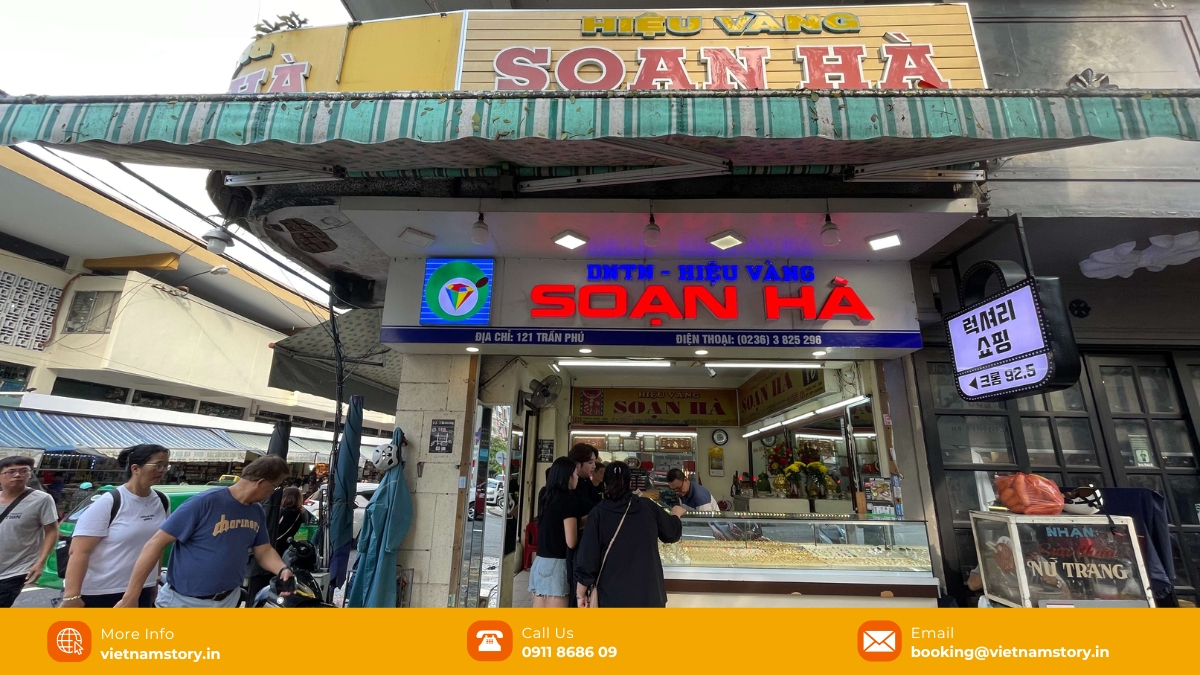
The streets around Han Market are among Da Nang’s busiest commercial areas. Visitors may encounter jewellery businesses and other counters displaying “Money Exchange” or “Đổi Tiền” signs nearby.
A sign can help you find a potential service, but it should not be the only thing you check before handing over foreign cash.
What to Check at a Private Money Exchange Counter
- Look for clear business and exchange-service information.
- Check the exchange rate before starting the transaction.
- Ask about commission or additional fees.
- Ask which bank or credit institution the exchange service works with if that relationship is not clear.
- Confirm the final amount of VND you will receive.
- Request and retain a receipt or transaction record.
- Avoid informal person-to-person or street exchanges.
If the service or transaction terms are unclear, using a bank or official airport counter is a simpler alternative.
Banks vs Money Exchange Services in Da Nang
Banks and city money exchange services can both be practical. Instead of assuming one category always provides a better rate, compare the option that supports your currency and transaction requirements on the day.
| What to compare | Bank | City money exchange service |
|---|---|---|
| Process | Generally formal | Depends on the provider |
| Identification | May be required | Requirements vary |
| Opening hours | Branch-specific | Provider-specific |
| Supported currencies | Confirm with the branch | Confirm with the exchange service |
| Exchange rate | Check the live cash rate | Check the live cash rate |
| Fees | Ask before exchanging | Ask before exchanging |
| Transaction record | Keep your documentation | Request and retain your documentation |
A passport or another form of identification may be requested for some cash-exchange transactions. Requirements vary, so check with the specific bank or exchange service rather than assuming every counter follows the same procedure.
Does the Condition of Foreign Banknotes Matter?
It can. Cash-exchange policies may vary according to the currency, denomination and physical condition of the notes presented.
If you plan to carry foreign cash into Vietnam:
- keep banknotes clean and in good condition;
- avoid relying on badly torn or heavily damaged notes;
- ask whether different denominations receive the same quoted rate;
- confirm the terms before exchanging a large amount of cash.
Do not assume that a larger denomination automatically receives a better exchange rate. Policies can differ between currencies and exchange services.
Using ATMs in Da Nang with an Indian Card
For many Indian travellers, an ATM is one of the simplest ways to obtain VND without carrying a large amount of foreign cash. The total cost can include charges from both the Vietnamese ATM operator and your Indian bank or card issuer.
Before confirming a withdrawal:
- look for an ATM displaying a network supported by your card;
- make sure international transactions are enabled on the card;
- check the withdrawal amount offered by the machine;
- look for any ATM fee displayed before confirmation;
- check your Indian bank’s overseas cash-withdrawal and forex charges;
- read any currency-conversion screen carefully;
- keep the receipt if you may need to reconcile the transaction later.
ATM withdrawal limits and fees can differ by bank, machine and card. Check the information shown during the actual transaction instead of planning around a fixed limit or fee quoted online.
Paying by Card in Da Nang
International credit and debit cards are accepted at many hotels, shopping centres, larger restaurants and other participating businesses in Da Nang. Smaller restaurants, local markets and independent vendors may still prefer or require VND cash.
For an Indian card, the final cost can depend on:
- the card network;
- merchant acceptance;
- the Indian bank’s foreign-transaction fee;
- the exchange rate applied to the transaction;
- Dynamic Currency Conversion, if offered.
What Is Dynamic Currency Conversion?
Dynamic Currency Conversion, or DCC, is an option that may appear when an ATM or card terminal offers to convert a VND transaction into your home currency, such as INR, before you approve it.
According to Visa’s guidance on Dynamic Currency Conversion, a DCC offer may display both the local-currency and cardholder-currency amounts, together with the conversion rate and any additional fee or markup.
If you decline the INR conversion and continue the transaction in VND, you decline the ATM operator or merchant’s DCC conversion. Your Indian card issuer may still apply its own exchange rate and overseas transaction fees.
The practical approach is to read the conversion rate and markup shown before confirming instead of assuming one option will always be cheaper.
How to Compare Currency Exchange Rates in Da Nang
The INR/VND, USD/VND or other rate shown on Google or a currency app can be useful as a reference, but it is not necessarily the rate a cash counter, ATM or card transaction will give you.
There are several different layers:
- Reference or mid-market rate: useful as a benchmark.
- Cash exchange rate: the rate offered by a bank or money exchange service, including its spread.
- ATM effective rate: the conversion rate combined with any ATM and issuer charges.
- Card effective rate: the conversion rate combined with foreign-transaction fees and, where applicable, DCC.
When comparing two cash exchange options, look at:
- the rate being offered;
- whether it is the correct buy or sell rate for the transaction;
- any commission;
- any fixed transaction fee;
- banknote condition or denomination requirements;
- the final amount of VND you will receive.
The final VND amount is often the clearest comparison.
For example: one counter may advertise an attractive exchange rate but add a separate commission, while another may quote a slightly different rate without that fee. Compare the final VND amount rather than the headline rate alone.
Da Nang Currency Exchange Safety Checklist
- Use a bank, official airport counter or money exchange service with clear business information.
- Check the exchange rate before handing over cash.
- Ask about commission and additional fees.
- Confirm the final VND amount you will receive.
- Count the notes before leaving the counter.
- Keep the receipt or transaction record.
- Avoid street and person-to-person exchanges.
- Keep foreign banknotes in good physical condition.
- Read ATM and card conversion screens before confirming.
- Do not assume INR is accepted at every exchange counter.
- Keep a backup card or another payment method.
These steps can reduce avoidable problems, although no exchange or payment method removes every possible transaction risk.
Frequently Asked Questions About Currency Exchange in Da Nang
Where can I exchange money at Da Nang Airport?
Da Nang International Airport has foreign-currency exchange counters as well as ATMs. Check the official airport information and the rate displayed by the individual counter when you arrive.
Can I exchange INR directly in Da Nang?
It may be possible at some city exchange services, but INR-to-VND exchange is provider-specific. INR is not currently included in Da Nang Airport’s published currency list, so confirm before travelling to a particular counter and keep a card or ATM option as backup.
Is it better to exchange money at Da Nang Airport or in the city?
The airport is convenient when you need VND immediately after arrival. Banks and city exchange services give you additional options to compare. The better choice depends on currency acceptance, the live exchange rate, fees and convenience rather than a universal rule that one location always offers the best rate.
Can I exchange money around Han Market?
Money exchange services can be found around some of Da Nang’s busy commercial areas. If Han Market is already part of your sightseeing or shopping plan, our Han Market guide covers the market itself, what to buy and practical tips for visiting. Check any exchange counter separately for supported currency, rate and fees.
Can I use an Indian debit or credit card in Da Nang?
Yes, where the merchant or ATM supports the card network and the card is enabled for international use. Foreign-transaction fees, overseas withdrawal charges and currency-conversion costs may apply.
Do ATMs in Da Nang charge fees?
They may. The Vietnamese ATM operator can charge a local transaction fee, while your Indian bank may separately charge for an overseas withdrawal or foreign-currency transaction. Check the ATM screen and your card’s fee schedule before confirming.
Should I choose INR or VND at an ATM or card terminal?
If the terminal offers to charge you in INR, it is offering Dynamic Currency Conversion. Review the displayed rate and markup before deciding. Continuing in VND declines that DCC conversion, although your own card issuer may still apply its exchange rate and international transaction fees.
How much cash should I carry in Da Nang?
There is no fixed amount suitable for every traveller. Base it on your itinerary, meals, shopping, transport, card acceptance and access to ATMs. Carry enough VND for situations where cards may not be practical without keeping more cash on you than you are comfortable carrying.
More Practical Planning for Your Stay in Da Nang
Your neighbourhood can also affect how often you need cash. Travellers staying around the beach may spend differently from those based in the city centre or visiting traditional markets.
If you are staying by the coast, our My Khe Beach guide for Indian travellers covers the beach area, nearby attractions and practical planning for your stay.
Planning Your Da Nang and Vietnam Route
Once your VND and payment plan is sorted, the bigger travel decision is how Da Nang fits into the rest of your Vietnam itinerary. You can keep the trip focused on Central Vietnam with Da Nang and Hoi An, combine it with Hanoi in the north, or continue south to Ho Chi Minh City.
If you are deciding what deserves the budget once cash and card access are sorted, use our things to do in Da Nang guide to compare city sights, half-day outings and full-day trips before adding more paid activities.
If you want to see how accommodation, meals, transport and paid sightseeing fit together, continue to the Da Nang travel cost guide. That is the better place to turn payment planning into a realistic trip budget.
Once you know the number of days and the Central Vietnam stops you want, compare the Da Nang tour options for Indian travellers. Keep this page focused on money access; use the tour page only when you are ready to compare route structure and inclusions.