
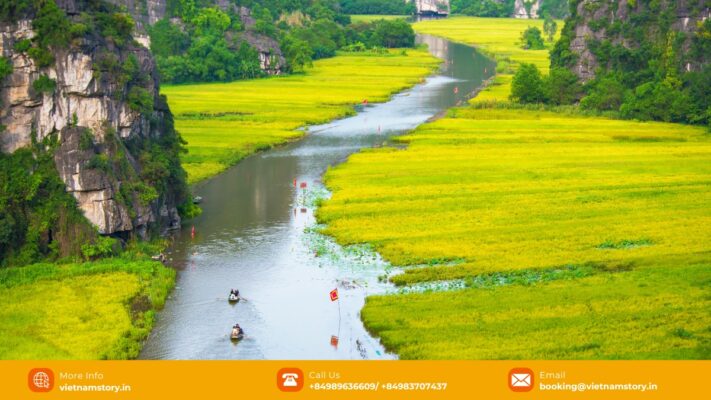
The best-known golden rice season at Tam Coc is usually late May to early June—not September or October. For Indian travellers visiting Ninh Binh, the first decision is whether you want a boat-level view of rice along the Ngo Dong River, the panorama from Hang Mua or a wider heritage excursion in Trang An. At Vietnam Story, we would choose the experience first, check the actual crop stage closer to your date and then fit it into a Hanoi-based or overnight Northern Vietnam route. No one can promise golden fields from a calendar alone.
What makes the Ninh Binh rice-field landscape different?
Around Tam Coc, the river passes flat rice paddies framed by limestone cliffs. This is different from terraced mountain fields in Sapa or the landscapes around Pu Luong. If your priority is hills, village walking and mountain terraces rather than a boat ride, compare our Mai Chau vs Pu Luong guide. Ninh Binh is strongest when the river, karsts and cultural sites are part of the appeal, even outside the rice harvest.
The fields are also a working agricultural landscape, not a permanent photo installation. Water level, planting, crop colour and harvest all change what you see. That is why we would choose the viewpoint and then check the current field stage rather than expect one fixed look from a calendar month.
The wider landscape forms part of the Trang An Landscape Complex; if the UNESCO relationship is the main question, use our Ninh Binh UNESCO guide rather than turning this crop-planning page into a heritage overview.
When to see golden rice around Tam Coc
For golden paddies along the Tam Coc–Ngo Dong River, plan around late May to early June. The Ninh Binh Tourism Department’s May 2026 update describes this local harvest window, while its rice-crop explanation notes one crop along the famous Tam Coc boat route. Do not confuse that specific landscape with separate farming calendars elsewhere in the province. Harvest timing and the exact colour vary with agricultural conditions.
If seeing ripe rice is the reason for your trip, ask your local accommodation or guide for recent photographs and the current harvest stage closer to departure. During an earlier or later month, the fields may be young, green, flooded, harvested or resting. For a photography-led Vietnam holiday, our photography itinerary from India helps balance Ninh Binh with Hanoi, Ha Long Bay and Hoi An without scheduling the entire trip around one uncertain scene.
If rice is only one factor in choosing the travel window, use our Best Time to Visit Ninh Binh guide. If your month is already fixed, use the weather-by-month guide for heat and rain, then verify the crop stage separately.
Where to see the rice fields in Ninh Binh
Rice fields appear across Ninh Binh, but the most useful perspectives for visitors are Tam Coc, Hang Mua and the village roads nearby. Choose based on whether you want a boat ride, a steep viewpoint climb or ground-level exploration. A single well-timed stop is usually better than trying to collect every viewpoint before returning to Hanoi.
Tam Coc (Ngo Dong River Boat Trip)
Tam Coc is the clearest choice for rice viewed from the river: boats pass paddies, cliffs and low cave entrances along the Ngo Dong. The outing takes meaningful time and depends on water, weather and operation at the boat dock. Use our Tam Coc boat-trip guide to check the actual route, ticket rules and operating conditions. Do not assume every short Hanoi excursion can comfortably include both Tam Coc and Trang An.
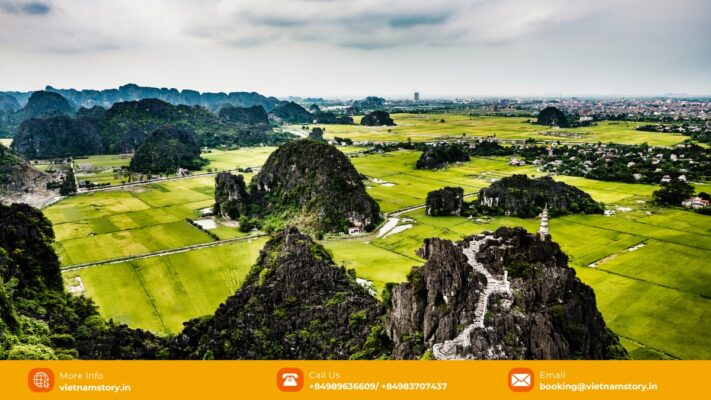
Mua Cave (Hang Mua Viewpoint)
Hang Mua gives the elevated perspective over the Ngo Dong landscape, but reaching it means climbing many steep, sometimes uneven steps. In the late-May harvest period, heat and humidity are important considerations for families and older travellers. Use our Hang Mua viewpoint guide for access and climb details. A photography-friendly route should not require everyone in the group to complete that climb.
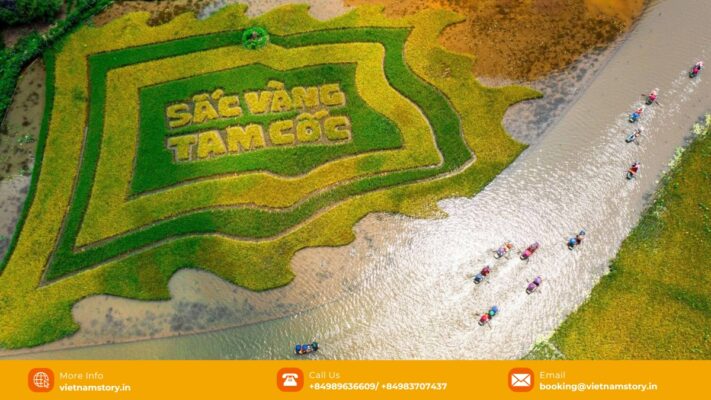
Trang An vs. Tam Coc for Rice Fields: Which is Better?
Choose Tam Coc when the rice along the river is your priority, especially near the documented harvest window. Choose Trang An if the wider caves, temples and heritage scenery matter more, whatever the crop stage. These are different boat experiences and need not both be booked on a one-day trip from Hanoi. Our Trang An vs Tam Coc vs Van Long comparison explains the trade-off.
Bich Dong Pagoda & Thai Vi Temple
The area around Bich Dong Pagoda and Thai Vi Temple allows slower exploration of the village landscape. Cycling or a short countryside drive can add context beyond the boat ride, but confirm road conditions, equipment and the group’s abilities first. These are lived-in villages and working agricultural roads, not managed photo sets.
Van Long: choose it for the wetland, not as a rice-field substitute
Van Long can include countryside and rice-field views around the reserve, but that is not its main role. Choose Van Long for the quieter wetland, limestone setting and wildlife context; treat any attractive rice-field sections as part of the wider landscape rather than a reason to replace Tam Coc when paddies are your main visual priority.
Hoa Lu Ancient Capital & Thung Nham Bird Park
Hoa Lu Ancient Capital and Thung Nham Bird Park add history or wildlife context to a longer stay. They are not substitutes for the Tam Coc river landscape and should be chosen for their own experience, not to inflate the list of rice viewpoints.
Remember that these are working rice fields
The fields change because farmers are planting, maintaining and harvesting a real crop. Water levels, access paths and the colour of individual plots can differ even within the same area, so a photo from last week—or from the same month last year—does not guarantee the exact scene you will find.
Use established roads, paths and boat routes, keep out of planted fields and avoid asking people to interrupt farm work for a photo. The landscape is more useful to understand as part of everyday Ninh Binh than as a staged attraction.
Practical planning for the Ninh Binh rice fields
- Check the crop, not only the calendar: field colour and harvest timing shift each year. If golden rice is the reason for travelling, verify recent local conditions close to departure.
- Choose the viewpoint deliberately: Tam Coc gives the water-level view; Hang Mua gives the elevated panorama; cycling or village roads give a slower ground-level perspective.
- Plan around heat and rain: exposed climbs and cycling become much harder in hot or wet conditions. Use the current forecast to order the day.
- Keep the route compact: Tam Coc, Hang Mua and nearby village sites can fit a focused day. Avoid adding another boat route just for an extra photo.
- Choose one day or an overnight: A day trip from Hanoi can cover a selected boat ride and a contrasting stop; an overnight near Tam Coc gives more flexibility with early light, rest and weather.
- Check meals and accessibility: If travelling with children or seniors, ask about boat boarding and the Hang Mua stairs. Vegetarian or Jain needs should be confirmed with the actual restaurant, not assumed from a generic tour label.
- Use the specialist pages for live prices: ticket and operating details belong on the Tam Coc, Hang Mua and attraction guides, where they can be refreshed without leaving stale copies across the cluster.
Frequently asked questions about Ninh Binh rice fields
- Are the best-known Ninh Binh rice fields inside the Trang An World Heritage landscape?
- The Tam Coc–Ngo Dong River rice landscape sits within the wider Trang An Landscape Complex. If heritage status is the main question, use our dedicated Trang An UNESCO guide rather than treating every rice field in the province as the same site.
- Which is better for rice-field views: Tam Coc or Trang An?
- Tam Coc usually gives the more direct river-and-paddy perspective. Choose Trang An when caves, temples and the wider heritage landscape matter more than seeing rice fields beside the boat route.
- Can you visit outside the golden-rice window?
- Yes. The river, karsts and caves are still worth visiting, although the field colour and crop stage change. If photography is the main goal, check local field conditions close to departure.
- Is Tam Coc golden in September or October?
- Do not rely on a second golden-rice season for the well-known Ngo Dong River boat route. Local Ninh Binh tourism sources describe its main rice harvest in late May and early June. Other paddies in the province follow different cycles, so verify the exact area before planning a trip around its crop colour.
- Should you visit Ninh Binh from Hanoi or stay overnight?
- For a first trip with limited nights, a day trip is usually enough for one boat experience and another nearby stop. Staying overnight suits travellers who value photography, flexible timing and an unhurried countryside evening.
What should you combine with a rice-field stop?
Keep the combination local to the viewpoint you chose. Tam Coc pairs naturally with Bich Dong and nearby cycling; Hang Mua works when the climb gives you the elevated view you want; Trang An should replace rather than duplicate another major boat route when time is short. If you are still choosing the wider attraction mix, use our things to do in Ninh Binh guide instead of adding sites simply because they are nearby on a map.
Choose the rice-field view that matches the trip
Use Tam Coc when you want the rice fields at river level, Hang Mua when the elevated landscape view matters, and nearby countryside roads when you want a slower ground-level perspective. If golden rice is the goal, watch the late-May to early-June crop window but verify the actual field stage for your year.
Do not build the whole Ninh Binh itinerary around a fixed harvest date. Let the crop stage, weather and the rest of the route decide how much time the fields deserve.
If rice-field photography is only one part of your Vietnam route, start with our Ninh Binh destination guide to decide how many nights it deserves. The Hanoi to Ninh Binh day-trip guide helps choose a realistic pickup, boat route and return time instead of adding too many attractions.
Planning Ninh Binh as part of a Vietnam trip from India?
Explore Vietnam tour packages from India and our North Vietnam itinerary guide, then tell Vietnam Story your departure city in India, travel dates, available nights, group size, preferred pace and any vegetarian or Jain meal requirements. We can help compare a Hanoi-based Ninh Binh excursion with an overnight countryside stay and clarify the actual boat route, tickets, transport, hotels, meals and exclusions in a written proposal. Golden rice, private transfers, special meals and every suggested activity should not be assumed guaranteed or included unless explicitly confirmed.